
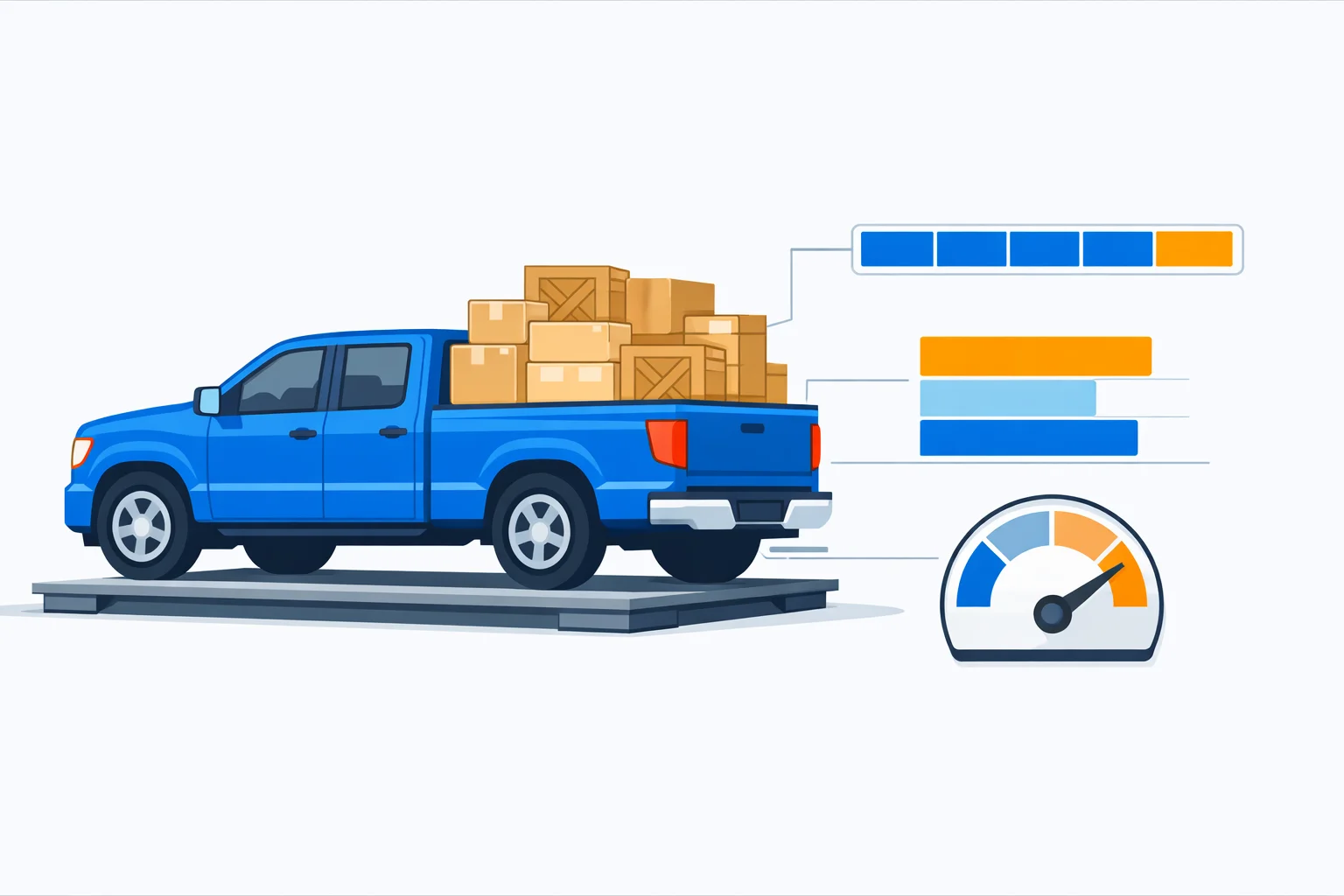
Why would anyone need a truck payload calculator for a pickup the brochure says tows 11,000 pounds? Because payload is the rating that runs out first, and it runs out embarrassingly early. Put four adults in a half-ton crew cab and the biggest trailer you can legally hook up is roughly 4,400 lb — not 11,000. The other 6,600 pounds of advertised towing exists only for a driver travelling alone with an empty bed.
1,500 Pounds Sounds Generous Until Four Adults Get In
Start with the arithmetic, because it's the only easy part: payload = GVWR − curb weight. A typical half-ton crew cab 4WD carries a 7,100 lb GVWR and weighs 5,600 lb empty, so the payload rating is 1,500 lb.
Here's the myth that number invites. Owners read "1,500 lb payload" as "1,500 lb of cargo in the bed," and it isn't. Payload is everything the truck carries that wasn't bolted to it at the factory — and the federal placard says so in plain English: the combined weight of occupants and cargo. People are payload. Watch what happens to that 1,500 lb on an ordinary weekend:
| What's aboard | Weight | Payload left |
|---|---|---|
| Payload rating (7,100 − 5,600) | — | 1,500 lb |
| Four adults at 175 lb | 700 lb | 800 lb |
| Tonneau, bed liner, toolbox, camp gear | 150 lb | 650 lb |
| Weight-distribution head and bars | 80 lb | 570 lb |
| Tongue weight, 6,000 lb trailer at 13% | 780 lb | −210 lb |
Over GVWR by 210 pounds, with a 6,000 lb trailer on a truck advertised at 11,000. Nobody did anything reckless here — that's a family, a cooler, and a mid-size travel trailer. Notice the ranking, too: the four passengers spent 47% of the payload rating before a single item went in the bed, and the tongue spent more than half of what was left.
The Brochure Says 2,400. Your Door Jamb Says 1,480.
There are two payload numbers for every pickup and they are not close. The one in the advertisement belongs to the lightest truck the manufacturer will sell you: regular cab, rear drive, longest bed, base trim, no options. The one that governs your truck is printed on a sticker inside the driver's door jamb, and it was calculated for the exact vehicle that rolled off the line with your VIN.
That sticker is a federal document. Under FMVSS No. 110, every passenger vehicle sold in the US must carry a placard reading "The combined weight of occupants and cargo should never exceed XXX kg or XXX lbs." It is normally white or yellow, it sits alongside the tire and rim data, and it beats every brochure, forum post and dealer listing you will ever read.
One detail worth banking, because it stops a common double-count: curb weight is defined with a full tank of fuel and all fluids topped off. A 36-gallon tank of gasoline is about 216 lb, and it's already inside the curb figure. You don't subtract fuel again. What you do subtract is every option and accessory, and this is where the payload lottery gets decided:
| Option or accessory | Weight it adds | Counted in curb weight? |
|---|---|---|
| Crew cab instead of regular cab | ~350 lb | Yes — already off your placard |
| 4WD instead of 2WD | ~220 lb | Yes |
| Diesel V8 instead of gas V8 (three-quarter ton) | ~750 lb | Yes — the single biggest payload tax |
| Top trim vs base: leather, power everything, 20s | ~250 lb | Yes |
| Panoramic sunroof | ~90 lb | Yes |
| Hard folding tonneau cover | 60–80 lb | No — fitted after the placard was printed |
| Steel front bumper plus winch | 250–350 lb | No |
| Aluminium crossover toolbox | 60–90 lb | No |
| Spray-in bed liner | ~25 lb | No |
Add the first five rows together and you get roughly 1,660 lb of factory options separating an advertised work truck from a loaded crew cab. That is the entire gap between a 2,400 lb payload figure and a 1,480 lb sticker — no mystery, just a different truck. The bottom four rows are the ones that quietly hurt, because they land on your truck after the sticker is printed and nothing re-prints it. A tonneau, a toolbox and a steel bumper is 400 lb of payload gone, and the door jamb will keep insisting you have all of it.
6,615 Pounds of Tow Rating You Can't Legally Use
Now the myth this whole page exists to kill. Tow ratings and payload ratings are usually printed side by side, which invites the assumption that they're independent limits. They aren't. A conventional bumper-pull trailer rests 10–15% of its loaded weight on the ball, travel trailers frequently measure 13–15%, and every pound of that is cargo the truck is carrying. It comes straight off the same placard as your passengers.
So invert the calculation. Instead of asking what the trailer weighs, ask what your leftover payload permits:
max trailer = (payload − occupants − gear − hitch hardware) ÷ tongue %
Our half-ton has 570 lb left after the family, the gear and the bars. At 13% that's 570 ÷ 0.13 = 4,385 lb of trailer. Against an 11,000 lb advertised rating, payload puts 6,615 lb of it permanently out of reach. Here's the same sum across trailer sizes, assuming four adults, 150 lb of gear and 80 lb of hitch hardware — 930 lb committed before the coupler drops:
| Loaded trailer | Tongue at 13% | Payload needed | Half-ton crew (1,500 lb) | 3/4-ton diesel (2,200 lb) |
|---|---|---|---|---|
| 3,000 lb | 390 lb | 1,320 lb | 180 lb spare | 880 lb spare |
| 4,000 lb | 520 lb | 1,450 lb | 50 lb spare | 750 lb spare |
| 5,000 lb | 650 lb | 1,580 lb | over by 80 lb | 620 lb spare |
| 6,000 lb | 780 lb | 1,710 lb | over by 210 lb | 490 lb spare |
| 8,000 lb | 1,040 lb | 1,970 lb | over by 470 lb | 230 lb spare |
| 10,000 lb | 1,300 lb | 2,230 lb | over by 730 lb | over by 30 lb |
Read the half-ton column and the pattern is brutal: it clears 4,000 lb with 50 lb to spare and fails everything above it. That is a truck legally rated to pull 11,000 lb. And the table is generous, because fifth wheels and goosenecks load 15–25% on the pin rather than 13% — a 14,000 lb fifth wheel puts 2,800–3,500 lb into the bed, which is more payload than most three-quarter tons possess.
One correction worth making loudly, because it's sold as a fix: a weight-distributing hitch does not create payload. It uses spring bars to lever load back onto the truck's front axle and the trailer's axles, which restores steering and braking balance. Total weight on the truck doesn't change, and the hardware itself adds 60–100 lb. It is essential equipment and it is not a capacity upgrade.
This page works the truck's side of the equation. The other three sides have their own math: our towing capacity calculator starts from GCWR to find the biggest trailer the powertrain and brakes are rated for, the tongue weight calculator turns cargo position into an actual tongue percentage instead of the 13% assumed here, and the trailer payload calculator checks what the trailer itself is allowed to carry once its axles and tires get a vote.
How Much Payload Do You Actually Need?
Work backwards from the heaviest thing you tow or haul, not from the badge on the tailgate. These thresholds assume a real family aboard rather than a lone driver:
- Under 1,200 lb — mid-size crew cab 4WD territory. Fine for two dirt bikes, a yard of mulch, or a 2,500 lb utility trailer with two people. Not fine for four adults plus any camper.
- 1,400–1,700 lb — the half-ton crew cab 4WD band. You get either a full cab of adults or a 5,000 lb trailer with a light load. Trying to have both is exactly the 210 lb overage in the worked example above.
- 2,000–2,400 lb — a regular cab 2WD half-ton, or a three-quarter-ton diesel. Enough for a 7,000–8,000 lb travel trailer with the family in the back seat.
- 3,000 lb and up — three-quarter-ton gas crew cab. Handles a 10,000 lb bumper pull, or a modest fifth wheel where pin weight alone runs 1,800–2,200 lb.
- 4,500 lb and up — one-ton dually. The only sane answer for fifth wheels past 14,000 lb, because 20% of that is 2,800 lb landing in the bed before you pack a thing.
Which produces the most counter-intuitive result in the whole segment: for pure payload, the gas three-quarter ton beats the diesel. Both carry a 10,000 lb GVWR, but the diesel arrives about 900 lb heavier once the engine, the extra cooling and the stiffer front springs are counted — so it has roughly 2,200 lb of payload against the gas truck's 3,100 lb. Diesel buys you grade-pulling torque, engine braking and towing range. It costs you almost 800 lb of the thing most buyers actually run out of first.
Where GVWR Stops Being Your Only Ceiling
Clearing GVWR isn't the same as being legal, and the reason is leverage. Tongue weight doesn't land on the rear axle — it lands roughly four feet behind it, on the end of a lever whose fulcrum is the rear axle. So it adds more than its own weight back there while simultaneously lifting the front.
The moment arithmetic on a 145 in wheelbase with the ball 48 in aft of the rear axle: a 780 lb tongue adds 780 × (145 + 48) ÷ 145 = 1,038 lb to the rear axle, and removes 780 × 48 ÷ 145 = 258 lb from the front. The two still sum to 780, so GVWR sees nothing unusual — but the rear GAWR just absorbed 33% more than the tongue actually weighs. This is precisely why a truck can pass a payload check and still bust its rear axle rating, and precisely what a weight-distributing hitch is engineered to claw back. Run your own numbers through the axle weight distribution calculator — it splits every load by its distance behind the front axle and checks both GAWRs separately, which is the check payload arithmetic can't perform.
Two more ceilings live on that same door-jamb label. Each axle carries its own GAWR, and the tires carry a stamped load limit that only applies at the stamped cold pressure — NHTSA's tire guidance is blunt that an under-inflated tire cannot carry its rated load, so check yours against the tire pressure calculator before a heavy trip. The hitch receiver has a third rating stamped on it, usually 500–800 lb of tongue weight without spring bars. Any one of the four can bind first.
What Ignoring the Placard Costs
Fuel, immediately and measurably. The DOE's fuel economy guidance puts every extra 100 lb at roughly 1% of your MPG. The 1,710 lb in our worked example is about a 17% penalty — on a truck returning 18 mpg unloaded, that's 15 mpg before the trailer's aerodynamic drag is even considered. Over 12,000 miles that's 133 extra gallons, about $450 a year at $3.40 a gallon, which our gas mileage calculator will price for your actual numbers. Rental box trucks are the extreme version of the same physics — a 26-footer carries close to its own empty weight again and gives up a full quarter of its rated MPG for it, which our moving truck fuel cost calculator works out by load level.
Rear-end components, eventually and expensively. Overloading concentrates on the parts sized for the rating you exceeded: rear brakes, leaf springs, wheel bearings and the rear differential. A rear wheel bearing and hub job runs $400–$900 per side on a half-ton; a differential rebuild after sustained overload starts around $1,500 and climbs past $3,000 on a loaded 4WD. Springs sag permanently long before they break, which is why a truck that's lived over its placard sits nose-high forever.
The insurance conversation nobody plans for. GVWR is not a manufacturer suggestion — it's a certified rating on a federally mandated label, which makes it documentary evidence of what you were told. Insurers routinely contest claims where a vehicle was loaded past it, and overweight citations are written against the placard figure with fines assessed on the overage (the schedule varies by state, and commercial-plated pickups face roadside enforcement on top). If you tow for money, price the whole trip properly with the towing cost estimator rather than absorbing the risk to save a load.
The fix costs $15 and an afternoon: drive to a public CAT scale loaded exactly as you travel, with the family aboard and the trailer hooked up. Weigh the truck alone, then the truck and trailer together, and write both figures inside the glovebox lid. Every payload calculation after that starts from a measured number instead of a brochure's idea of your truck.