
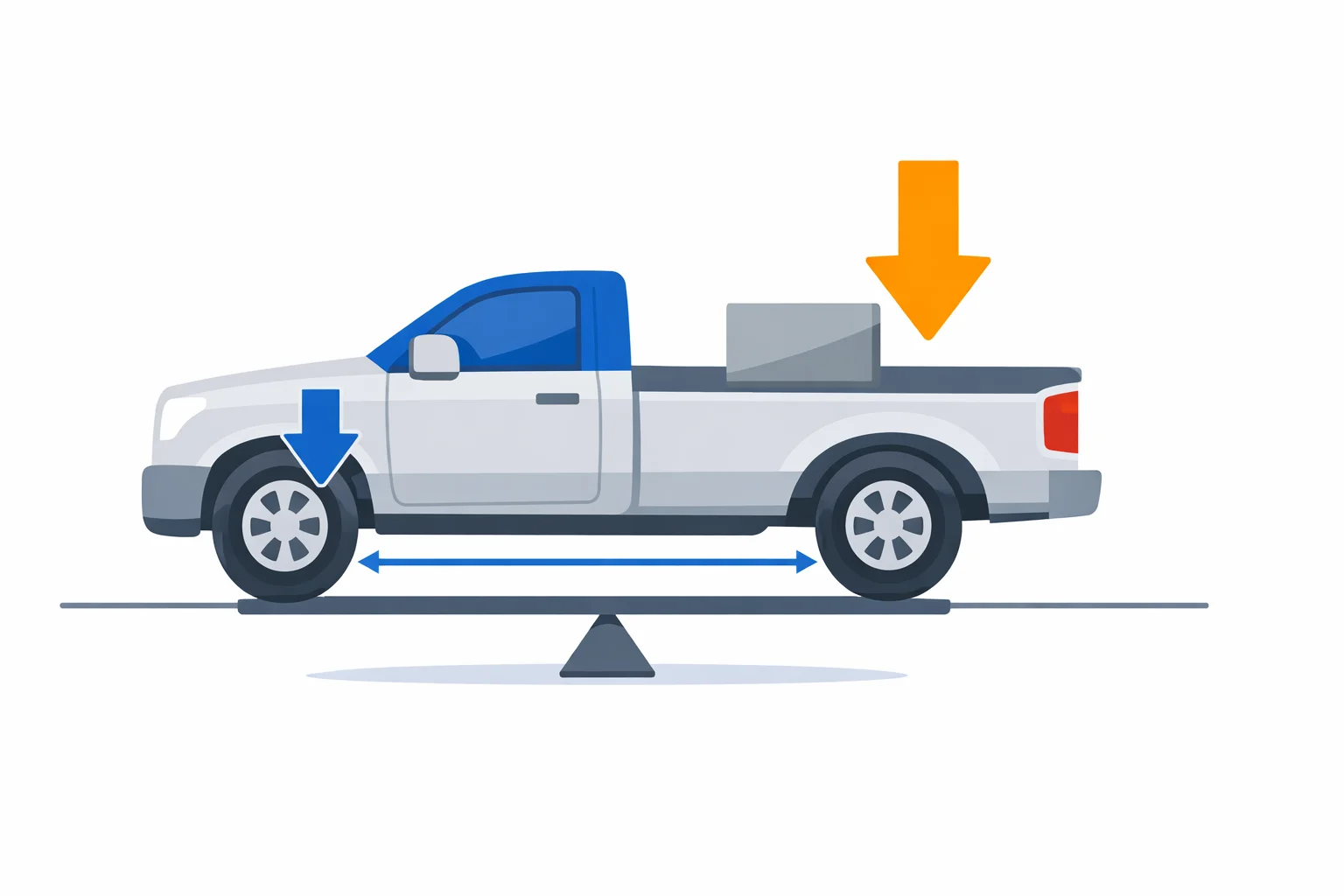
An axle weight distribution calculator answers a question your payload sticker can't: slide 1,600 lb of gravel from the front of a pickup bed back to the open tailgate — about four and a half feet — and 607 lb walks off the front axle onto the rear, while the scale total never changes by an ounce. Same truck, same cargo, same 6,800 lb on the platform. One arrangement is legal and one is 294 lb over the rear axle rating. Below is the whole comparison, the one ratio that produces it, and the point where a truck that passes on gross weight fails on an axle.
1,600 Pounds, Five Places to Put It, Five Different Answers
Here is the verdict first, because it's the entire argument. The vehicle is a half-ton crew cab: 145 in wheelbase, 5,200 lb curb weight sitting 2,964 lb front and 2,236 lb rear, a 7,000 lb GVWR, a 3,750 lb front GAWR and a 4,050 lb rear GAWR. One load of 1,600 lb goes in the bed. Nothing else changes between rows — only the distance from the front axle to the middle of the pile.
| Where the 1,600 lb sits | Behind front axle | Lever | Front axle | Rear axle | Against 4,050 lb rear GAWR |
|---|---|---|---|---|---|
| Hard against the bed bulkhead | 136 in | 0.94× | 3,063 lb | 3,737 lb | 313 lb to spare |
| Centred over the rear axle | 145 in | 1.00× | 2,964 lb | 3,836 lb | 214 lb to spare |
| Middle of a 5.5 ft bed | 158 in | 1.09× | 2,821 lb | 3,979 lb | 71 lb to spare |
| Pushed against the tailgate | 179 in | 1.23× | 2,589 lb | 4,211 lb | 161 lb OVER |
| Tailgate down, half the load hanging out | 191 in | 1.32× | 2,456 lb | 4,344 lb | 294 lb OVER |
Every row weighs 6,800 lb gross. Every row is 200 lb under GVWR. A truck payload capacity calculator would clear all five identically, because subtracting curb weight from GVWR has no way to know where anything is sitting. The axles know. Between the first row and the last, the steer axle drops from 45% of the vehicle's weight to 36% — on a truck that carries 57% up front when it's empty.
One Ratio Produces That Entire Table
Treat the vehicle as what it structurally is: a beam resting on two supports, separated by the wheelbase. Take moments about the front axle and the split falls out in one line. Distance is measured from the front wheel centre back to the centre of gravity of the load.
Rear axle share = W × d ÷ L
Front axle share = W − rear share = W × (L − d) ÷ L
W is the load in pounds, d is inches behind the front axle, L is the wheelbase in inches. The ratio d ÷ L is the lever, and it's the only thing the geometry contributes. Substituting row four — 1,600 lb against the tailgate at 179 in on a 145 in wheelbase:
Rear share = (1,600 × 179) ÷ 145 = 286,400 ÷ 145 = 1,975 lb.
Front share = 1,600 − 1,975 = −375 lb.
Rear total = 2,236 + 1,975 = 4,211 lb against a 4,050 lb rating.
Front total = 2,964 − 375 = 2,589 lb. Gross = 6,800 lb.
The gross figure says you have 200 lb of payload left. The rear axle says you're 161 lb over. Both statements describe the same truck on the same day, and the second one is the one an inspector writes down. The fix is arithmetic too: shifting a load forward reduces the rear axle by W × Δ ÷ L, so on this truck every inch that 1,600 lb pile moves toward the cab is worth 11.0 lb off the rear axle. Fifteen inches clears the violation without removing a single pound.
Past the Rear Axle, a Pound Weighs More Than a Pound
Look at the lever column again. Once d exceeds L, the ratio passes 1.00 and the arithmetic turns strange in a way almost no calculator online models. A 100 lb box placed 179 in back on a 145 in wheelbase adds 123 lb to the rear axle and removes 23 lb from the front. The rear axle gains more than the box weighs, because the front axle is being levered upward and that missing weight has to land somewhere.
This is why hitch weight is so much more expensive than it looks. On the same truck, the ball sits roughly 203 in behind the front axle — a 1.40 lever. A 700 lb tongue weight, which is a perfectly conventional 10% of a 7,000 lb travel trailer, doesn't add 700 lb to the rear axle. It adds 980 lb to the rear and takes 280 lb off the front. Work out your own figure with the tongue weight calculator and then run it through the tool above at the ball's distance, not the axle's.
The same equation explains why gooseneck and fifth-wheel ratings dwarf bumper-pull ratings on the same chassis. On a 160 in wheelbase three-quarter-ton, a gooseneck ball sits about 152 in back — a 0.95 lever, ahead of the axle. A 2,000 lb pin weight there puts 1,900 lb on the rear axle and actually adds 100 lb to the front. Hang the same 2,000 lb off a bumper ball at 232 in and the 1.45 lever puts 2,900 lb on the rear axle while stripping 900 lb off the front. Same truck, same trailer weight, a 1,000 lb difference on the drive axle decided by nothing but where the ball is bolted.
A weight-distributing hitch is the counter-move, and it isn't magic: the spring bars apply a reverse moment through the receiver that pushes load back onto the steer axle. Manufacturers generally specify tensioning the bars until the front axle regains at least half of what the tongue took off it, which means you need a before-and-after scale ticket to set one up properly. Guessing at bar tension is how people end up with a hitch installed and a front axle still 150 lb light.
Three Ceilings, and They Don't Add Up
Here's the trap that catches most people the first time they read a door jamb. Our example truck has a 3,750 lb front GAWR and a 4,050 lb rear GAWR. Those sum to 7,800 lb. The GVWR is 7,000 lb. That 800 lb gap is not bonus capacity — it exists so the vehicle can be loaded nose-heavy or tail-heavy within reason, and you never get to spend both ratings at once. Three separate ceilings apply, and you must be under all of them simultaneously:
- GVWR caps the whole loaded vehicle. Geometry-blind — it only counts pounds.
- Front and rear GAWR cap each axle independently. Geometry decides these entirely.
- Tire capacity caps each axle a second time: two tires × the sidewall maximum, valid only at the cold inflation pressure on the placard. If P-metric tires are fitted to a truck or van, the industry standard divides their rated load by 1.10 before you compare it to the GAWR — a derating almost nobody applies. Check your placard pressures against the tire pressure calculator before you trust a tire ceiling.
Which one bites first tells you what to do. Rear axle over but gross under? Reposition — it's free, and every inch is worth W ÷ L pounds. Both over? Something has to come out; no arrangement of a load changes what it weighs. Front axle under about 35% of gross? You're legal but the steering and braking bias have moved away from what the chassis was engineered around, and that shows up as vague steering and a longer stop before it shows up on any scale.
What Your Placard Should Say, by Class
Typical figures, so you can sanity-check a number you've just read off a door jamb or estimate one for a truck you're shopping. Note how the gap between the summed GAWRs and the GVWR widens as the vehicle gets more load-focused — that's designed-in freedom to load unevenly.
| Vehicle class | Front GAWR | Rear GAWR | GVWR | Sum − GVWR |
|---|---|---|---|---|
| Midsize crossover, FWD | 2,700–3,000 | 2,500–2,900 | 5,000–5,600 | 200–400 |
| Three-row SUV | 2,850–3,200 | 3,300–3,700 | 6,000–6,600 | 150–450 |
| Half-ton pickup | 3,600–4,000 | 3,800–4,800 | 6,800–7,850 | 550–1,000 |
| Full-size cargo van | 4,000–4,600 | 4,600–5,400 | 8,600–9,500 | 100–500 |
| Three-quarter-ton pickup | 4,800–5,600 | 6,100–7,000 | 10,000–11,400 | 900–1,300 |
| One-ton dually | 5,500–6,200 | 9,000–9,750 | 13,300–14,000 | 1,000–1,900 |
Above 26,000 lb the ratings stop being the manufacturer's alone. On the Interstate system, federal law caps a single axle at 20,000 lb, a tandem at 34,000 lb and gross at 80,000 lb, with the Federal Bridge Formula deciding how close together those axles are allowed to be. That last part is why the simple two-support model above stops working on a tractor-trailer: with five axle groups, spacing matters as much as weight.
The Four Mistakes That Turn a Legal Load Illegal
None of these are exotic. All four show up on scale tickets constantly, and each one is worth real money.
- Using brochure curb weight. Published curb figures describe a base trim with nothing fitted. A bed liner, running boards, a tonneau, a spray-in and a toolbox add 150–400 lb that your calculation never counted — and most of it lands behind the rear axle, where the lever amplifies it.
- Forgetting fuel. Gasoline runs about 6.1 lb per gallon, diesel about 7.1. A 36 gal tank is 220 lb of gasoline that appears and disappears depending on when you weighed. Weigh full, load full.
- Assuming the bed's middle is over the axle. On a 5.5 ft bed crew cab it isn't close — the axle sits about 21 in behind the bulkhead and 46 in ahead of the tailgate, so the geometric middle of the bed already runs a 1.09 lever. Dead centre in the bed is not a neutral position.
- Ignoring the hitch hardware itself. A weight-distributing head, bars and shank are 60–100 lb hanging at the longest lever on the vehicle. At 1.40 that's another 84–140 lb of rear axle before the trailer is even coupled.
The consequences aren't theoretical. In most states an overweight axle and an overweight gross are cited separately, so a single badly positioned load can produce two tickets from one weighing. Mechanically, the rear axle assembly and bearings on a half-ton are a $1,500–3,000 job when they let go, and going up one load range in LT tires to buy margin is $1,100–1,600 for a set of five. And because the certification label is a federal document under 49 CFR 571.110, an insurer reviewing a claim can point at the exact number you were told and ignored.
Where This Model Stops Being Right
The beam calculation is static and it assumes level ground, which makes it exactly right for planning and only approximately right for driving. Four situations need a scale instead of a formula:
- Dynamic loads. Hard braking transfers weight forward, acceleration pushes it back, and a pothole can momentarily multiply an axle's load several times over. GAWR is a static rating; the engineering margin above it is what absorbs those spikes. Spend the margin at rest and there's nothing left for the road.
- Side-to-side imbalance. GAWR is per axle, but a tire rating is per tire. A van with shelving down one wall can pass on both axles and still overload one tire. Only a scale with individual wheel pads sees that — NHTSA's tire guidance is worth reading if you run a loaded van daily.
- Three or more axles. A tandem, a tag axle or a tri-axle trailer isn't a two-support beam and the sharing between axles depends on suspension type. Use the Bridge Formula, not this.
- Anything with a weight-distributing hitch or air springs. Both deliberately re-apply moments the simple lever doesn't model. Air springs in particular restore ride height without removing a pound — a level truck can still be well over its rear GAWR.
For the towing side of the arithmetic, the towing capacity calculator handles GCWR and tow ratings, and the trailer payload calculator works out what the trailer itself can legally carry. Then bring the tongue figure back here and put it at the ball's distance. A CAT scale run costs about $15 and settles every estimate on this page in four minutes.