
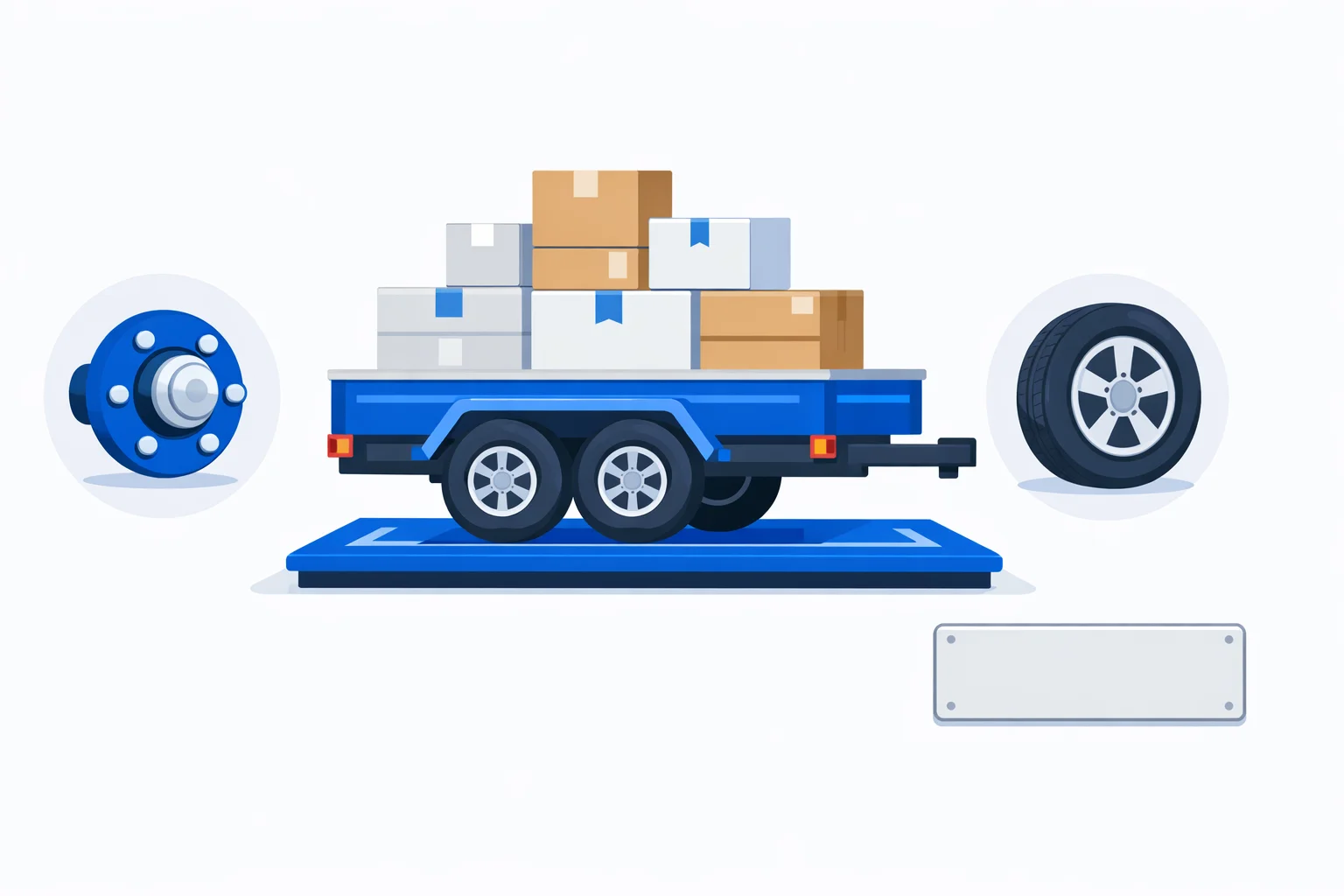
500 pounds. That's the gap between what a trailer payload calculator tells you if it only subtracts empty weight from GVWR, and what the 7,000-lb tandem utility trailer in the tool above can actually carry behind a mid-size truck. The subtraction says 4,820 lb. The honest answer is 4,320 — because the truck is rated for 6,500 lb of trailer, and that trailer will never get to find out what its own GVWR feels like.
Four Ratings Cap Your Cargo. Only the Lowest One Counts.
Trailer payload isn't a subtraction, it's a minimum. Four independent ratings each put a ceiling on the loaded trailer, and the one that runs out first is the only number you get to use. Three of them live on the trailer, one lives on the truck:
- GVWR caps the whole loaded trailer — steel, cargo, and the load resting on the ball. Straight ceiling: GTW ≤ GVWR.
- Axle capacity (GAWR) caps only what sits on the wheels. With 12% on the tongue, the axles see 88% of gross: GTW × 0.88 ≤ ΣGAWR.
- Tire capacity shares that load path exactly, so it takes the same 88% credit — and it's the rating that silently changes when somebody buys cheap replacements.
- Tow vehicle and hitch are rated on gross trailer weight, tongue included. No credit, and the lower of the two wins.
Rearranged for the axles and tires, the ceiling on gross weight becomes capacity ÷ (1 − tongue %). That division is the piece almost every other calculator skips, and it changes the answer in both directions — sometimes handing you capacity you didn't know you had, sometimes taking away capacity the GVWR promised.
The Same Trailer, Four Different Answers
Run the numbers on a 7x16 tandem utility trailer: 7,000 lb GVWR, 2,180 lb empty with the ramp gate and spare, two 3,500 lb axles, ST205/75R15 Load Range C tires, 12% on the ball, hooked to a mid-size truck rated 6,500 lb.
| Rating | Rated at | Max loaded trailer | Cargo it allows |
|---|---|---|---|
| GVWR | 7,000 lb | 7,000 lb | 4,820 lb |
| Axles (2 × 3,500) | 7,000 lb | 7,955 lb | 5,775 lb |
| Tires (4 × 1,820) | 7,280 lb | 8,273 lb | 6,093 lb |
| Tow vehicle | 6,500 lb | 6,500 lb | 4,320 lb |
Four answers spanning 1,773 lb, and the winner is the smallest. Notice what that does to the shopping list: buying stronger axles or a heavier load range buys you nothing here, because neither is the binding constraint. The truck is. Upgrading anything other than the row that binds is money spent on capacity you still can't use — which is exactly what the towing capacity calculator works out from the other end, starting at the vehicle's GCWR.
Why 3,500 lb Axles Under a 7,000 lb Trailer Aren't Maxed Out
Look at the table again and you'll spot something that trips people up constantly. The trailer is rated 7,000 lb gross. The axles add up to exactly 7,000 lb. That looks like a manufacturer cutting it fine — zero margin, right at the edge.
It isn't. Load that trailer to a full 7,000 lb with 12% on the tongue and the axles carry 7,000 × 0.88 = 6,160 lb. The remaining 840 lb is transferred through the coupler into the tow vehicle, and the axles never see it. Those axles are sitting at 88% of their rating at the trailer's legal maximum, which is deliberate engineering, not a corner cut. Tandem 3,500 lb axles under a 7,000 lb GVWR is one of the most common pairings in the industry precisely because the tongue eats the difference. That 840 lb doesn't vanish, though — it lands on a hitch ball well behind the truck's rear axle, where an axle weight distribution calculator will show it arriving as 1,176 lb on the rear axle and 336 lb off the front.
The credit cuts the other way too. Load the same trailer nose-heavy at 18% and the axles drop to 5,740 lb — even more margin. Load it tail-heavy at 6% and they climb to 6,580 lb, past their rating, while the trailer is still legally under GVWR. Same cargo, same scale ticket, different axle loads, and only one of those loadings tracks straight down the interstate. Where that percentage lands is a cargo-position problem, and our tongue weight calculator turns "I need more weight forward" into a specific box moved a specific distance.
Which Ceiling Bites First — and What Each One Costs to Fix
After enough scale tickets, a pattern shows up. The binding limit is usually predictable from the kind of trailer you own:
- GVWR binds on a well-matched new trailer. This is the healthy result. It means the builder specified running gear with room to spare, and the number on the label is your real limit. Nothing to fix.
- Tires bind after a cheap replacement set. The single most common failure, and it's invisible until you weigh. A 3,500 lb single-axle utility trailer with 900 lb empty weight should carry 2,600 lb. Fit Load Range B tires rated 1,430 lb apiece and the pair caps the axle load at 2,860 lb, which caps gross at 3,250 and cargo at 2,350 lb. You just lost 250 lb of capacity at the tire shop and nobody mentioned it. Fixing it costs one load range, typically $30–$60 more per tire.
- Axles bind on a re-tagged or home-built trailer. If someone welded on a heavier tongue and ordered a new VIN plate, the axles underneath didn't change. This is the expensive row — new axles, springs and hubs on a tandem run well into four figures installed, which is why the sensible move is to treat the lower figure as the trailer's real GVWR and load to that.
- The tow vehicle binds more often than owners expect. Trailers outlive trucks. Buy a bigger trailer for the truck you have and you can end up permanently unable to use the last 500–1,500 lb you paid for. And the tow rating usually isn't even the binding figure — the truck payload capacity calculator shows why, since the 840 lb of tongue load above lands on the truck's placard alongside your passengers and caps most half-tons long before their tow rating does. Worth pricing the whole trip with the towing cost estimator before deciding a heavier trailer is the answer.
The Load Ratings You'll Need to Look Up
Two numbers do most of the work, and both are stamped on parts rather than printed in a brochure. Trailer axles come in a handful of standard sizes — 3,500, 5,200, 6,000, 7,000 and 8,000 lb — and the figure is stamped on the axle tube or listed as GAWR on the certification label. Tires are harder, because load range changes the answer far more than size does:
| ST tire size | Load range | Cold psi | Per tire | Four tires |
|---|---|---|---|---|
| ST175/80R13 | C | 50 | 1,360 lb | 5,440 lb |
| ST205/75R14 | B | 35 | 1,430 lb | 5,720 lb |
| ST205/75R14 | C | 50 | 1,760 lb | 7,040 lb |
| ST205/75R15 | C | 50 | 1,820 lb | 7,280 lb |
| ST205/75R15 | D | 65 | 2,150 lb | 8,600 lb |
| ST225/75R15 | D | 65 | 2,540 lb | 10,160 lb |
| ST225/75R15 | E | 80 | 2,830 lb | 11,320 lb |
| ST235/80R16 | E | 80 | 3,520 lb | 14,080 lb |
Every one of those load figures assumes the stamped cold pressure. That's the catch: an ST225/75R15 Load Range D is a 2,540 lb tire at 65 psi and something considerably less at 50, so a trailer sitting on soft tires has quietly lowered its own payload ceiling. Check them cold, before the trailer has rolled a mile, and use the sidewall figure rather than the number our tire pressure calculator returns for a passenger car — ST tires are run at their maximum, not at a comfort pressure. NHTSA's tire safety guidance makes the same point: a tire only carries its rated load at its rated pressure.
That Sticker on the Frame Rail Is a Federal Document
The metal or foil label near the front of the driver's side isn't marketing. Under 49 CFR Part 567, every trailer built for US roads carries a certification label showing the manufacturer, the build date, the VIN, the GVWR, and the GAWR for each axle. That's the legal source for three of the four numbers this calculator needs, and it beats every listing, brochure and forum post you'll find.
The label carries something else worth knowing about. Under FMVSS No. 120, the tire and rim sizes a manufacturer lists must be capable of carrying the axle ratings they certified. In other words, the tires the trailer left the factory on were chosen to support its GAWR — so if your tire row comes up short in the calculator, the trailer almost certainly isn't wearing the tires it was built with. That single check catches more overloaded trailers than any amount of eyeballing the springs.
One thing the label won't tell you is the empty weight, and that's where most payload calculations go wrong. Brochure dry weight excludes the spare, the ramp gate, the toolbox, the jack, and anything the dealer bolted on — commonly 150–400 lb of equipment that's already eaten your cargo allowance before you load a single item. A public scale run costs about $15 and replaces the guess. Weigh it empty once, write the figure on the inside of the fender, and every payload calculation after that starts from a real number. While the wheels are off for that first tire inspection, run them back up to the correct lug nut torque — trailer wheels lose clamp load faster than car wheels do.