
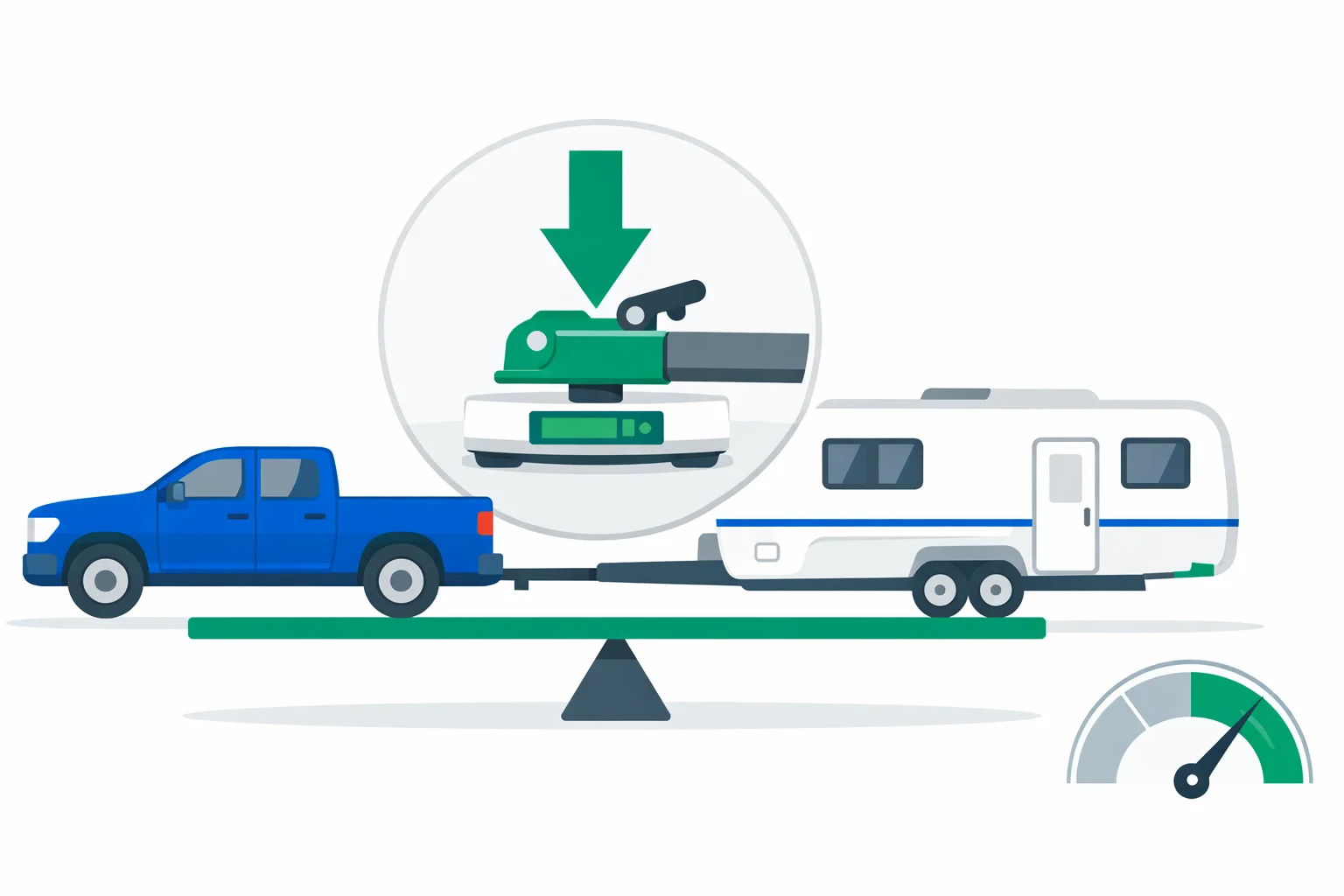
A tongue weight calculator divides one number by another: the load pressing down on your coupler, over the weight of the whole loaded trailer. Land between 10% and 15% and you're done. That definition is correct and it is also backwards, because tongue weight isn't a setting you dial in. It's a consequence of where your cargo is sitting, and the percentage you're chasing is really a statement about one distance — how far ahead of the trailer's axle the load balances. Once you see it that way, "I need 240 more pounds on the tongue" turns into "I need to move that box twelve feet forward," which is a job you can actually do in a driveway.
The Trailer Felt Fine Until the Semi Went Past
Here's the setup that produces most sway incidents. A 6,000-pound travel trailer, hitched and level, carrying 480 pounds on the ball. That's 8.0% — two points under the floor, which sounds like a rounding error. On county roads at 45 mph it feels completely normal. Then you merge onto the interstate, settle at 62, and a semi goes by.
The trailer steps out a few inches, comes back, steps out further. What's happening is a balance problem at the axle. With 8% on the tongue, that trailer's loaded centre of gravity sits just 1.28 feet ahead of its own axle on a 16-foot coupler-to-axle span. The trailer is very nearly balanced on its own wheels, so almost nothing resists it rotating about them — and every yaw the truck's bow wave induces feeds the next one instead of damping it out. Push the tongue to 12% and the balance point moves out to 1.92 feet. That extra eight inches of lever arm is the entire difference between a trailer that self-centres and one that hunts. NHTSA has been making this point in its towing guidance since 2002: too little tongue weight causes sway, too much unloads the tow vehicle's front wheels, and the NHTSA guide to connecting a trailer still leads with it.
Two things people try that don't work: speeding up to "pull it straight," which is the wrong direction because sway is speed-dependent and there's a critical velocity above which each oscillation grows; and grabbing more steering, which puts you exactly out of phase with the trailer. Ease off the throttle, keep the wheel still, and apply the trailer brakes by hand if you have a controller. Then pull over and fix the loading, because the loading is the actual fault.
One Chest Freezer, 12 Feet, and 150 Pounds of Tongue Weight
Getting from 480 pounds to a mid-band 720 means finding 240 pounds of tongue weight. You don't find it by adding 240 pounds — you find it by moving weight you're already carrying across the axle. The equation is a moment balance, and it's one line:
- ΔTW = (W × s) ÷ L — where W is the weight you move, s is how far you move it, and L is the coupler-to-axle distance
- Rearranged for the job: the moment you need is ΔTW × L = 240 × 16 = 3,840 lb-ft
So: the 200-pound chest freezer that's been riding 6 feet behind the axle goes 6 feet ahead of it. That's a 12-foot journey, not a 6-foot one, and it buys 200 × 12 ÷ 16 = 150 pounds of tongue weight in one lift. Two 60-pound totes making the same 12-foot trip add another 90. Total: 240 pounds, and the trailer now sits at 12.0%.
Notice which variable did the work. Nudging that same freezer 2 feet forward inside the same compartment gains you 25 pounds — barely a sixth as much for the same amount of sweating. Distance is cheap, weight is expensive. Cross the axle with something heavy and you get paid twice, once for leaving the back and once for arriving at the front.
This is also why bolting a generator to the A-frame is a weaker fix than it looks. Hang a 60-pound generator 15 feet ahead of the axle and you do add 56 pounds to the tongue — but you also added 60 pounds to the trailer, so the percentage only crawls from 8.0% to 8.8%. Adding nose weight raises the numerator and the denominator together. Moving weight you already have raises only the numerator — and it costs you nothing against the trailer's own cargo ceiling, which the trailer payload calculator derives from your GVWR, axle and tire ratings.
Where the 10–15% Rule Came From — and Who It Doesn't Apply To
The band isn't federal law. It's an industry convention that hardened into every owner's manual, and it describes conventional trailers specifically. Worth knowing: SAE J2807, the tow-rating standard the whole industry finally adopted by 2015, standardised how a manufacturer measures what a truck can pull — a Davis Dam grade climb, a launch time, a lane-change stability run. It standardised the rating. It said nothing about how you load the trailer, which stayed entirely your problem. That's why a truck that comfortably exceeds its J2807 test can still be dangerous behind a badly packed 6,000-pound box.
| Trailer style | Target band | Why it differs |
|---|---|---|
| Travel trailer, bumper-pull | 10–15% | Tall, long body hanging behind a ball that sits well behind the rear axle — the geometry most prone to yaw |
| Utility / open flatbed | 10–15% | Same band, worst hit rate. The deck is bare, so you place the load and nothing stops you placing it over the axle |
| Car hauler with a vehicle on it | 10–15% | Set almost entirely by where you stop the car — roughly 60% of its weight wants to be ahead of the trailer axle |
| Boat trailer | 5–10% | A hull sits low and long with the axle set back for ramp launching; the low centre of gravity resists sway that a camper can't |
| Fifth wheel / gooseneck | 15–25% | The pin loads the truck's rear axle directly instead of levering behind the bumper, so there's no overhang to amplify yaw |
Get the row wrong and you can be dangerous while doing the arithmetic perfectly. A 700-pound tongue on a 5,000-pound boat trailer rig is a textbook 14% — and roughly double what that trailer wants. Meanwhile 14% pin weight on a fifth wheel is under-loaded and will chuck and porpoise down the highway.
5 Things That Move Your Number After You've Weighed It
Tongue weight is a snapshot, and it expires. Running the same 6,000-pound trailer with a 16-foot span, here's what an ordinary weekend does to it:
- Filling the fresh water tank. Forty gallons is 334 pounds, and everything depends on where the tank lives. Four feet ahead of the axle it adds 84 pounds of tongue and takes you to 8.9%. Three feet behind, it removes 63 and drops you to 6.6%. Same water, same trailer, 2.3 percentage points apart.
- Two e-bikes on a rear bumper rack. 120 pounds hanging 10 feet behind the axle pulls 75 pounds off the tongue while adding 120 to the trailer. You go from 8.0% to 6.6% by loading bicycles — which is why bumper-mounted racks are the single most common cause of a camper that suddenly sways on a route it always handled fine.
- Propane and batteries on the A-frame. Two filled 30-pound propane bottles (about 57 pounds each) plus a 60-pound battery, sitting 15 feet ahead of the axle, put 163 pounds on the ball. That placement isn't styling — it's the manufacturer buying back tongue weight with hardware you were going to carry anyway.
- Where you stop the car on a hauler. On a 16-foot span, a 3,500-pound car moves 219 pounds of tongue weight per foot of deck position. One extra tug on the winch outweighs every other item on this list combined, and it's the reason loading marks get painted on deck rails.
- Dumping the black tank. The counterintuitive one. Thirty-five gallons of waste is 292 pounds, and it usually sits behind the axle — so emptying it raises your tongue weight by 91 pounds even though the trailer got lighter. That trailer leaves the campsite at 8.0% and rolls away from the dump station at 10.0%. The leg of the trip where it was least stable is the one you already drove.
The practical version: re-weigh whenever the load plan changes, not once a season. And when the trailer wheels come off for a bearing service or a tire swap, treat the reassembly as its own job — trailer wheels shed clamp load faster than car wheels, so run the correct lug nut torque again at 10, 25 and 50 miles, and set trailer tires to the pressure stamped on the sidewall rather than the number our tire pressure calculator returns for a passenger car.
Do You Need Weight-Distributing Bars?
There are three thresholds, and hitting any one of them means yes:
- The trailer is over ~5,000 lb or the tongue is over ~500 lb. Look at the sticker on the receiver itself — almost every Class III and IV hitch is stamped with two ratings, a lower "weight carrying" figure and a higher "weight distributing" one. A Class III typically goes from 8,000/800 lb to 12,000/1,200 lb the moment bars are fitted.
- The trailer weighs more than half of what the tow vehicle weighs. Ratio matters as much as absolute weight, which is what our towing capacity calculator works out once your passengers and gear are in the truck.
- The front end rose when you hitched up. Measure the front fender height at the wheel centre unhitched, then hitched. More than about half an inch of rise means the tongue has levered weight off your steering axle. Properly adjusted bars should put at least half of that drop back. To see how many pounds that lever is actually moving, put the ball's distance into the axle weight distribution calculator: at a 1.40 lever, 700 lb on the ball adds 980 lb to the rear axle and lifts 280 lb off the front.
Two things bars do not do. They don't reduce tongue weight — the scale reads the same before and after, and your truck's payload still carries every pound of it, plus 60 to 100 pounds of head and bars. Check that the placard can absorb it with our truck payload capacity calculator, because a 780-pound tongue plus hardware is well over half the payload of a typical half-ton crew cab before anyone climbs in. And weight distribution is not sway control: bars fight squat, while friction or dual-cam sway control fights yaw. A trailer loaded to 6% with a sway bar bolted on is still a trailer loaded to 6%. Hardware doesn't move your cargo.
You Can Weigh the Tongue With a Bathroom Scale
Most bathroom scales quit around 300–400 pounds, and a proper tongue is heavier than that. A lever fixes it. Lay a stout board across a pipe or brick acting as a pivot, rest the coupler on the board 1 foot from the pivot, and put the scale under the board 3 feet from it. Moments about the pivot mean the scale reads exactly a third: a 240-pound reading is a 720-pound tongue. Keep the board roughly level and the coupler at its normal towing height, or you're measuring a different trailer attitude than the one you drive.
The gold standard is still a public truck scale. Weigh the rig hitched, note the tow vehicle's axle weights, unhitch, and weigh the tow vehicle alone — the difference is your tongue weight, and you get your axle loads and gross combined weight in the same visit. A CAT scale run runs about $15, which is cheap for the only number on this page that isn't an estimate.