
Calculating horsepower from torque takes one line of arithmetic: HP = (Torque × RPM) ÷ 5,252. Feed it 400 lb-ft at 5,500 RPM and you get 419 horsepower. That's the entire formula — no fudge factors, no engine-specific constants, nothing about displacement or turbochargers. The interesting part isn't the math. It's the fact that almost everyone who uses it misreads what the answer means, because horsepower isn't a separate thing an engine makes. Itis torque, measured against time.
Where Does 5,252 Come From? Blame a Scottish Engineer and a Horse
That constant looks arbitrary. It isn't — it falls out of a marketing decision made in 1782. James Watt was trying to sell steam engines to mine owners who already had horses, so he needed a unit his customers could price. After watching draft horses turn a mill wheel, he settled on 33,000 foot-pounds of work per minute as "one horsepower": a horse lifting 330 pounds one hundred feet in sixty seconds. It was a generous number, and it stuck.
Now convert that to a spinning crankshaft. Rotational work equals torque multiplied by the angle swept, and one revolution is 2π radians. A shaft turning at N revolutions per minute therefore does Torque × 2π × N foot-pounds of work every minute. Divide by Watt's 33,000 and you have horsepower:
- HP = (Torque × 2π × RPM) ÷ 33,000
- Rearranged: HP = (Torque × RPM) ÷ (33,000 ÷ 2π)
- And 33,000 ÷ 2π = 5,252.113
So 5,252 is just Watt's horse divided by the geometry of a circle. It has no connection to engines at all, which is why it holds for a lawnmower, a Cummins diesel, and a Formula 1 V6 identically. The metric world runs the same derivation with 60,000 watt-seconds instead: kW = (Nm × RPM) ÷ 9,549. Different horse, same circle. If you want the underlying unit definitions, the NIST reference on SI units defines the watt these figures ultimately trace back to.
The Myth That Torque Wins Races
"Horsepower sells cars, torque wins races" is the most repeated line in car culture, and it's backwards. Here's the demonstration that settles it. Take an engine making 300 lb-ft at 4,000 RPM — that's 228 hp. Send it through a 3.50:1 first gear and a 3.73:1 final drive, a 13.06:1 total reduction. At the axle you now have 3,917 lb-ft of torque turning at 306 RPM. Run the formula on those axle numbers: 3,917 × 306 ÷ 5,252 = 228 hp.
Thirteen times the torque, and not one extra horsepower. Gearing multiplies torque for free because it trades away rotational speed in exact proportion — that's what a gear ratio calculator is really showing you. Power is the quantity that survives the gearbox. Engine torque doesn't tell you how fast a car accelerates, because a taller gear can hand you any torque figure you like. Horsepower does, because it already accounts for how quickly the work is being done.
Which is why a heavy-duty pickup making 1,000 lb-ft at 1,800 RPM produces 343 hp, while a litre superbike making 82 lb-ft at 12,500 RPM produces 195 hp. The truck has 12 times the torque and 1.8 times the power — and the bike still walks away from it, because it weighs 450 pounds and gears that power into wheel torque. Torque is what you feel from the driver's seat. Power is what determines the outcome.
You can watch that play out on a timeslip. Quarter-mile trap speed is set by power divided by weight and nothing else — drop 480 hp into a 3,880 lb car and it traps 117 mph whether the torque peak lands at 1,800 rpm or 6,500. Our quarter mile calculator runs that arithmetic both ways, so you can also work backwards from a trap speed to the horsepower that produced it.
Where those two torque figures come from is cylinder geometry, not litres. The Cummins swings a 124 mm stroke against a 107 mm bore — a 0.86 ratio that puts leverage on the crank and torque low down. The superbike runs a stroke near 51 mm, which is the only reason it can see 12,500 RPM at all. Our engine displacement calculator turns bore and stroke into cc, litres and cubic inches, and shows the ratio that decides which end of the rev range an engine works at. How hard that mixture gets squeezed matters just as much: our compression ratio calculator works out both the static and the dynamic figure, and a point of compression is worth roughly 3–4% of the torque you are converting here.
How Much Horsepower Is 400 lb-ft?
This is the most common way the question gets asked, and it has no single answer — which is exactly the point. Four hundred pound-feet is worth wildly different power depending on where in the rev range it happens:
| 400 lb-ft delivered at | Horsepower | What that looks like |
|---|---|---|
| 1,800 RPM | 137 hp | Turbodiesel just off idle |
| 3,500 RPM | 267 hp | Mid-range pull in a big V6 |
| 5,252 RPM | 400 hp | The crossover — numbers match exactly |
| 6,500 RPM | 495 hp | Naturally aspirated V8 near redline |
| 8,000 RPM | 609 hp | Race engine territory |
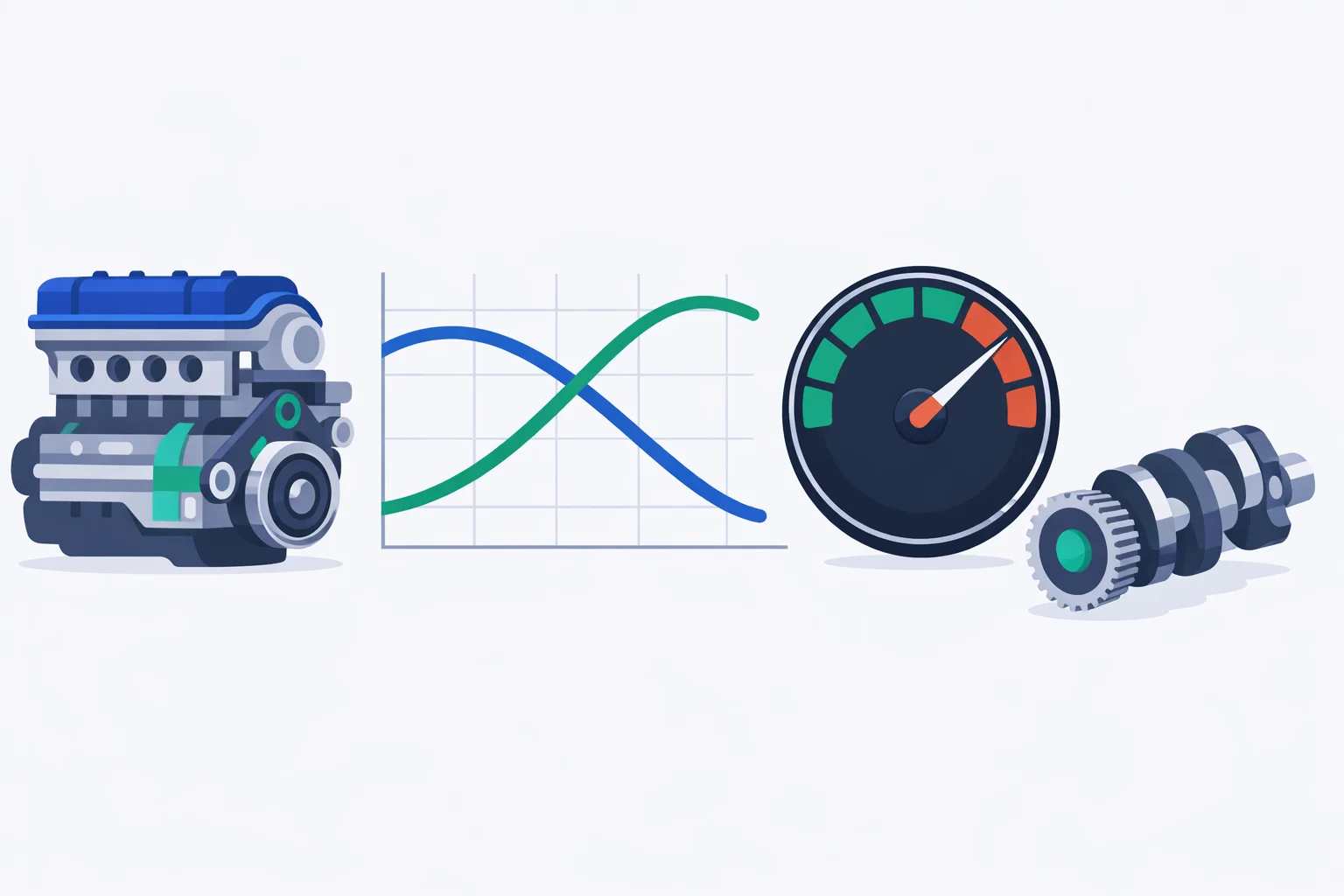
Notice the 5,252 row. Because horsepower is torque scaled by RPM ÷ 5,252, that scaling factor equals exactly 1.0 at 5,252 RPM — so the two numbers are identical there, always. Below it, the horsepower figure is smaller than the torque figure. Above it, larger. That single fact is why every dyno chart you have ever seen has its power and torque lines crossing at the same spot, regardless of what engine was on the rollers. The chart in the calculator above draws it out.
Why Peak Torque and Peak Power Never Share an RPM
Spec sheets quote two peaks at two different engine speeds, and the gap between them tells you more about a car's character than either number alone. Peak power always lands higher in the rev range, because power keeps climbing as long as torque falls off more slowly than RPM rises. Here are typical published figures by engine class, with one extra column most spec sheets never show you — what the engine is actually making in horsepower at its torque peak:
| Engine class | Peak torque | Peak power | HP at the torque peak |
|---|---|---|---|
| 2.0L turbo four | 280 lb-ft @ 4,500 | 255 hp @ 5,500 | 240 hp |
| 5.0L naturally aspirated V8 | 410 lb-ft @ 4,900 | 480 hp @ 7,000 | 383 hp |
| 6.7L heavy-duty turbodiesel | 1,000 lb-ft @ 1,800 | 400 hp @ 2,800 | 343 hp |
| 1,000cc superbike | 82 lb-ft @ 11,500 | 195 hp @ 12,500 | 180 hp |
| Single-motor EV | 340 lb-ft from 0 | 283 hp @ 4,400 | ~0 hp at 0 RPM |
The EV row is the one worth staring at. An electric motor makes full torque from a standstill, which sounds unbeatable until you run the formula: at 0 RPM, 340 lb-ft produces zero horsepower, because nothing is moving and no work is being done. The shove you feel off the line is real, but the power builds as the motor spins up, then plateaus once the controller starts trimming torque to hold its rating. Diesels behave the same way at the other end of the tach — enormous torque, low ceiling. That's also why axle ratio matters so much when you're hauling: our towing capacity calculator covers the weight side, and gearing is what turns the engine's power into the pull that moves it.
4 Ways This Formula Gets Misused
- Pairing peak torque with the peak-power RPM. The single most common error. Take that V8: plugging 410 lb-ft into 7,000 RPM returns 546 hp, when the real figure is 480. The engine isn't making 410 lb-ft at 7,000 — it's down to about 360. Torque and RPM have to come from the same point on the curve or the answer is fiction.
- Comparing crank horsepower to wheel horsepower. Manufacturers quote power at the flywheel; a chassis dyno reads it after the drivetrain has taken its cut. Budget roughly 10–12% loss on front-wheel drive, 15% on rear-wheel drive, and 20–25% on all-wheel drive. A 400 hp RWD car showing 340 whp isn't underperforming — it's reading normally. Our drivetrain loss calculator runs that correction both ways, and explains why dividing by 0.85 is right where adding 15% is wrong.
- Treating PS and hp as the same unit. A European brochure quoting 300 PS is quoting metric horsepower, worth 735.5 watts against the 745.7 watts in a mechanical hp. That car makes 296 hp, not 300 — a 1.4% gap that quietly shows up in every cross-market comparison.
- Dropping newton-metres straight into the lb-ft formula. One lb-ft equals 1.3558 Nm, so 500 Nm is 369 lb-ft. Skip the conversion and you'll overstate power by 36%. Either convert first, or switch to the metric form and divide by 9,549 instead of 5,252.
Two more things worth knowing before you trust any published figure. Since 2005, US manufacturers have certified power under SAE J1349 with independent witnessing, which is why some pre-2006 cars were quietly "re-rated" lower without a single mechanical change. And engine output tracks air density, so the same car loses roughly 3% of its power per 1,000 feet of elevation — about 12% in Denver. If you want to see where your engine is actually sitting on the tach at a given road speed, our RPM calculator works backward from gearing and tire diameter. For the history behind the unit itself, the full history of the horsepower unit is worth ten minutes.