
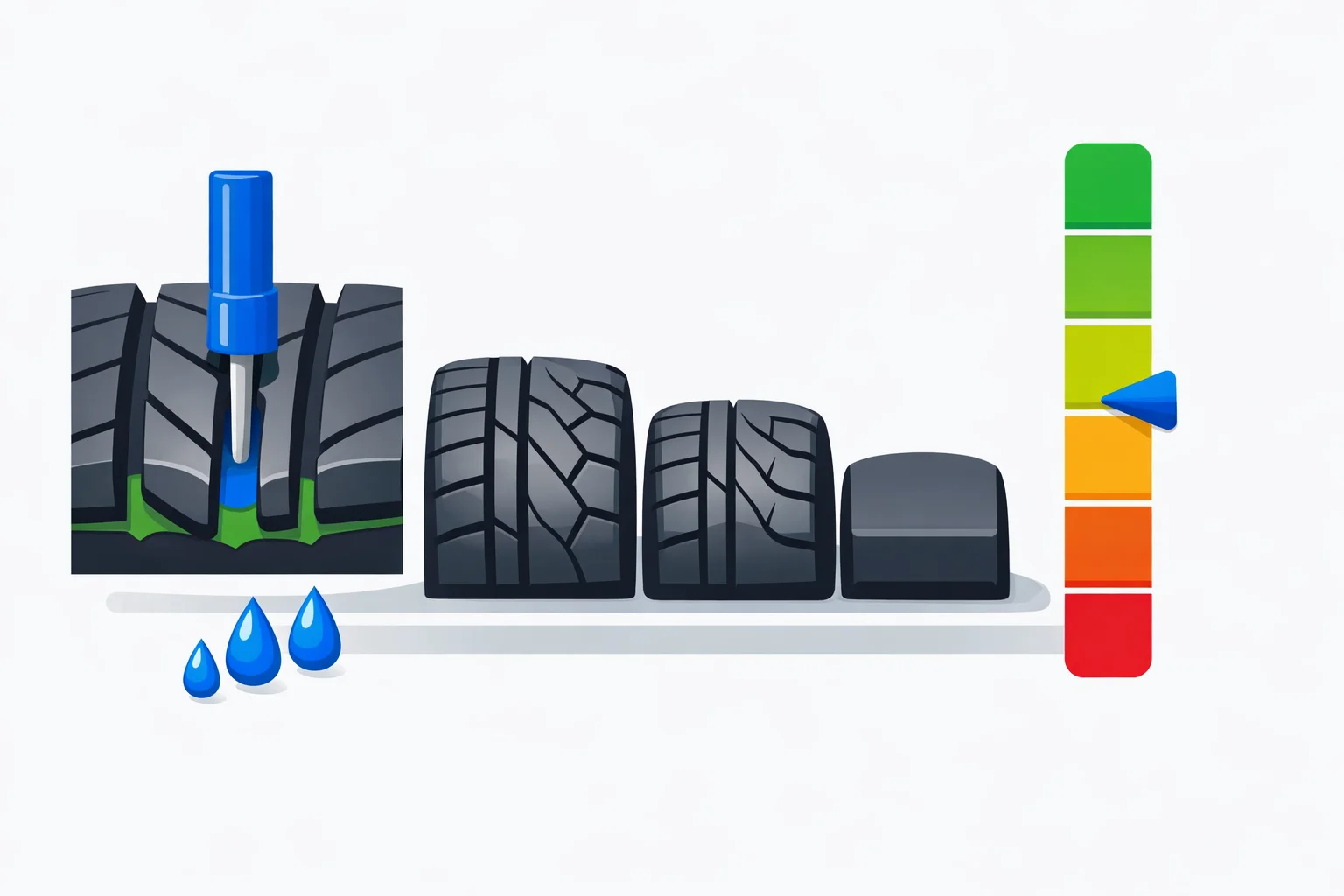
Eighty-seven feet. That is what a tire tread depth calculator is really measuring for you — the extra distance AAA recorded a passenger car travelling before it stopped on wet pavement at 60 mph, running tires worn to 4/32" instead of new ones. Eighty-seven feet is longer than a semi-trailer. At the moment the car on new tires has come to a complete halt, the one on 4/32" rubber is still doing 40 mph. And 4/32" is perfectly legal in all fifty states.
Your Tires Are Fine, Then Suddenly They Aren't
Here is the scenario the calculator above is built around. You bought all-seasons two and a half years ago, they came out of the mould at 10/32", and the odometer says you have put 30,000 miles on them. You push a gauge into the shallowest groove this morning and it reads 6/32". That is three numbers, and they are enough to tell you everything.
You have burned 4/32" over 30,000 miles, so your wear rate is 0.13/32" per 1,000 miles — one full thirty-second gone every 7,500 miles. From 6/32" you have 4/32" of legal tread left, which works out to 30,000 more miles, or about 27 months at 13,500 miles a year. The set is tracking toward 60,000 miles total.
But read the same three numbers a second way. You cross 4/32" — the AAA threshold — in 15,000 miles, roughly 13 months. So the honest answer to "how long do I have?" is not 27 months. It is 13 months of tires you would want in a thunderstorm, followed by 14 months of tires that are merely legal. Most people plan around the wrong one of those two numbers.
What Each Thirty-Second Actually Buys You
Tread depth is not a slider from "good" to "bad". Specific things stop working at specific depths, and knowing which is which changes when you buy:
| Depth | Metric | What has changed |
|---|---|---|
| 10–11/32" | 7.9–8.7 mm | Factory depth for most all-seasons. Full water evacuation. |
| 6/32" | 4.8 mm | Snow traction is effectively finished. Wet grip is measurably down but still decent. Start pricing the next set. |
| 4/32" | 3.2 mm | +87 ft of wet stopping distance at 60 mph, and 33% less wet handling grip. The real replacement point. |
| 3/32" | 2.4 mm | Hydroplaning speed drops sharply. Borderline tires begin failing state inspections. |
| 2/32" | 1.6 mm | Wear bars sit flush with the tread. Illegal in all 50 states and across the EU. |
Notice how compressed that scale is. The whole usable life of a 10/32" tire is eight thirty-seconds — a quarter of an inch of rubber. Half of it is gone by 6/32", and the genuinely good half is gone by 4/32". That is why measuring beats eyeballing: a tire at 5/32" and a tire at 9/32" look identical in a parking lot and behave nothing alike in standing water.
Why the 2/32" Rule Is Older Than Almost Every Car on the Road
The 2/32" limit is not a modern safety finding. It came out of federal rulemaking in the late 1960s, written first for the commercial trucking fleet, and it was set at the depth where testing of the era showed a tire losing traction rapidly. That is also why every tire sold today has treadwear indicator bars moulded into the grooves at exactly 2/32" — the wear bar is the regulation made visible. Commercial vehicles still carry a stricter rule: under 49 CFR 393.75, steer-axle tires on a truck need 4/32", not 2/32".
Sit with that for a second. The federal government decided decades ago that 4/32" is the floor for the tires that steer an 80,000-pound truck — the same depth where AAA later measured your car needing an extra 87 feet to stop. Passenger cars simply never got the update. Europe landed on 1.6 mm, which is 2.02/32", so the two systems agree almost exactly, and both are chasing a 1960s number. The legal minimum tells you when a tire becomes a citation. It was never designed to tell you when a tire stops being good, which is the question the calculator above answers instead.
Three Things That Quietly Double Your Wear Rate
The projection is only as good as the wear rate behind it, and the rate is not a property of the tire — it is a property of how the car is set up and driven:
- Skipping rotations. Front tires on a front-wheel-drive car steer, brake, and put the power down, and they wear roughly twice as fast as the rears. Measure all four and you will often find 5/32" up front against 8/32" at the back on the same 30,000-mile set. Rotate every 5,000–7,500 miles and the four wear as one; skip it and you replace a set at 40,000 miles that had 60,000 miles of rubber in it.
- Running underinflated. A tire 20% below placard pressure flexes at the shoulders, runs hotter, and scrubs its outer edges away up to 25% faster. On our example set, that turns a 60,000-mile life into about 45,000 — a 15,000-mile loss for something a monthly check with a tire pressure calculator and a $12 gauge prevents entirely. The NHTSA tire safety guidance is blunt about this being the single most common cause of premature wear. Two wheels pay an even steeper penalty: motorcycle rears last just 3,000–10,000 miles to begin with, so a soft tire burns real money fast — our motorcycle tire pressure calculator sets load-corrected cold targets for solo, two-up and touring setups.
- Alignment left uncorrected. A toe setting off by a fraction of a degree drags the tire sideways across the road every mile. It shows up as one shoulder measuring 3/32" while the other reads 7/32" — and because the calculator asks for your shallowest groove, that inner edge is what ends the tire's life. A $100 alignment after a serious pothole is cheap against a set you can price out with our tire replacement cost calculator.
There is one more consequence nobody expects. Going from 10/32" to 2/32" strips a quarter-inch off the tire's radius — half an inch of overall diameter. On a 31.6-inch truck tire that is a 1.58% change, so a worn set makes your speedometer read slightly fast and your odometer count slightly high. Our speedometer error calculator puts a number on it, and it is larger than the error some people pay to have recalibrated after a tire swap.
Wearing Out Early? The Warranty May Owe You Money
If the calculator projects a total life well under the treadwear warranty printed on your receipt, that gap is worth something. Say you bought a 70,000-mile set and your measured wear rate puts them at the wear bars around 44,000 miles. Treadwear warranties pay pro rata, so the 26,000 miles you did not get is 37% of the promise — and that becomes roughly a 37% credit toward the replacement, not a refund in cash.
Two things kill these claims. The tire has to reach 2/32" to qualify at all, so a set you replace early on principle is worth nothing under the warranty. And every manufacturer requires documented rotations, usually every 5,000–7,500 miles, which means keeping the receipts. Bring the worn tires with you when you claim; adjusters settle against the carcass, not a photo. It is worth folding that credit into the wider picture with our car maintenance cost calculator, since tires and brakes tend to come due within a year of each other.
Frequently Asked Questions
Projections assume your tread wears at the same rate it has so far. Real wear accelerates slightly as the tread block gets shallower and stiffer, so treat the final few thousand miles as optimistic.