
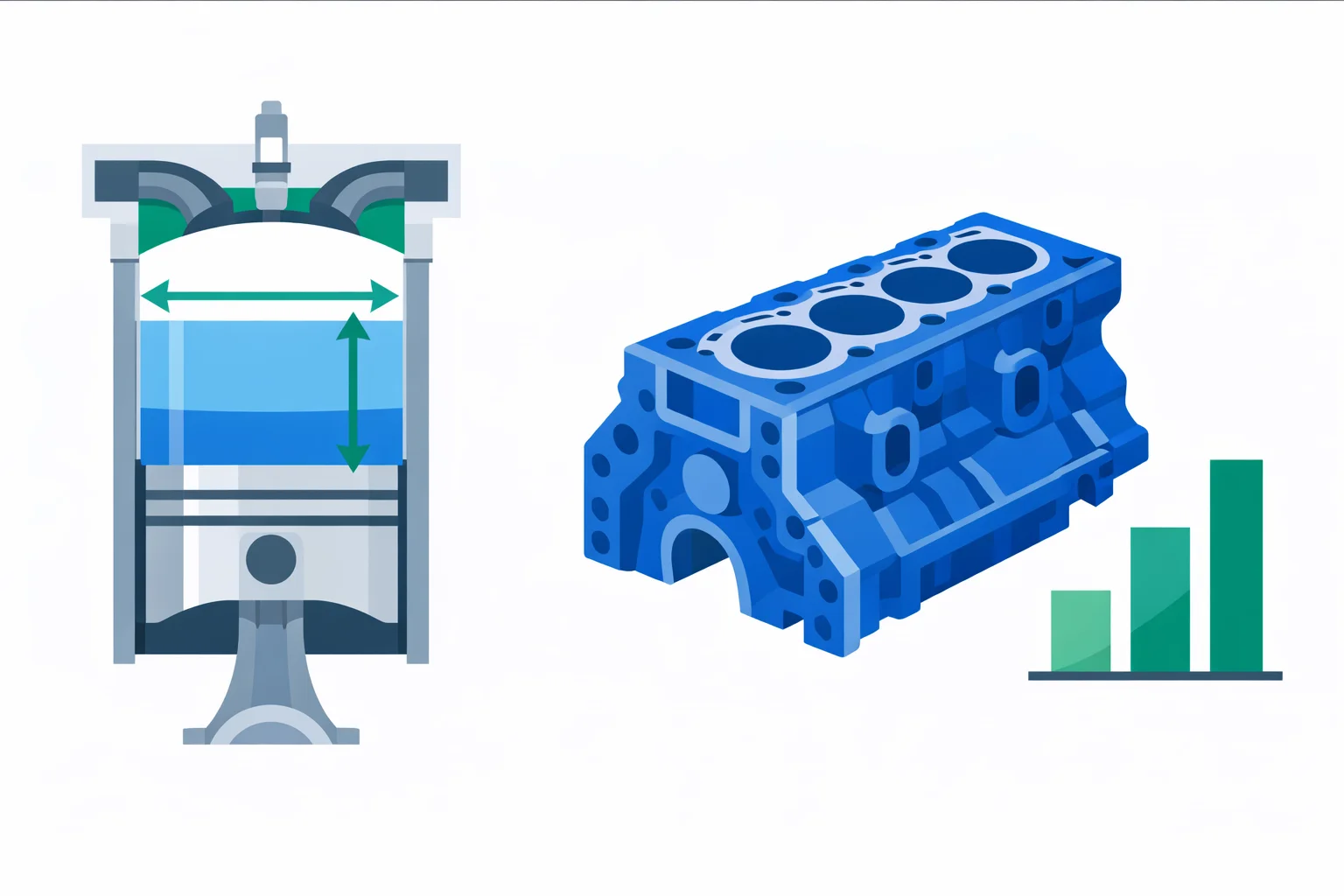
An engine displacement calculator runs exactly one equation: V = (π ÷ 4) × bore² × stroke × cylinders. Hand it a 4.000-inch bore, a 3.480-inch stroke and eight cylinders and it returns 349.85 cubic inches — the engine Chevrolet spent forty years badging as a 350. Same arithmetic in metric: 101.6 mm and 88.39 mm give you 5,733 cc, or 5.73 litres. That part is settled. The interesting question is what the number does not tell you, because two engines can land on the same displacement and drive nothing alike.
Three 3.0-Litre Sixes, Seventeen Cubic Centimetres Apart
Put a Toyota 2JZ-GTE, a BMW B58 and a Porsche 9A2 flat-six side by side and the spec sheets agree: 3.0 litres, six cylinders. Run their real geometry through the formula and they land within 17 cc of each other — a rounding error, roughly the volume of a tablespoon. Then look at how they got there.
| Engine | Bore × stroke | Displacement | B/S ratio | Piston speed @ 7,000 |
|---|---|---|---|---|
| Porsche 9A2 flat-six | 91.0 × 76.4 mm | 2,981 cc | 1.19 | 17.8 m/s |
| Toyota 2JZ-GTE | 86.0 × 86.0 mm | 2,997 cc | 1.00 | 20.1 m/s |
| BMW B58 inline-six | 82.0 × 94.6 mm | 2,998 cc | 0.87 | 22.1 m/s |
At an identical 7,000 rpm, the BMW's pistons are covering 24% more ground per minute than the Porsche's. Mean piston speed is just 2 × stroke × rpm, and displacement never enters it — only stroke does. That single fact explains most of what people attribute vaguely to “engine character”. The 76.4 mm stroke lets Porsche chase revs while ring flutter and rod loading stay manageable. The 94.6 mm stroke gives BMW a longer lever on the crank and a fat mid-range, and costs it the top end. Toyota split the difference at dead square.
There is a second consequence of a wide bore that never shows up in the litre figure: valve room. A 91 mm bore has 23% more crown area than an 82 mm bore, and that area is where the intake valves have to fit. Bigger valves breathe better at high rpm, which compounds the short stroke's advantage. So when you compare two engines by displacement alone, you are comparing the one number that deliberately throws away the two that decide behaviour.
Bore and Stroke for 18 Engines People Actually Look Up
Every figure below is the published factory geometry, with displacement recalculated from it rather than copied off the badge. Watch the last column: the ratio spread runs from 0.86 to 1.26 across engines whose sizes overlap heavily.
| Engine | Bore × stroke | Cyl | cc | CID | B/S |
|---|---|---|---|---|---|
| Honda B18C | 81.0 × 87.2 mm | 4 | 1,797 | 109.7 | 0.93 |
| VW / Audi EA888 2.0 TSI | 82.5 × 92.8 mm | 4 | 1,984 | 121.1 | 0.89 |
| Honda K20 | 86.0 × 86.0 mm | 4 | 1,998 | 121.9 | 1.00 |
| Ford EcoBoost 2.3 | 87.5 × 94.0 mm | 4 | 2,261 | 138.0 | 0.93 |
| Subaru EJ257 | 99.5 × 79.0 mm | 4 | 2,457 | 149.9 | 1.26 |
| Nissan RB26DETT | 86.0 × 73.7 mm | 6 | 2,569 | 156.7 | 1.17 |
| Porsche 9A2 3.0 | 91.0 × 76.4 mm | 6 | 2,981 | 181.9 | 1.19 |
| Toyota 2JZ-GTE | 86.0 × 86.0 mm | 6 | 2,997 | 182.9 | 1.00 |
| BMW B58 3.0 | 82.0 × 94.6 mm | 6 | 2,998 | 182.9 | 0.87 |
| Toyota 2GR-FE 3.5 | 94.0 × 83.0 mm | 6 | 3,456 | 210.9 | 1.13 |
| Mercedes-AMG M177 4.0 | 83.0 × 92.0 mm | 8 | 3,982 | 243.0 | 0.90 |
| Ford Coyote 5.0 | 92.2 × 92.7 mm | 8 | 4,951 | 302.1 | 0.99 |
| Chrysler 5.7 Hemi | 99.5 × 90.9 mm | 8 | 5,654 | 345.1 | 1.09 |
| GM LS1 5.7 | 99.0 × 92.0 mm | 8 | 5,665 | 345.7 | 1.08 |
| Chevrolet small-block 350 | 4.000 × 3.480 in | 8 | 5,733 | 349.8 | 1.15 |
| GM LS3 6.2 | 103.25 × 92.0 mm | 8 | 6,162 | 376.1 | 1.12 |
| Cummins 6.7 turbodiesel | 107.0 × 124.0 mm | 6 | 6,690 | 408.3 | 0.86 |
| Harley-Davidson Twin Cam 103 | 3.875 × 4.375 in | 2 | 1,691 | 103.2 | 0.89 |
The two extremes are worth sitting with. Subaru's EJ257 runs a 99.5 mm bore against a 79 mm stroke to keep the flat-four short enough to fit under a bonnet with the crank low. Cummins goes the other way entirely — a 124 mm stroke, longer than the bore is wide, which is how a diesel makes 1,000 lb-ft while redlining barely past 3,000 rpm. Feed those torque figures into our horsepower and torque calculator and the low-rpm penalty shows up immediately. Swept volume is also only the first half of a build spec — pair it with the chamber, deck, gasket and piston volumes in our compression ratio calculator and you get the number that decides what fuel the engine will tolerate.
0.030 Over Buys You 5 Cubic Inches. A Longer Crank Buys You 27.
Here is where the exponents in the formula start costing people money. Displacement scales with bore squared but with stroke only linearly, which sounds like bore is the powerful lever. In practice it is the opposite, because of how much of each you can realistically add.
| Chevrolet 350 build | Bore × stroke | CID | Gain |
|---|---|---|---|
| Standard bore | 4.000 × 3.480 | 349.8 | — |
| 0.030 over | 4.030 × 3.480 | 355.1 | +5.3 · 1.5% |
| 0.060 over | 4.060 × 3.480 | 360.4 | +10.6 · 3.0% |
| 400 crank, standard bore | 4.000 × 3.750 | 377.0 | +27.1 · 7.8% |
| 400 crank, 0.030 over — the 383 | 4.030 × 3.750 | 382.7 | +32.8 · 9.4% |
A 0.030-inch cut sounds substantial until you write it as a fraction: it is 0.75% more diameter. Square that and you get 1.5% more displacement — 5.3 cubic inches for a machine shop bill that typically lands somewhere around $200 to $400 to bore and hone a V8 block, plus a fresh set of oversize pistons. Swapping in a 400 crank moves stroke from 3.480 to 3.750, a 7.8% increase you keep in full because the relationship is linear. Do both and you have the 383 stroker, which is why that combination has outlived several generations of the engine it is built from.
The overbore table in the calculator above runs this same arithmetic on whatever geometry you enter, in whichever unit you are working in. One caution it can't give you: every block has a maximum safe overbore set by how much cylinder wall the casting actually has, and thin-wall production castings are often under the number quoted in forums. A sonic check at a machine shop measures the real wall thickness before you commit to pistons, and it costs far less than discovering the answer after the boring bar has gone through.
The Badge Has Been Rounding Since the 1960s
Not one engine in the reference table above displaces exactly what its badge claims. The Chevrolet 350 is 349.8. The LS1 that replaced it wears the same 5.7 badge on 345.7 cubic inches — four fewer than the pushrod engine it succeeded. Chrysler's 5.7 Hemi is 345.1. Three engines, one badge, a 4.8 cubic-inch spread between them.
The best example is Ford's. The Coyote is sold as a 5.0 and calculates to 4,951 cc, or 302.1 cubic inches — within six-tenths of a cubic inch of the 1968 302 Windsor whose name it borrows. The two arrive there from opposite geometry: the Windsor is a 4.000 × 3.000 oversquare design with a 1.33 ratio, the Coyote is 92.2 × 92.7 mm and essentially square at 0.99. Same swept volume, forty years apart, built on completely different assumptions about where the power should live.
Rounding is not always upward, and that is where regulation shows its hand. Honda's K20 stops at 1,998 cc. The EA888 sits at 1,984. Neither is an accident — a great many markets tax and classify by displacement bracket, and crossing 2,000 cc moves a car into a more expensive band for no gain the driver would notice. Japan's kei class is drawn at 660 cc for the same reason, and manufacturers build to 658 or 659 rather than risk it. Meanwhile the long-run trend is straight down: the EPA Automotive Trends Report tracks average engine displacement falling steadily as turbocharging spread. Ford will sell you a Mustang with a 2,261 cc EcoBoost four in place of the 4,951 cc Coyote — 54% less swept volume in the same engine bay.
Where This Formula Stops Telling You Anything Useful
Displacement is swept volume and nothing else, so there are three situations where the number is either meaningless or actively misleading.
- Rotary engines have no bore or stroke. A Mazda 13B is two rotors of 654 cc, quoted as 1,308 cc, but each rotor completes three power events per revolution rather than one every two. That is why race sanctioning bodies apply an equivalency factor instead of taking 1,308 cc at face value, and why the formula on this page simply doesn't apply.
- Boost decouples displacement from air consumed. Swept volume tells you the cylinder's capacity, not what actually goes in. At 15 psi of boost the intake charge sits at roughly (14.7 + 15) ÷ 14.7 = 2.02× atmospheric density, so that 2,261 cc EcoBoost ingests about the air mass of a 4,568 cc naturally aspirated engine. Comparing a turbo engine to an NA one by litres alone is the single most common mistake made with this number.
- Swept volume excludes the combustion chamber. Displacement stops at the piston crown at top dead centre; the clearance volume above it is a separate figure entirely. Compression ratio is (swept + clearance) ÷ clearance, so two engines with identical displacement can run 9.5:1 and 12.5:1 and want completely different fuel.
None of that makes displacement useless — it remains the honest baseline for how much air an engine can move per two revolutions, which is why registration, insurance and emissions classes worldwide are still written around it. Ratings published under SAE test standards and the figures on fueleconomy.gov both list it for exactly that reason. Just don't ask it to predict how a car feels. For that, look at the ratio, then work out where the gearing puts you — our RPM calculator and gear ratio calculator cover the half of the equation that happens after the crank.