
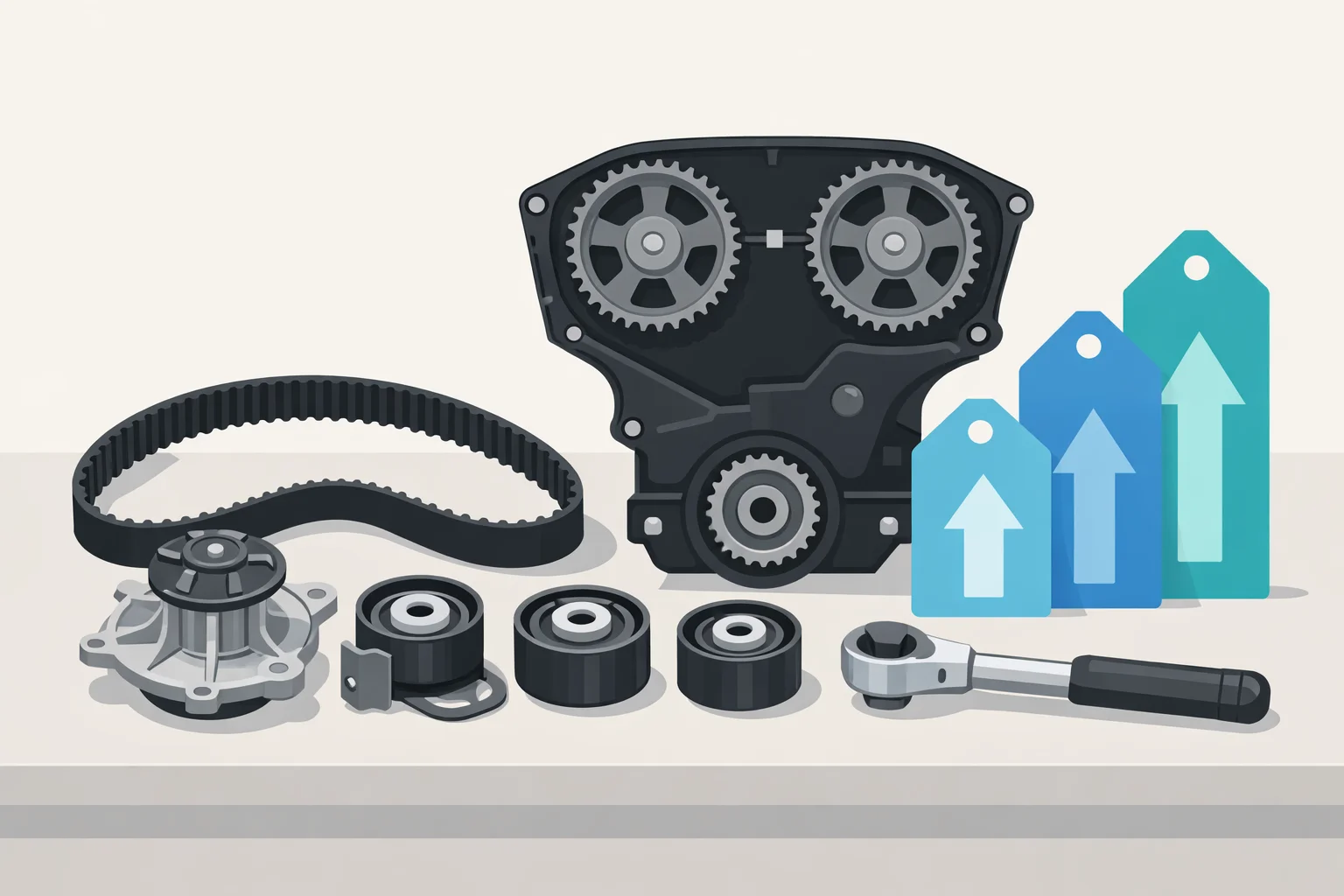
Timing Belt Replacement Cost: $592 for the Belt, $945 for the Kit That Protects the Engine
Three different jobs get sold under the words timing belt replacement, and the price you are quoted depends mostly on which one it is. On a Honda-style transverse V6 at an independent shop charging $140 an hour, the belt alone is $592, the belt with a new tensioner and idlers is $738, and the full kit with the water pump and fresh coolant is $945. The same full kit at a dealer's $175 rate is $1,113. Our timing belt replacement cost calculator above prices each version for your engine, your hours and your shop, and then does the part most quotes skip: it shows what the cheaper version costs if the part you left behind fails first.
The published averages agree on the shape of the bill. RepairPal puts a timing belt replacement at $889 to $1,291, with $589 to $865 of that in labor and $300 to $426 in parts, before tax and local pricing; its Toyota Camry estimate is $626 to $1,071 and its Tundra estimate $908 to $1,352. ConsumerAffairs (2026) lands on $887 to $1,302 and about $1,200 when the water pump goes in at the same visit. Labor is two-thirds or more of every one of those numbers, which is the whole reason the kit question matters.
Three Jobs Sold Under One Name
The belt is the cheap part. A Gates T286 for the Honda J-series V6 lists at $28.49. The kit adds the tensioner and the idler pulleys that keep the belt tight; the bearings inside them wear at the same rate as the belt, and Gates' own Timing 101 guide states that 95% of timing failures happen after only the belt was replaced. The kit with water pump adds the pump because on most belt-driven engines the timing belt drives it, so the pump lives behind the same cover and comes out for free while the belt is off. Gates' TCKWP329 kit with pump for the 2003 to 2017 Honda V6 was $228.97 at PartsGeek on September 7, 2026; Aisin's TKT-021 for the Toyota 4.7 V8 was $185.97; AutoZone's Duralast kits with pump run about $201 to $204; Aisin kits for the four-cylinder Camry $112 to $170. Subaru is the outlier, with the Gates TCKWP328 at $482 and a la carte Aisin kits at $180 to $300 plus a $45 to $80 pump.
| Engine layout | Belt only | Kit | Kit with water pump |
|---|---|---|---|
| Four-cylinder, transverseCivic and Accord 4-cyl, Camry and Corolla 4-cyl, Elantra, VW 2.0 | $4242.8 hr | $5383 hr | $7133.6 hr |
| Subaru flat-fourEJ25 and EJ20 Outback, Forester, Legacy, Impreza and WRX | $3562.2 hr | $5712.4 hr | $7683 hr |
| Transverse V6Honda J35 Accord, Odyssey, Pilot, Ridgeline; Acura MDX and TL; Toyota 1MZ Camry, Sienna, Highlander | $5924 hr | $7384.2 hr | $9454.8 hr |
| Toyota truck V6 or V82UZ-FE 4.7 Tundra, Sequoia, 4Runner, Land Cruiser, Lexus GX and LX; 5VZ-FE 3.4 Tacoma | $6504.3 hr | $7914.5 hr | $9765.1 hr |
| European four, five or six-cylinderAudi A4 and A6, VW Jetta, Passat and TDI, Volvo five-cylinders | $7264.8 hr | $9355 hr | $1,1645.6 hr |
Those parts prices are illustrative defaults from the same code that runs the calculator, not quotes for your car; the parts field exists so you can type in the line from your estimate. What the table shows is the spread that never changes: going from the belt to the full kit adds $353 on the V6 row, and about $207 of that is the pump and coolant. Read across any row and the labor is nearly identical in all three columns, because the labor is the cover coming off, not the parts going on.
The Repeat Visit Is the Whole Argument
Skip the tensioner and idlers and the risk is not a slightly shorter belt life; it is a tensioner bearing that seizes at 40,000 miles and takes a belt with it, on an engine where a broken belt can wreck the valves. Fixing that means the whole job again. RepairPal prices a tensioner replacement on its own at $483 to $695, which is the belt job's labor with a $101 to $135 part, and our calculator prices the return trip the same way: on the V6 example, the belt-only job is $592 today, and a kit job later is $738, so the worst case is $1,330 for a saving of $146.
The water pump is the same trade at a bigger scale. A belt-driven pump that starts weeping at 130,000 miles is a $945 job, because the belt has to come off to reach it and no honest shop refits a coolant-soaked belt. Our water pump replacement cost calculator prices that job from the other end, with the pump failing first and the belt kit as the option. RepairPal's standalone water pump estimate of $857 to $1,106 is that job with a different name on the invoice; ConsumerAffairs figures a pump alone takes two to six hours and that bundling it saves about $400 in labor; the shop guide from Chloe's Auto Repair (July 2026) puts the pump at $50 to $150 in parts against $300 to $500 of labor saved. In the calculator the full kit costs $207 more than the kit today and removes a $945 return visit; that is the scope table's middle row, and it is why we default to the full kit and let you argue yourself down from it rather than up to it.
Two add-ons are worth a line of their own. The cam and crank seals are exposed with the belt off; if they are weeping, a new belt will be running in oil, so we price them at $40 and half an hour. The accessory drive belts have to come off to get at the timing cover, so replacing them is minutes rather than the hour they cost on a separate visit, which is the same logic our alternator replacement cost calculator uses for the serpentine belt. Coolant is included with the pump because the system is drained to fit it; our coolant mix calculator covers what goes back in.
Labor: Two to Six Hours, and the Layout Sets It
A shop bills book time, the hours a labor guide assigns to your engine, and for timing belts that number is set by how much has to move to expose the belt. Posted times we found while researching this page: a 2009 Subaru Outback books 2.2 hours for the belt, 0.2 more for the pulleys and tensioner and 0.6 more for the water pump; a 2005 Honda Accord V6 books 4.0 hours for the belt and a 2006 Accord V6 4.8 hours with the pump; Toyota's 4.7 V8 is quoted at 5 to 7 hours billed for belt and pump because the fan, shroud and often the radiator come out first; Audi A4 owners report 4 to 6 hours quoted. The calculator uses the Subaru increments (0.2 hours for pulleys, 0.6 for the pump) to price the scopes you did not pick, and the hours field is editable for the time your shop actually books.
| Engine layout | Belt only | Kit | Kit with pump | Labor at $140 | Labor at $175 |
|---|---|---|---|---|---|
| Four-cylinder, transverse | 2.8 hr | 3 hr | 3.6 hr | $504 | $630 |
| Subaru flat-four | 2.2 hr | 2.4 hr | 3 hr | $420 | $525 |
| Transverse V6 | 4 hr | 4.2 hr | 4.8 hr | $672 | $840 |
| Toyota truck V6 or V8 | 4.3 hr | 4.5 hr | 5.1 hr | $714 | $892 |
| European four, five or six-cylinder | 4.8 hr | 5 hr | 5.6 hr | $784 | $980 |
The rate is the other half. AAA's 2026 labor-rate guide, citing the 2025 PartsTech shop survey, says almost half of U.S. repair shops charge $120 to $159 an hour and that dealers cost more, often by 25% or more; Tekmetric's 2026 index of more than 10,000 shops averages $132. Our defaults of $140 and $175 sit inside both. On a five-hour job the rate gap alone is $175, which is why the dealer's V6 full kit lands at $1,113 against the independent's $945; that matches the $1,100 to $1,600 range reported for a full Ridgeline belt service at Honda dealers. Pay the dealer rate when you want genuine parts and a labor-backed warranty on a job that is expensive to redo; pay the independent when the shop has done your engine before, because a technician learning the procedure on your car will not finish inside book time.
Interference Engines: The Belt Is Cheap, the Valves Are Not
An interference engine is one where a fully open valve reaches into the space the piston sweeps through. The two never meet while the belt keeps the camshaft and crankshaft in step; the design buys a higher compression ratio and better breathing, which is why, as the standard definition puts it, most modern production engines are built this way. When the belt breaks, the crankshaft keeps turning under the car's momentum while the cams stop, and the pistons hit whichever valves were open. AA1Car's guide describes the usual result as one or more bent intake valves and possibly a broken piston, at a repair cost of several thousand dollars; the Gates replacement guide marks these engines with an asterisk and lists the Honda J-series V6, Subaru's 2.5 SOHC, Toyota's 1MZ-FE V6 and 2UZ-FE V8, Hyundai's 2.4 and 2.7, VW's 1.8T and Ford's Zetec 2.0 among them. A few belt engines are non-interference, such as Ford's 2.3 and 2.5 Ranger fours and Chrysler's 2.4 DOHC, and on those a snapped belt is a tow and a bad afternoon.
The repair bill after a failure is the number to hold next to the belt quote. RepairPal prices a cylinder head replacement at $1,700 to $2,494 in labor plus $2,552 to $2,620 in parts; a valve job on a Subaru EJ25 is put at $2,500 to $4,000 by Vehiclebar's guide; Chloe's Auto Repair quotes $3,000 to $7,000 or more once pistons and the head are involved. We default the damage estimate to $4,500 plus a $150 tow and let you change both. The arithmetic is then simple. Replacing the belt now costs $945. Letting it break costs the same $945, because the belt still has to be replaced, plus about $4,650: $5,595 in total.
That means waiting has no upside if you are keeping the car; the belt job is owed either way and every percentage point of failure risk you accept costs about $47 in expectation. The only version of the gamble that can pay is skipping the job entirely because you plan to sell first, and it pays only while the chance of the belt failing before the sale is under 20%, which is $945 divided by $4,650. A belt at 85% of its interval on a fifteen-year-old car does not clear that bar, and a buyer who checks service records will price the missing belt job into the offer anyway. On a non-interference engine the same panel in the calculator uses only the tow, because there is nothing behind the failure but inconvenience.
When It Is Due: Miles and Years Both Count
Intervals are set by the automaker, and they differ. Honda's Maintenance Minder calls for the belt at sub-item code 4, "Replace timing belt and inspect water pump," which arrives at roughly 105,000 miles or seven years under normal use; Honda's own Odyssey maintenance document adds that in temperatures over 110 F, under -20 F, or when towing a trailer, the belt should be replaced every 60,000 miles. Subaru's schedule says 105,000 miles or 105 months, whichever comes first. The Gates guide lists 90,000 miles for Toyota's 1MZ-FE V6 and 2UZ-FE V8, 105,000 to 120,000 for VW's 1.8T depending on year, 60,000 for the Hyundai and Kia V6s of the 2000s, and 60,000 as its own suggestion wherever the automaker gives no figure. Cars.com makes the point that matters for low-mileage cars: manufacturers often pair a time limit with the mileage, because rubber ages parked as well as driven.
That is why the calculator runs two clocks. Enter the miles on the current belt and its age, and it shows which one runs out first. In the worked example, 80,000 miles and six years on a 105,000-mile, seven-year interval is 76% used by distance but 86% used by age, so the age clock is the one to watch and the job is due within a year. Spread over the interval, a $945 full kit works out to about $9 per 1,000 miles or $135 a year, which is a useful way to see it next to the tires and brakes in our car maintenance cost calculator, and next to depreciation and insurance in the total cost of ownership calculator.
Does Your Car Even Have a Timing Belt?
Many do not. Most engines designed since the late 2000s drive the cams with a chain that runs in engine oil and is meant to last the life of the car; J.D. Power notes a chain has no scheduled interval but costs $1,500 to $4,000 if it or its guides do wear out. Belts persist where the automaker chose them: Honda's single-cam J35 V6 still uses one in the Odyssey, Passport and Ridgeline through the 2026 model year, and every Ridgeline built since 2006 is a belt car; Subaru's EJ engines through the early 2010s; Toyota's 1MZ V6 and 2UZ V8 of the 1990s and 2000s; VW, Audi and Volvo fours, fives and sixes of the same era; and a long list of Hyundai, Kia, Mitsubishi and Chrysler engines. Ford's 1.0 and 1.5 EcoBoost three-cylinders use a belt that runs inside the engine oil; a UK dealer's guide to those wet belts notes Ford's 150,000-mile or ten-year interval against real-world failures between 60,000 and 100,000 miles, and the job runs far longer than a dry belt because the sump comes off, so treat that engine as its own case rather than one of the presets here.
The check is quick. The maintenance schedule in the owner's manual lists a timing belt if there is one; a chain never appears in it. Under the hood, a belt hides behind a plastic cover at the end of the engine and a chain behind a metal one that is bolted and sealed. If the previous owner's records are silent and the car is past the interval, assume the belt has never been done: a belt's condition cannot be judged by looking at the inch of it visible through the cover.
Doing It Yourself
Parts for the full kit run $170 to $330 on the layouts above, which makes the DIY version of the V6 example about $273 against $945 at the shop. The tools are the catch, not the parts: a crank pulley holder or the correct locking tool for your engine, a torque wrench for the pulley bolt (Subaru specifies 132 lb-ft), and on some engines a cam locking fixture. Vehiclebar puts an experienced first-timer at four to six hours on a Subaru. The risk is proportionate to the reward. A belt fitted one tooth off on an interference engine bends valves the first time it is started, so this is a job for someone who has followed a procedure exactly before, not a good first repair. If you are choosing between doing it yourself and paying an independent, the honest comparison is the labor line only, and the calculator shows it when you switch the shop to do it yourself.
What This Calculator Assumes
Parts prices are illustrative September 2026 retail figures for each engine layout and scope, not a lookup for your VIN; the parts field exists so you can replace them. Hours are posted-style presets by layout, with the belt-only and pump scopes offset by 0.2 and 0.6 hours from the Subaru posted times; overwrite them with your shop's book time. Rates default to $140 and $175 an hour from the AAA and Tekmetric ranges cited above. The repeat-visit column prices the whole job again at default parts and your rate, without the seals or drive belts, and assumes the skipped part fails before the next scheduled belt. Sales tax applies to parts only; some states tax labor. The interval defaults are typical for each layout and are editable, because the figure in your manual wins. The failure math treats the damage estimate as your judgment of the repair on your engine and the failure probability as yours to judge; it does not model a failure rate, because none is published per engine. Chain-driven engines are outside the tool.