
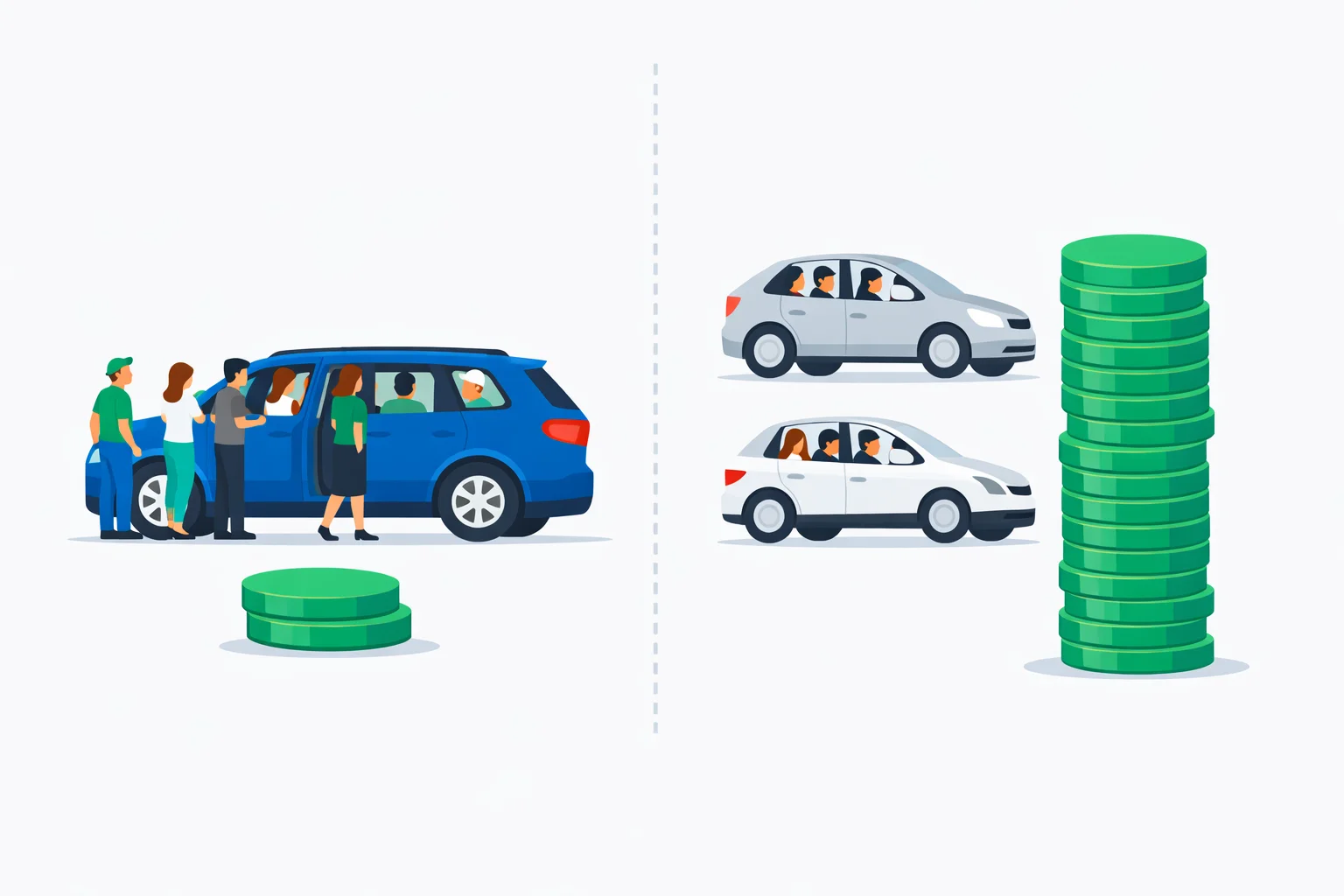
One Integer Decides Your Whole Group Ride
A group ride cost calculator only really computes one thing, and it isn't the fare. It's this:
Cars needed = riders ÷ seats per car, rounded up
Cost per person = (cars × cost per car) ÷ riders
That rounding is where all the money hides. Uber won't sell you three quarters of a vehicle. On an 8-mile cross-town run, four people in one UberX pay $17.35 all in. Add a fifth passenger and the cheapest booking becomes a single UberXL at $28.79 — so that fifth person costs the group $11.44, which is 66% of what the first four paid combined. Add a sixth and they ride for free, because the seat is already bought.
Fares move smoothly with distance. Group costs move in steps. Every calculation below comes from that one difference.
Six People, 8 Miles, Friday Night
Here's the whole thing worked through at typical US mid-market rates — 8 miles, 20 minutes, no surge, 18% tip on each fare.
Step 1 — price one car of each type. UberX bills $1.00 base + (8 mi × $0.90) + (20 min × $0.20) = $12.20 metered, plus a $2.50 booking fee, plus tip = $17.35. UberXL bills $2.00 + (8 × $1.55) + (20 × $0.35) = $21.40, plus a $3.00 booking fee, plus tip = $28.79.
Step 2 — count cars. UberX seats 4, so six riders need two of them. UberXL seats 6, so one covers the group.
Step 3 — multiply, then divide. Two UberX is $34.69. One UberXL is $28.79. The XL wins by $5.90, and the per-head number is $4.80 against $5.78.
| Booking for 6 riders | Seats bought | Total | Each |
|---|---|---|---|
| 1 × UberXL | 6 | $28.79 | $4.80 |
| 2 × UberX | 8 | $34.69 | $5.78 |
| 2 × Uber Comfort | 8 | $45.90 | $7.65 |
| 1 × Uber Black SUV | 6 | $78.71 | $13.12 |
Worth noting what the pooling itself is worth before you argue about tiers: six people taking six separate UberX rides would spend $104.08. Getting into one car costs $28.79. That's $75.28 saved, and it dwarfs every tier decision on this page.
Seven Is the Worst Number of Friends to Have
Bring one more person to that Friday night and the arithmetic turns hostile. Seven riders still need two UberX — but they now need two UberXL as well, because one XL tops out at six. Two XLs cost $57.58 against two UberX at $34.69. You're paying 66% more for five empty seats.
The rule underneath it: a bigger vehicle is only worth booking when it removes a car from the order. Express that as a threshold and you can decide any group size in your head.
UberXL wins when its price is below (UberX cars needed ÷ UberXL cars needed) × one UberX.
| Riders | UberX cars | UberXL cars | XL wins below | Verdict at a real 1.66x |
|---|---|---|---|---|
| 1 – 4 | 1 | 1 | 1.00x | UberX, always |
| 5 – 6 | 2 | 1 | 2.00x | UberXL, always |
| 7 – 8 | 2 | 2 | 1.00x | UberX, never close |
| 9 – 12 | 3 | 2 | 1.50x | UberX, unless the trip is under 2.6 mi |
| 13 – 16 | 4 | 3 | 1.33x | UberX |
| 17 – 18 | 5 | 3 | 1.67x | Dead heat — run your own numbers |
The reason a single number works as a rule of thumb is that the XL premium barely moves. We priced it across the whole realistic range and it sat between 1.60x and 1.72x — 1.60x on a 3-mile hop, 1.66x at 8 miles, 1.70x at 20 miles, 1.72x at 50. Surge doesn't rescue it either; at 2.5x the premium drifts up to 1.71x, because surge multiplies the bigger metered fare by the same amount. Only below about 2.5 miles does the ratio collapse to 1.33x, and that's purely because both tiers land on their minimum fares.
Read the table once and the 5–6 row is the only unconditional “go big.” Everywhere else the smaller car wins or it's close enough to check. If you want the same trip priced on the other app first, our Uber vs Lyft price comparison calculator runs both rate cards side by side.
The 9-Person Booking Nobody Makes
Nine riders is where the app actively leads people wrong, because it asks you to pick one tier and then books however many of that tier you need. Nine people gives you three obvious-looking choices and one that isn't on the menu:
- Three UberX — $52.04. Twelve seats bought to move nine people.
- Two UberXL — $57.58. Also twelve seats, and $5.54 more expensive.
- One UberXL plus one UberX — $46.14. Ten seats, two cars, and $5.90 cheaper than the best uniform option.
That mixed booking works out to $5.13 a head instead of $5.78, and it needs one fewer driver than the three-car version — which matters more than the money when nine people are standing outside a restaurant at 11pm. The calculator above tests mixed fleets automatically and only surfaces one when it actually beats both pure options. You book it by sending two separate requests rather than one.
Group Size Isn't What Sets Your Per-Person Cost
Here's the result that reframes the whole problem. On our 8-mile trip, price the per-person cost for every group that fills its cars exactly:
- 4 riders, 1 full UberX — $4.34 each
- 8 riders, 2 full UberX — $4.34 each
- 12 riders, 3 full UberX — $4.34 each
- 16 riders, 4 full UberX — $4.34 each
Identical, to the cent. Per-person cost doesn't depend on how big your group is — it depends entirely on how full the cars are. A group of 16 pays exactly what a group of 4 pays. A group of 5 pays $5.76 because one seat rides empty in an XL, and a group of 7 pays $4.96 because they left one seat spare across two cars.
Which flips the practical advice. Don't hunt for the cheaper tier — the tier decision is worth $5.90 on a six-person night. Fill the seats instead. If your group is at five and someone's undecided, inviting them costs literally nothing: the XL is already booked, and the per-head figure drops from $5.76 to $4.80 for everybody. That is the only situation in transport where an extra passenger makes the trip cheaper for the people already in the car.
A full car is also rarer than it sounds. The federal National Household Travel Survey has found for decades that the average American car trip carries well under two people, which is exactly why a six-person UberXL at $4.80 a head undercuts almost any other way of crossing town. You're not beating Uber's pricing — you're beating the empty seats everyone else is paying for.
One input can quietly reverse a verdict, though: how you tip. Tip 18% and two UberX cost $5.90 more than one XL. Switch to a flat $5 per driver — which plenty of people do on short rides — and the gap widens to $10.00, because a flat tip scales with the number of drivers rather than the size of the fare. Toggle the tip method in the calculator and watch every multi-car option get worse. Our Uber tip calculator works out what's reasonable per driver before you commit to a method.
When You Should Ignore All of This
Cheapest isn't always bookable. Four situations break the model above, and three of them are capacity problems wearing a pricing costume:
- Anyone under about 8 years old. A seat is a seat belt — NHTSA is unambiguous that every passenger needs their own restraint, and a booster or car seat consumes a seat without adding a payer. Six adults and one toddler is a 7-seat problem, not a 6-seat one.
- Airport runs with luggage. UberXL's six seats assume six people and hand baggage. Six checked bags do not fit, and a driver can refuse the trip at the curb, which costs you a cancellation fee on top of the fare. Two UberX with a trunk each is often the only workable booking regardless of the $5.90.
- Different destinations. Multi-stop rides bill wait time at every stop and the whole group pays for the longest leg. Two separate rides going two places usually beats one ride going both, and this calculator assumes a single shared destination.
- Rides you book in advance. Reserve charges a reservation fee per car, so a two-car group pays it twice — a detail that pushes several of the rows above back toward the single-vehicle option. Price that separately with our scheduled Uber fare calculator.
Two more caveats on the numbers themselves. Every rate here is a typical US mid-market card, and both companies set prices city by city — Lyft's help centre says so plainly, and your own quote always beats our defaults. And UberX seats four in most markets but only three in a handful of them, which quietly turns every threshold in that table into a different number. Check the seat count in the app before you plan around a group of five. If you only need one car and want the fare itself broken down, the Uber fare calculator handles the single-vehicle case in more detail.