
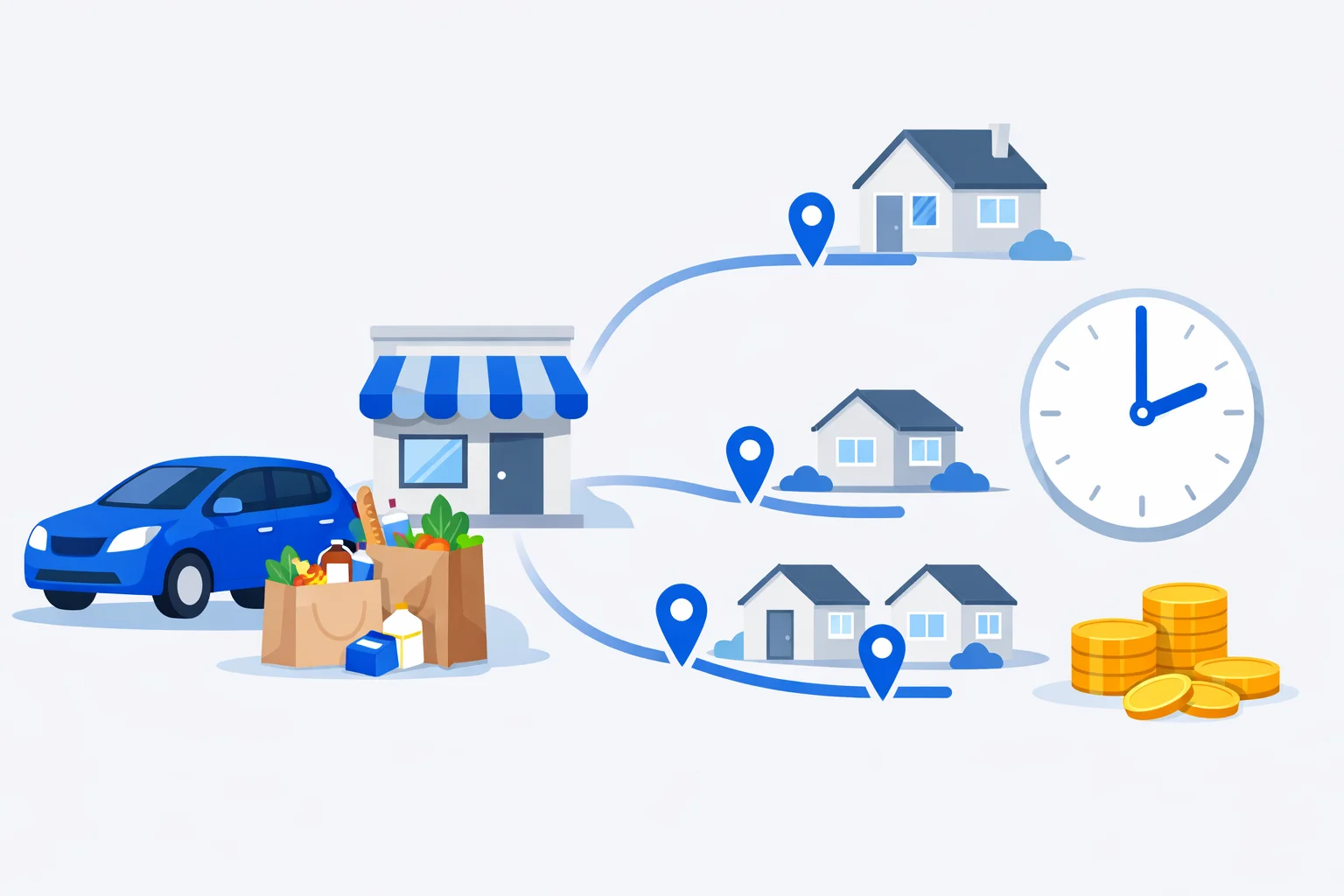
A bigger Spark offer isn't automatically a better hour
Our Spark driver pay calculator measures earnings from a complete trip, but a trip can contain several customer orders. Three drop-offs don't mean three separate offer payments. In our illustrative comparison, an $18 single-drop payout earns $18 per hour after vehicle costs, while a $28 batch earns $16.50. The larger payout takes longer and travels farther.
We compare the full working cycle: reaching pickup, loading or shopping, delivering, waiting and returning to a useful working location. That answers a different question from dollars per customer. All prices and times below are hypothetical inputs, not a survey of Walmart Spark driver earnings or a promised local wage.
Spark's offer-type guidance distinguishes single offers from batches containing two or more customer orders in one trip. Round-robin describes how an offer reaches a driver; it isn't a pay multiplier. Shopping offers also require store work before delivery, so don't assign them the same time budget as a ready-to-load curbside pickup.
Count the route once, then divide by the clock
Net hourly pay = [trip pay + tips + earned incentive − (route miles + return miles) × vehicle cost per mile] × 60 ÷ total work minutes. Customer count only divides the per-order result. It never multiplies trip pay, mileage or the incentive. Our Spark driver pay calculator applies that same equation to both offers.
Route A pays $12 plus $6 total tips. Eight miles through the last drop and two return miles cost $3 at $0.30 per mile. Its 35 work minutes, ten waiting minutes and five return minutes total 50. Keeping $15 over 50 minutes produces $18/hour, before taxes.
Route B pays $18 plus $10 total tips for three customer orders. Fourteen route miles plus six return miles cost $6. It takes 55 work minutes, 15 waiting minutes and ten return minutes: 80 in total. The $22 net equals $16.50/hour and $7.33 per customer order.
| Complete trip | Single drop | Three-order batch |
|---|---|---|
| Gross / vehicle cost | $18 / $3 | $28 / $6 |
| Net / complete minutes | $15 / 50 | $22 / 80 |
| Net hourly pay | $18.00 | $16.50 |
| Projected net over 20 hours | $360 | $330 |
The batch needs $2 more total pay to tie: $18/hour × 80/60 hours + $6 costs = $30 gross. That threshold assumes no extra work. Another customer requiring ten minutes changes the equation. For delivery blocks sold as a scheduled period, use our Amazon Flex pay calculator instead.
The loading bay can reverse the winner
Add 15 waiting minutes to each trip while holding payout and miles fixed. Route A falls to $15 ÷ 65 × 60 = $13.85/hour. Route B becomes $22 ÷ 95 × 60 = $13.89/hour. The batch now leads slightly because the same fixed delay consumes a larger share of the shorter trip.
That's a reason to record store-specific loading delays. It isn't evidence that batches always win. A long apartment drop-off, substitutions on a shopping offer, or a return to a distant store can reverse the result again. Count actual between-offer waiting once; don't charge the same idle period to two adjacent trips.
Return mileage also has a measurable price. Omitting Route B's six return miles understates costs by $1.80. Omitting its ten return minutes as well makes the route look like $20.40/hour instead of $16.50. Neither omission changes your bank deposit, but together they overstate the value of your working hour by $3.90.
Keep the incentive attached to the qualifying trip
Spark's incentive guidance describes per-trip, standard and tiered opportunities with specific eligibility conditions. A per-trip incentive applies to a qualifying trip, not automatically to every customer stop within it. Check the offer's qualification and completion rules before assigning any bonus to its earnings.
Suppose a qualifying three-order batch earns a $5 trip incentive. Add $5 once. Multiplying it by three invents $10, overstating our 80-minute batch's hourly net by $7.50. For a completed multi-trip bonus, allocate the earned amount across its qualifying trips once. A tier's cumulative total isn't another payment to stack on top of all earlier tiers.
Leave an unfinished promotion out of settled earnings. If the final qualifying trip is still ahead, compare the remaining work and the incremental bonus as a separate decision. Restaurant-delivery promotions need their own inputs; our DoorDash pay calculator keeps that alternative available without assuming Spark incentives transfer between apps.
Check the receipt after the offer screen
According to Spark's current tip guidance, confirmed tips belong entirely to the driver and generally process within 24 hours. Customers can reduce a pre-tip for up to three hours after completion and add or increase it for up to 24 hours. Those are different windows. We checked this guidance on September 6, 2026.
For a completed trip, use confirmed earnings. For an offer, compare the displayed tip scenario with zero. Removing tips from our examples reduces Route A to $10.80/hour and Route B to $9/hour. Don't add a displayed total that already contains tips to the same tips again.
Reconciliation has a concrete history here. In February 2026, the FTC announced a $100 million Walmart judgment settling allegations about misleading Spark earnings claims. Keep the offer details, trip receipt and final earnings breakdown together. A historical settlement doesn't establish today's pay for your route; your own records establish what was offered and received.
Fuel is only part of the delivery bill
At $3.60 per US gallon and 30 MPG, fuel costs $0.12 per mile. Our hypothetical $0.30 allowance adds $0.18 for other vehicle costs. Build your own allowance from charging or fuel, maintenance, depreciation and allocated vehicle expenses. Use the fuel cost calculator to isolate the fuel portion. Separate tolls and parking need additional accounting beyond this tool.
This operating-cost allowance isn't a tax deduction. The IRS business-use-of-car guidance describes distinct actual-expense and standard-mileage methods. Don't subtract both here. Our weekly projection also excludes taxes and local earnings adjustments; the rideshare quarterly tax calculator covers a separate planning step. Twenty projected hours assume repeated route economics, not guaranteed order availability.