
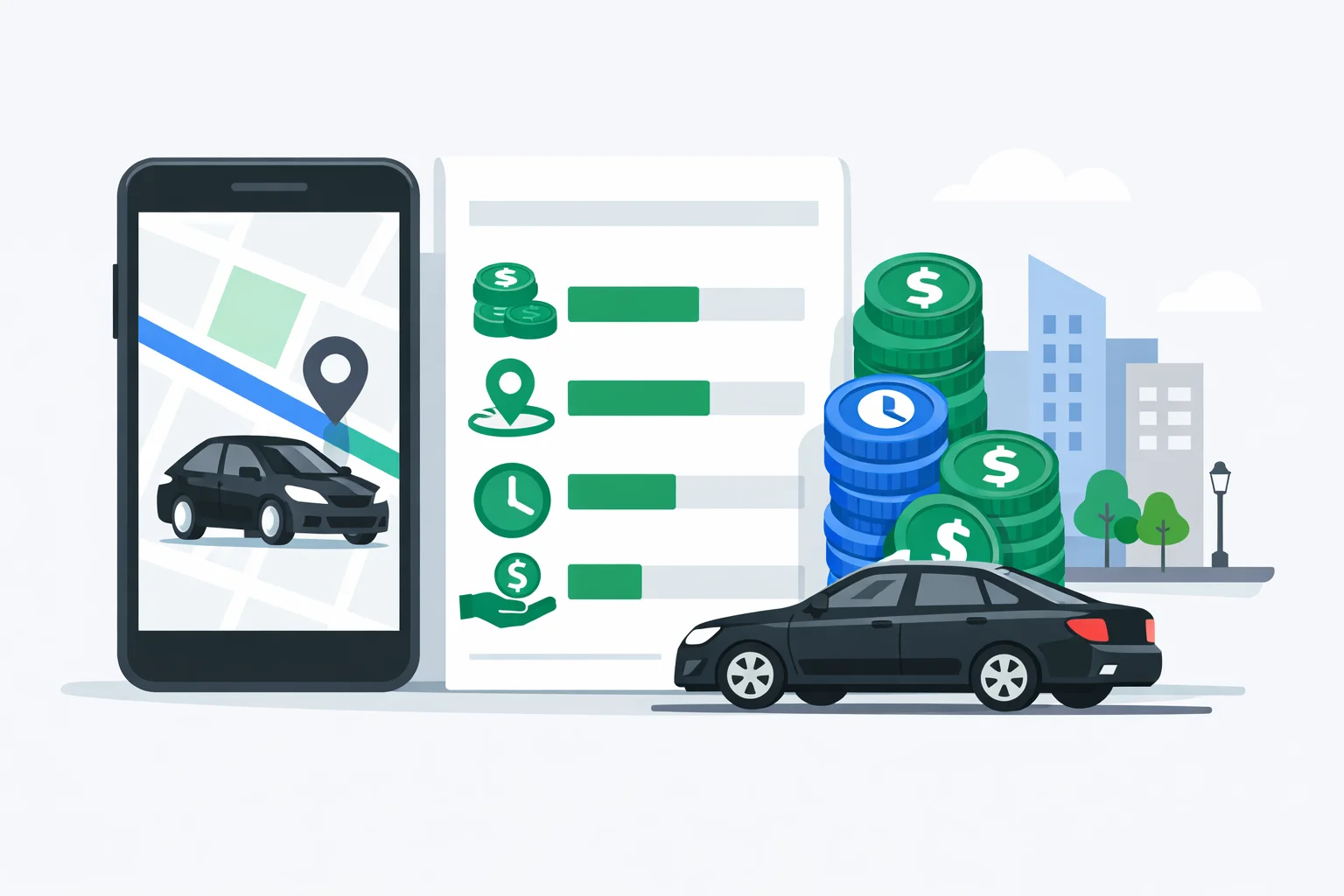
That $20 Uber Ride Is Really Six Charges Stacked Together
Our Uber fare calculator splits any ride into the six charges that actually make up the price — base fare, distance, time, the booking fee, surge, and your tip — so you can see where every dollar goes instead of staring at one mystery total. Uber shows you a single upfront number and hides the math behind it. That's fine until the price looks high and you have no idea which part to blame. This tool reverse-engineers the receipt for you, and the rest of this page explains how to read it.
We'll walk a real 10-mile UberX trip down to the cent, show you how much of your fare your driver actually keeps, explain why surge doesn't hit the whole bill, and flag the three situations where any fare estimate — ours or anyone else's — will miss.
Reading the Receipt: A 10-Mile UberX Trip, Line by Line
Picture a standard UberX ride: 10 miles, about 25 minutes in normal traffic, no surge. Using U.S. national-average rates ($1.00 base, $0.90 per mile, $0.20 per minute, $2.50 booking fee), here's how the fare builds up — and why the total lands at $17.50 before you tip.
| Charge | How it's calculated | Amount |
|---|---|---|
| Base fare | Flat per ride | $1.00 |
| Distance | 10 mi × $0.90 | $9.00 |
| Time | 25 min × $0.20 | $5.00 |
| Booking fee | Flat, goes to Uber | $2.50 |
| Trip fare | Subtotal before tip | $17.50 |
| Tip (18%) | 18% × $17.50 | $3.15 |
| Total you pay | Trip fare + tip | $20.65 |
Notice that distance ($9.00) and time ($5.00) do the heavy lifting — together they're 80% of the trip fare. The base fare and booking fee are fixed costs you pay on every ride no matter how short. That's why a 2-mile hop can feel overpriced: a $4–5 ride is mostly fixed fees, not mileage. Switch the ride type to Uber Comfort or UberXL in the calculator and the per-mile rate jumps to $1.20 or $1.55, which is where the 20–40% price gap between tiers comes from. That XL premium lands at roughly 1.66x a single UberX, so it only pays off when the bigger car removes a whole vehicle from your booking — our group ride cost calculator works out which party sizes clear that bar.
Where Each Dollar of Your $17.50 Fare Actually Goes
Here's the part Uber doesn't put on your receipt: the split between your driver and the company. On that $17.50 trip fare, the driver typically keeps around 70% of the metered portion — roughly $10.50 — while Uber takes its service fee plus the full $2.50 booking fee. Your tip is the cleanest part of the transaction: 100% of it goes to the driver, with no cut taken. Add an 18% tip and the driver's take climbs from about $10.50 to $13.65, while Uber's share stays flat near $7.00.
This is why tipping moves the needle for drivers far more than it costs you. Rounding a $3.15 tip up to $5.00 adds $1.85 to your bill but a full $1.85 to the driver's pocket — our Uber tip calculator does that rounding for you. If you ride the same commute twice a day, that's the difference between a driver earning minimum wage and earning a living on your route. The U.S. Bureau of Labor Statistics tracks driver wage data that shows just how thin those margins run.
The Surge Multiplier Doesn't Hit Your Whole Fare
Most riders assume a 1.8x surge means the entire bill is 1.8 times higher. It doesn't. The multiplier applies to the time-and-distance portion of the fare — not flat charges like the booking fee. On our 10-mile example, the metered portion is $15.00 ($1.00 base + $9.00 distance + $5.00 time). At 1.8x, that becomes $27.00, a $12.00 surge premium. Add the un-surged $2.50 booking fee and your trip fare is $29.50 — not the $31.50 you'd get if surge multiplied everything.
That $2.00 gap is small on one ride but reveals the bigger lesson: surge is a tax on movement, so the longer and slower your trip, the more a multiplier stings. A 2.5x surge on a quick 2-mile ride might add $4; the same multiplier on a 20-mile airport run can tack on $40 or more. Use the surge slider in the calculator before you book during rush hour or after a concert — if the premium looks brutal, waiting 10 minutes for the multiplier to fall is often the single best money move you can make. And when you know about the trip in advance — a 5am airport run, say — you can sidestep the multiplier entirely by locking tonight's rate. Our scheduled Uber fare calculator works out the exact surge level at which paying Uber Reserve's reservation fee beats hailing on demand.
When This Fare Calculator Will Be Wrong
No fare estimator is perfect, and it's more honest to tell you where this one breaks down. First, city rates vary widely. New York and San Francisco run 15–25% above the national averages we use, while smaller markets can be 10–15% below. Second, Uber's upfront pricing isn't always a pure time-and-distance formula anymore — the company factors in route demand and your specific pickup zone, so two riders on the same street can see different prices. Third, airport trips carry surcharges ($2.50–$5.00 at many hubs) that you have to add manually in the tolls field.
Fourth, and easiest to forget: a fare estimate assumes the ride actually happens. Cancel after the two-minute free window and you owe a flat $5 on UberX with no miles driven, and if the driver already reached your curb the wait meter adds about 40 cents a minute on top. Our rideshare cancellation fee calculator prices that scenario, since none of it appears in a time-and-distance formula.
Treat the result as a tight ballpark, not a quote. For a true side-by-side of every Uber tier on one trip, switch over to our Uber ride estimate, and if you want to check whether the other app is cheaper that night, put both head to head with our Uber vs Lyft price comparison before you commit. To see how this stacks up against a traditional metered cab on the same route, run our taxi fare calculator. For a deeper look at how ride-hailing fares compare with metered cabs, Investopedia's breakdown of Uber versus yellow cabs is a useful primer.