What does rideshare insurance add to your budget?
The added cost is the difference between your existing personal premium and the full premium with rideshare coverage. An endorsement quote may list only the extra charge; a replacement policy quote usually lists the whole policy. Compare the same coverage and the same length of time before deciding which is cheaper.
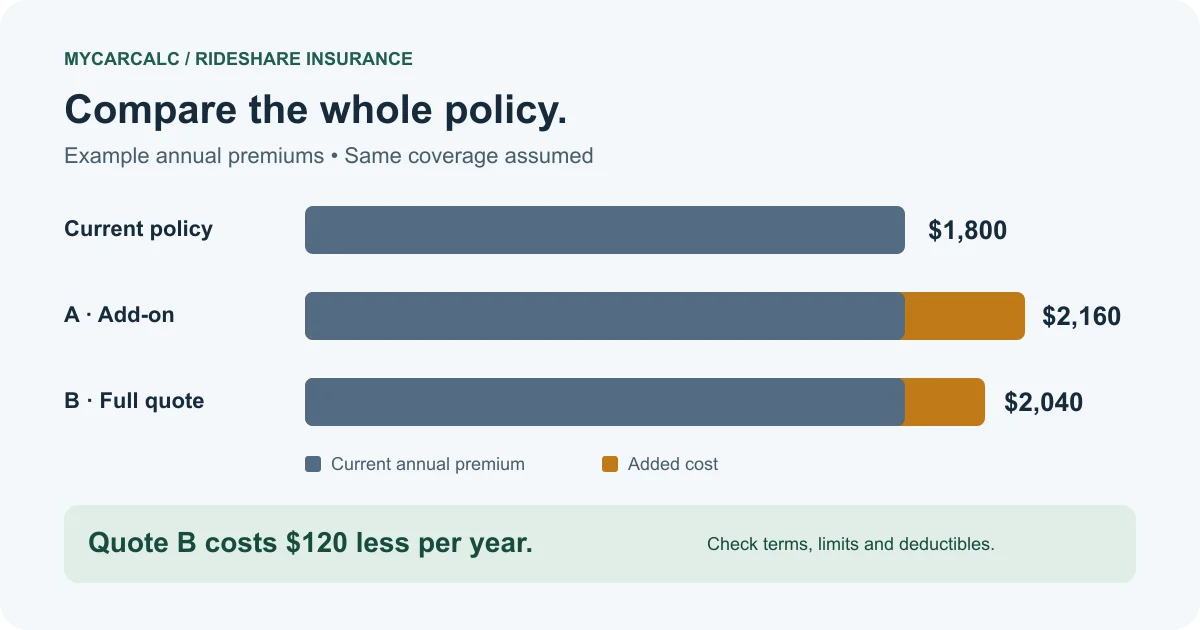
For example, a $30 monthly add-on costs $360 over a year. But switching from a $150 monthly personal policy to a $170 monthly policy that includes rideshare adds only $240 a year. The second option is $120 cheaper annually, assuming comparable coverage. The calculator above handles both quote formats without adding your old premium to a replacement policy.
These are invented prices for a worked example, not typical Uber or Lyft insurance rates. A written quote for your vehicle, drivers, location and intended work is the useful starting point. A price comparison cannot tell you whether an exclusion applies to a particular accident.
The app stage matters as much as the premium
For U.S. passenger rideshare, separate personal driving, waiting for a request, and the period after accepting one. A car with no passenger may already be on an accepted trip. That makes “before pickup” too broad a description of the coverage gap.
01 · App off
Personal driving
Review your personal policy.
02 · Online, waiting
Before accepting a request
Check vehicle damage coverage here.
03 · Request accepted
Pickup journey and ride
Check platform conditions and deductible.
Uber’s U.S. rideshare insurance page says it maintains third-party liability while a driver is online and waiting, but no Uber-maintained comprehensive or collision coverage at that stage. After accepting a request, vehicle-damage coverage depends on carrying comprehensive and collision on the personal policy; the listed deductible for a qualifying personally owned vehicle is $2,500. Liability for damage to others and a deductible for damage to your own car are different things.
Lyft’s insurance guidance also separates waiting from pickup and the ride. It lists contingent comprehensive and collision after acceptance, subject to having those coverages personally, with a $2,500 deductible. Its regional exceptions and separate rental-program terms matter. A platform overview is not a substitute for the certificate and policy that apply to your location and vehicle.
These summaries were checked September 6, 2026. This page addresses U.S. passenger-rideshare budgeting with a personally owned vehicle. Delivery, commercially licensed services and rental programs need their own coverage review.
Compare two quotes without double counting
Use this sequence with the premium documents in front of you:
- Enter the current personal premium. In this example it is $900 for six months, equivalent to $1,800 a year. Include recurring fees consistently across every quote.
- Identify what each quote includes. Quote A is a $180 add-on for six months. Quote B is a $2,040 full annual policy that includes rideshare.
- Use the full period. A $90 charge covering the three months remaining before renewal is not a six-month endorsement price. Ask for the full renewal premium.
- Enter realistic work. Twenty hours and 400 miles each working week, for 48 weeks, produce 960 hours and 19,200 miles a year.
Quote A totals $2,160.00 a year, or $360.00 more than the current policy. The added $30.00 per calendar month becomes $0.38 per working hour and $0.019 per mile after display rounding.
Quote B totals $2,040.00 a year, adding $240.00 annually. Its added cost is $0.25 per working hour and $0.013 per mile. It leaves $120.00 more in the annual budget than Quote A, before considering any differences in coverage.
Use the full policy amount when budgeting all vehicle expenses. Use the added amount when asking what changes because you start rideshare driving. The Uber and Lyft driver earnings calculator accepts a monthly insurance expense. If insurance is already included in another vehicle-cost allowance, avoid deducting it twice.
How the calculations work
Annual premium = quoted premium × 12 ÷ months in the quoted period.
Full annual cost = annualized add-on + current annual premium; for a full replacement quote, use its annual premium directly.
Added annual cost = full annual cost − current annual premium.
Added hourly cost = added annual cost ÷ (weekly working hours × working weeks).
Added mileage cost = added annual cost ÷ (weekly rideshare miles × working weeks).
Dividing by 12 gives a monthly budget equivalent, not a prediction of installments or a renewal price. Calculations keep full precision until display. Currency rounds to cents, except per-mile costs, which use three decimals because insurance can add only a few cents per mile.
Reducing the example to 24 working weeks doubles Quote A’s hourly allocation from $0.375 to $0.75. It does not halve the premium. The model assumes insurance stays in force all year at the entered rate. It does not calculate seasonal cancellations, refunds, temporary coverage or installment discounts.
A replacement quote below your existing premium produces a negative added cost: $1,500 a year against $1,800 means $300 in annual savings. Zero work hours or miles produces N/A for the corresponding unit cost; the annual policy expense still exists. The allocation is a budgeting measure, not an insurer’s rating formula or a tax deduction.
Check these details before choosing the lower quote
Progressive’s rideshare coverage description illustrates why endorsements differ. It extends selected personal coverages while waiting for a request and describes reimbursement of the difference between the platform deductible and the personal deductible. Those benefits depend on its policy terms; do not assume every endorsement includes them.
- Tell the insurer what work you do. Specify each passenger and delivery app, your vehicle and where you operate. Ask for written confirmation that the offered policy covers that use.
- Match limits and coverages. A lower premium with less liability coverage or no collision is not an equivalent quote. Check waiting-stage vehicle damage specifically.
- Ask about deductibles and reimbursement. Confirm eligible claims, any reimbursement limit and whether you must pay first. A reimbursement benefit is different from an immediately lower deductible.
- Budget for downtime separately. Ask whether rental reimbursement permits rideshare use, and whether any benefit replaces lost earnings. Neither is included in this calculator.
- Check the effective dates and fees. Make sure the quote covers the intended work from the date it begins. This calculator excludes one-time switching costs and cancellation adjustments.
The car insurance deductible calculator can help compare a premium saving with a larger claim payment. A deductible is only one part of risk: an excluded loss is not capped at the deductible. The general car insurance cost estimator addresses personal-policy budgeting; actual quotes should drive this rideshare comparison.