
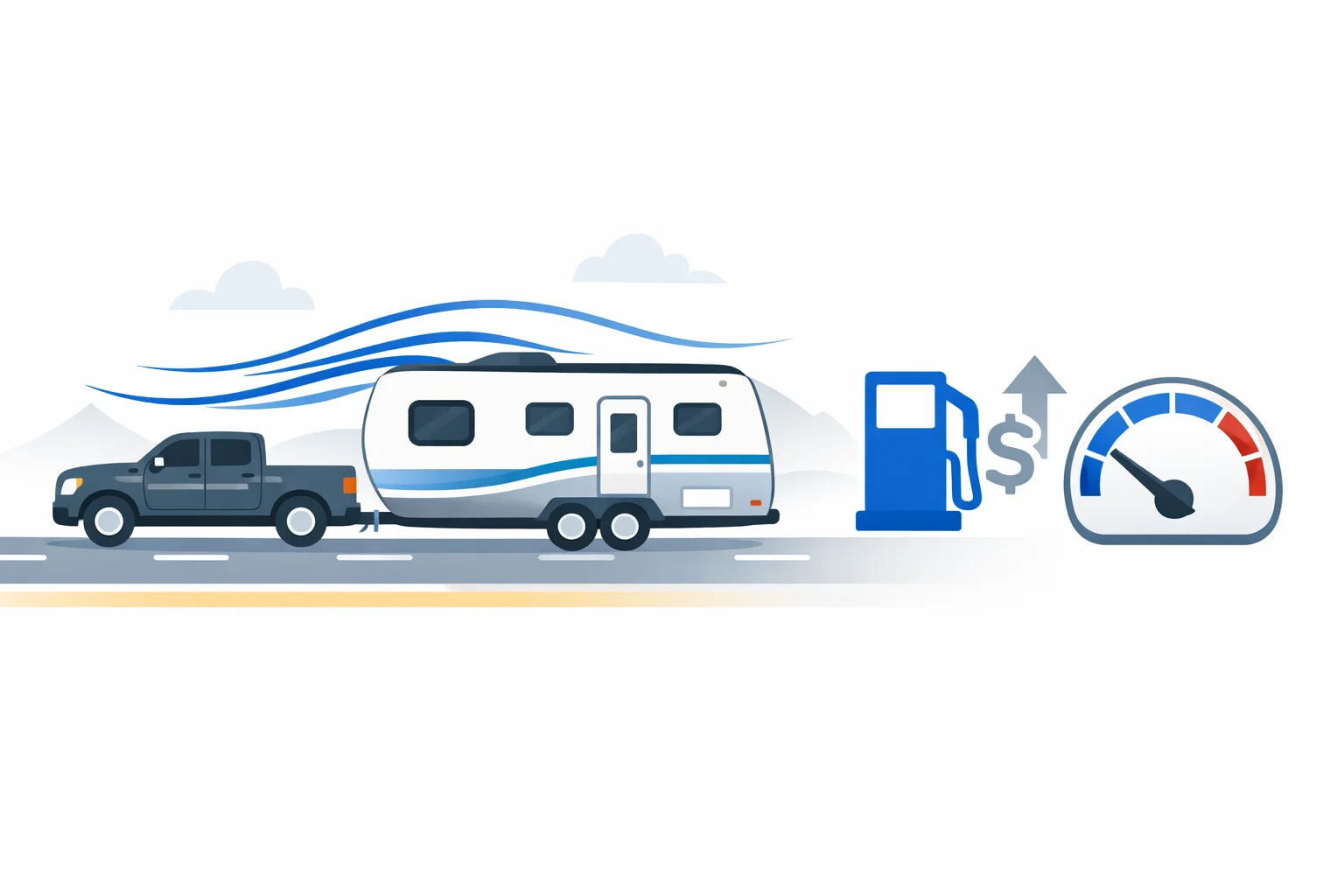
How Much MPG Towing Really Costs You Per Trip
A towing fuel cost calculator exists because the honest answer catches people off guard. Hitch a 6,000 lb travel trailer to a half-ton pickup that returns 20 MPG empty, and you don't settle at 15 — you land at 10.6 MPG. The 500-mile run to the lake that costs $84 in fuel unhitched costs $167 behind the trailer. Towing doesn't make your fuel bill worse. It roughly doubles it.
Here's the part almost nobody gets right, and it's why we built the tool above to split the penalty rather than just quote a number. At 62 mph behind that trailer, 66% of your extra fuel goes into pushing air and only 34% into hauling the weight. So the lever most people reach for first — leaving gear at home — is the weaker of the two.
The 500-Mile Trip That Costs $167 Instead of $84
Take a common setup: a half-ton crew cab that averages 20 MPG on the highway empty, pulling a travel trailer loaded to 6,000 lb. Five hundred miles of flat interstate, 62 mph, fuel at $3.55, a 26-gallon tank. Note the word loaded — water, propane, batteries and gear routinely add 800 to 1,500 lb over the dry weight on the brochure, and that's the number the trailer actually weighs when you're rolling.
| Same truck, same road | Unhitched | Towing 6,000 lb |
|---|---|---|
| MPG at 62 mph | 21.1 | 10.6 |
| Gallons for 500 miles | 23.7 | 47.1 |
| Fuel cost at $3.55/gal | $84 | $167 |
| Cost per mile | $0.17 | $0.33 |
| Range on one tank | 466 mi | 235 mi |
The $83 towing premium is the number worth budgeting. The 235-mile range is the number worth planning around — a trip you'd normally do on a single tank now needs two stops, at stations with pull-through lanes you can actually get a trailer into. And before any of this matters, confirm the truck is rated for the load with our towing capacity calculator and check what's left for cargo using the trailer payload calculator.
Your Trailer's Shape Costs More Than Its Weight
This is the finding that changes how you pack. We ran four trailers at an identical 4,000 lb behind the same half-ton at 62 mph, over the same 500 miles. Only the profile changed.
| All exactly 4,000 lb | Towing MPG | 500-mi fuel | Air's share |
|---|---|---|---|
| Open utility / flatbed | 15.6 | $114 | 33% |
| Boat on trailer | 14.4 | $123 | 50% |
| Enclosed cargo trailer | 12.1 | $147 | 70% |
| Travel trailer | 11.2 | $158 | 74% |
Same weight, 4.4 MPG apart, $44 apart on one trip. Now run it the other way. Keep the travel trailer and add weight: 3,000 lb gives 11.6 MPG, 6,000 lb gives 10.6, and 9,000 lb still returns 9.8. Tripling the weight costs 1.8 MPG. Changing the shape at fixed weight costs 4.4.
The physics is straightforward once you see it. Rolling resistance rises in a straight line with weight, and it's a small coefficient — roughly 1.3% of the trailer's weight as drag force. Aerodynamic drag rises with frontal area and with the square of speed. A tall box trailer adds around 1.45 m² of effective drag area to the rig; an open utility trailer tucked in the truck's wake adds about 0.25 m². At 62 mph the air wins that argument decisively.
MPG Loss by Trailer Type: What to Expect Before You Hitch Up
Typical rigs, flat highway at 62 mph. Half-ton figures assume a truck that returns 20 MPG empty at 65 mph; the heavy-duty rows assume 18. Use these as a starting sanity check, then run your own weight and route through the calculator above.
| Trailer type | Loaded weight | Tow vehicle | Towing MPG | MPG lost |
|---|---|---|---|---|
| Open utility / flatbed | 2,000 lb | Half-ton | 17.1 | 19% |
| Pop-up camper (closed) | 2,500 lb | Half-ton | 14.1 | 33% |
| Boat on trailer | 4,500 lb | Half-ton | 14.1 | 33% |
| Enclosed cargo trailer | 5,000 lb | Half-ton | 11.7 | 45% |
| Travel trailer | 6,500 lb | Half-ton | 10.5 | 50% |
| Horse trailer (2-horse) | 7,000 lb | 3/4-ton | 10.9 | 43% |
| Fifth wheel / toy hauler | 12,000 lb | 3/4-ton | 8.4 | 56% |
Look at rows two and three. A closed pop-up at 2,500 lb and a boat at 4,500 lb land on the same 14.1 MPG — the pop-up weighs 2,000 lb less and gives it all back in height. That single comparison is the whole lesson of this page.
If the trailer behind you is a boat, the tow is the cheap half of the day. A 120-mile round trip to the ramp costs about $10 in extra diesel, while a 250 hp outboard burns roughly 12.3 gallons an hour once you launch — near $387 for a six-hour outing at marina prices. Run that side through the boat fuel cost calculator and add the two together before you budget the weekend. And if the trailer is a travel trailer headed for a week of campgrounds, fuel is only the first line of the budget — our RV trip cost calculator stacks the towing fuel on top of campsite nights, food and propane, then compares the total to doing the same trip with a car and hotels.
Slowing Down Is Worth $70 on a 1,200-Mile Vacation
Because drag scales with the square of speed and a trailer roughly doubles the area you're pushing, cruising speed moves your towing fuel bill more than any other choice you make on the day. Here's the same 6,000 lb travel trailer over a 1,200-mile round trip at $3.55/gal.
| Cruising speed | Towing MPG | Fuel for 1,200 mi |
|---|---|---|
| 55 mph | 12.1 | $353 |
| 60 mph | 11.0 | $387 |
| 65 mph | 10.1 | $423 |
| 70 mph | 9.2 | $462 |
| 75 mph | 8.5 | $502 |
Backing off from 65 to 55 saves $70 and costs you about three and a half extra hours behind the wheel — roughly $21 an hour, which you can decide for yourself is worth it or not. The spread from 55 to 75 is $149 on one vacation. The DOE's fuel economy driving-habits data shows the same curve for unloaded cars; towing simply steepens it.
There's a safety argument stacked on top of the money one. Most special-trailer (ST) tires carry a 65 mph speed rating, and heat is what kills them. If you're budgeting a full holiday rather than one leg, our road trip cost calculator adds lodging, food and tolls on top of the fuel figure you get here.
Where These Numbers Come From
Most towing estimates online apply a flat percentage — “expect to lose 30%” — which is why they can't tell a boat from a box. We model the resistive force your engine actually has to overcome at cruising speed instead:
Force = (Crr × weight × g) + (½ × air density × drag area × speed²)
MPG towing = MPG unhitched × (Force unhitched ÷ Force towing)0.85
The trailer adds to both terms: its weight to the rolling-resistance term, its frontal area to the drag term. The 0.85 exponent is a load correction — engines run at better thermal efficiency under heavy load than at light cruise, so the fuel penalty lands below the raw force ratio. Without it, the model predicts 8.7 MPG for our test rig instead of 10.6, and real owners of half-tons pulling 6,000 lb consistently report 9 to 11. Your entered MPG is anchored to unhitched cruising at 65 mph, which is why the calculator shows 21.1 rather than 20 when you slow to 62.
What Hills Do to the Math
Grades punish a towing rig far harder than an empty truck, because you carry the extra mass up and then brake most of that energy away coming down. Take a 7,000 lb travel trailer over 500 miles: flat interstate returns 10.3 MPG and $172 of fuel, rolling hills drop it to 9.6 MPG and $185, and sustained mountain grades give 8.6 MPG and $206. On that mountain route, terrain alone accounts for 23% of your towing penalty — nearly as much as the trailer's weight. The EPA's list of factors that affect fuel economy ranks load and terrain alongside speed for exactly this reason.
When This Calculator Won't Match Your Trip Computer
We'd rather tell you where the model breaks than let you trust it blindly. Skip it, or treat the output as a floor, in these cases:
- Real wind. Drag depends on airspeed, not ground speed. A 15 mph headwind at 62 mph means the trailer sees 77 mph of air — a 54% jump in drag force that no still-air model catches. Crosswinds cost you too, through steering correction and trailer sway.
- Stop-and-go towing. The math describes steady highway cruise. Launching 9,000 lb from every red light burns fuel that never appears in a drag equation, and long waits at ramps and scales add up — see our idling fuel cost calculator for that slice.
- Towing with an EV. The percentage range hit is similar, but the output here is gallons and dollars per gallon. Price electric miles with the EV charging cost calculator instead.
- Diesel consumables. Heavy towing drives up diesel exhaust fluid use well beyond the usual 2-3% dose rate, and that's a separate line item — our DEF cost calculator covers it. If you're still choosing a tow vehicle, the diesel vs gas cost calculator weighs the fuel-price and efficiency trade.
- A rental box truck, not a pickup. The percentages here start from a tow vehicle's unladen highway MPG. A 26-foot moving truck starts at 10 mpg empty and loses about a quarter of that to its own cargo before a dolly is even hitched — the moving truck fuel cost calculator models the load penalty and the car carrier together.
- Sizing a truck or a trailer. This tool tells you what a trip costs, not what you're allowed to pull. Ratings, tongue weight and payload are a different question — and if you're shopping, an RV's depreciation curve will dwarf its fuel bill.