
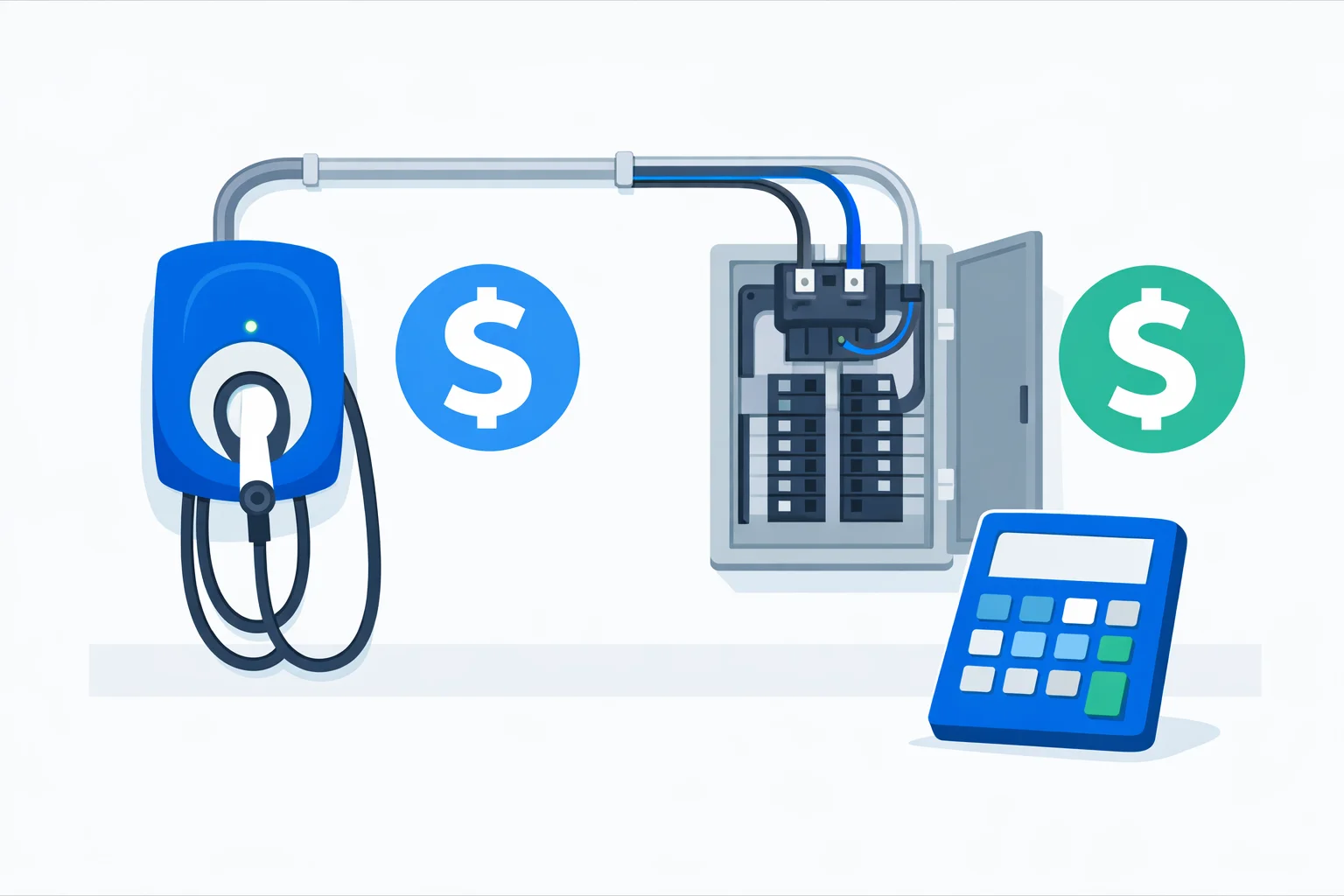
Two electricians walked through the same garage last spring and quoted $900 and $4,200 for the same Level 2 charger. Neither was cheating anyone. The first planned to run 8 AWG cable 18 feet along an open joist bay into a 200-amp panel with two empty slots. The second assumed the 1974 100-amp panel needed replacing first. Our EV charger installation cost calculator exists to tell you, before anyone shows up, which of those two houses is yours — because that single question moves the price more than the charger, the permit, and the labor rate combined.
Why Did One House Cost $900 and the Other $4,200?
Strip an install down and there are only five line items: the charger itself ($290–$650), wire and conduit, electrician hours, the permit, and panel work. Four of those are fairly predictable. The fifth is a coin flip that ranges from $0 to $5,200.
A Level 2 charger is a big continuous load. A 48-amp unit draws 11.5 kW for hours at a stretch, which under NFPA 70 (the National Electrical Code) Article 625 must sit on a breaker sized to 125% of its rating — a 60-amp breaker for that 48-amp charger. The question isn't whether your panel has room for the breaker physically. It's whether your service has the headroom electrically, which an electrician settles with an NEC 220.82 load calculation.
Here's the part that saves people thousands: roughly 80% of homes on 200-amp service built after 2000 pass that calculation with no upgrade at all. The $4,200 quote is real, but it is not the default. Assume it and you'll overpay; assume the opposite and you'll get a nasty surprise mid-job.
Walking Through a Real Quote, Line by Line
Take the common case: a 32-amp charger, 25 feet from a 200-amp panel with free slots, run along an unfinished basement ceiling, $110/hr electrician, $150 permit.
| Line item | How it's priced | Cost |
|---|---|---|
| 32A charger unit | 7.7 kW hardwired EVSE | $420 |
| Wire, conduit, 40A breaker | $180 base + 25 ft of 8 AWG at ~$7/ft | $355 |
| Electrician labor | 3.0 hrs × $110/hr | $330 |
| Permit & inspection | Municipal fee | $150 |
| Panel work | Spare slots, adequate service | $0 |
| Total installed | — | $1,255 |
That $1,255 sits comfortably inside the $1,200–$1,800 band most homeowners land in, against a national average near $1,700. Now change exactly one input — the panel becomes a 100-amp service needing a 200-amp upgrade — and the same job runs about $4,255. The charger didn't change. The wire didn't change. The labor didn't change. One dropdown tripled the bill.
The distance surcharge people forget to measure
Wire runs are priced along the path, not the straight line. A detached garage 60 feet away across a lawn isn't a 60-foot job — it's a trench, which carries a ~$650 base plus roughly $22/ft, and pushes labor from 3 hours to 6 or more. Budget close to $2,600–$3,200 for that scenario even with a perfectly healthy panel. Meanwhile, moving the charger 10 feet to the wall the panel already sits on can cut $200 off the estimate for the price of a longer charging cable.
The $1,000 Federal Credit Is Gone — Check the Date Before You Trust an Article
This is the single biggest source of bad information about EV charger costs right now. Section 30C, the Alternative Fuel Vehicle Refueling Property Credit, gave homeowners 30% of installed cost up to $1,000. The Inflation Reduction Act ran it through 2032. The One Big Beautiful Bill Act, signed in July 2025, moved the residential deadline up to June 30, 2026.
| Placed in service | Federal 30C credit | Catch |
|---|---|---|
| Jan 1, 2023 – Jun 30, 2026 | 30% of cost, max $1,000 | Address had to be in a low-income or non-urban census tract; filed on Form 8911 |
| Jul 1, 2026 onward | $0 | Expired. State and utility rebates are unaffected |
Note the census-tract requirement in that top row — plenty of suburban buyers never qualified even while the credit was alive. If a 2026-dated guide still tells you to knock $1,000 off your quote, it hasn't been updated. Confirm anything you read against the IRS page for the credit and search your utility's name plus “EV charger rebate” — those programs run $200–$1,500 and are alive and well in much of the country.
When a Panel Upgrade Is the Wrong Answer
If your electrician says the panel needs replacing, there's a middle option worth raising: a load management device. It watches total household draw and throttles the charger when the dryer or oven fires up. Installed, it runs $600–$1,800 against $1,500–$5,000 for a service upgrade.
The practical cost is close to zero. A 32-amp charger adds about 25 miles of range per hour, so a 9-hour overnight window delivers roughly 225 miles. Even if load management cuts that in half for the 40 minutes the dryer runs, you lose maybe 8 miles — on a car you plug in with 40 miles of range already left. Compare that to a real trip-cost estimate using our EV charging cost calculator and the throttling barely registers.
Choose your path
- 200A panel, spare slots, attached garage → hardwire a 32A unit. Expect $1,000–$1,400. Don't overthink it.
- 200A panel, no free slots → tandem breakers or a small subpanel, roughly $320 extra. Not an upgrade.
- 100A service, single EV → price load management first. A panel upgrade only wins if you're also adding a heat pump, induction range, or second EV.
- Detached garage → get the trench quoted separately. Some homeowners legally dig their own trench to the electrician's spec and save $400–$800.
- Renting, or moving within 3 years → a plug-in unit on a NEMA 14-50 outlet costs about $95 more and leaves with you.
When Not to Install a Home Charger At All
A $1,255 install isn't automatic. Three cases where it doesn't pay:
You drive under 25 miles a day. A standard 120V outlet adds 3–5 miles per hour, or 40–60 miles overnight. That covers a 25-mile commute with room to spare, for $0. Level 2 solves a problem you don't have.
Your workplace or building charges free. At the U.S. residential average near 16¢/kWh, a 300-mile-a-week driver spends roughly $15–$20 a week at home. Free workplace charging erases that, and $1,255 has no payback period at all.
You're selling within a year. A hardwired charger is a fixture — it stays. Buyers rarely pay a premium for one, so you'd be gifting $1,200 of equipment.
If none of those apply, run the numbers on the overall ownership picture with our EV vs gas cost calculator, then check what your daily driving actually demands with the EV range calculator. A driver saving $1,400 a year on fuel pays off a $1,255 install in under 11 months.
How to get an honest quote
Photograph your open breaker panel — the main breaker amperage is stamped on it — and send that photo with your distance measurement when you request bids. Electricians quoting blind pad for the worst case, which is exactly how you end up with a $4,200 number on a $900 job. Ask specifically: “Does this include the permit, and have you run a 220.82 load calc?” Anyone recommending a panel upgrade without that calculation is guessing. The U.S. Department of Energy's home charging guide is a useful neutral reference to have open during that conversation.