
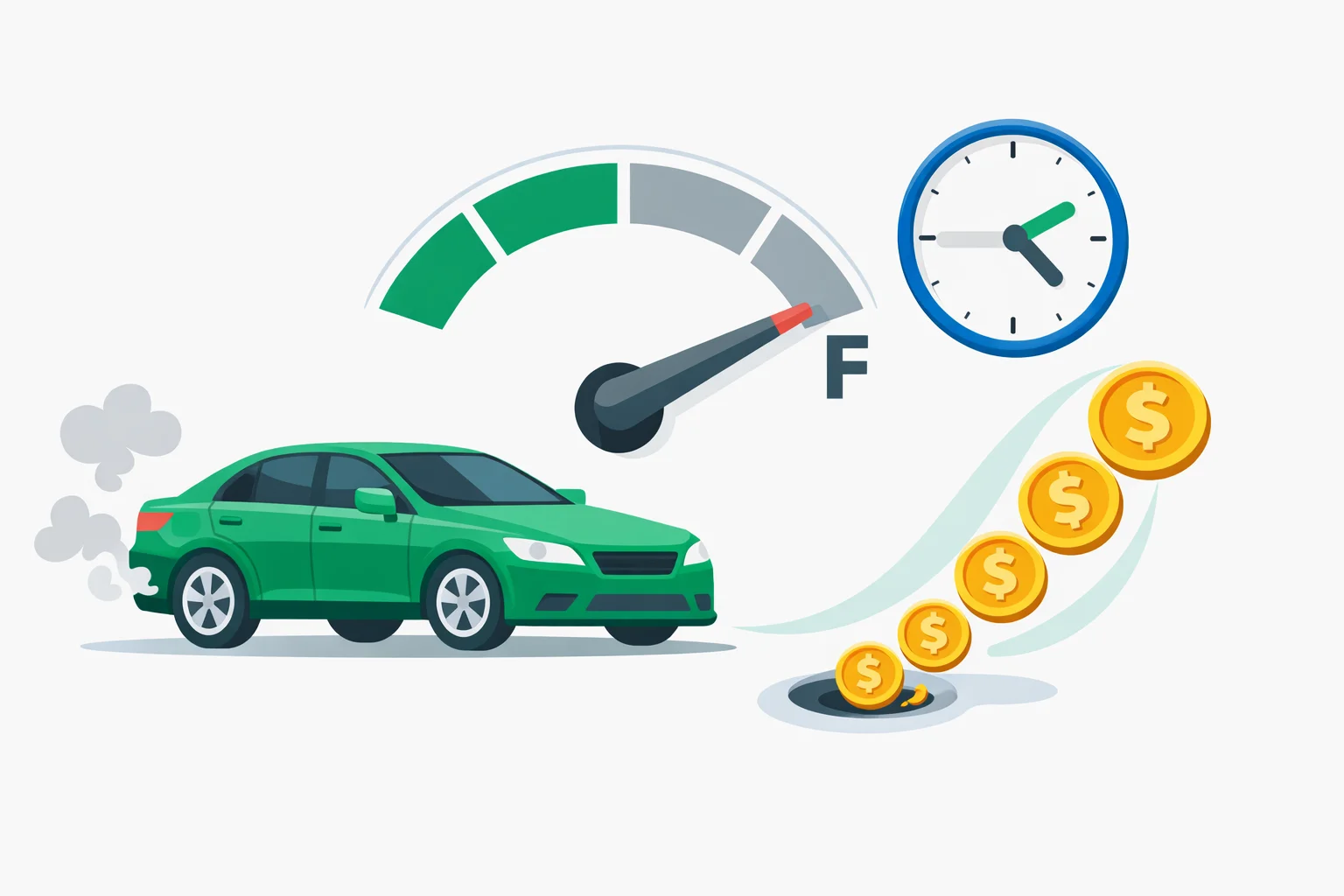
Idling Fuel Cost Calculator: What Your Engine Burns Going Nowhere
Our idling fuel cost calculator puts a dollar figure on the one fuel you burn without moving an inch. A typical crossover left running for 20 minutes a day quietly torches about 48 gallons a year — roughly $160 at $3.30 a gallon, or three-plus full tanks poured out the tailpipe while the odometer sits still. Idling never shows up on your mile-per-gallon math because there are no miles, which is exactly why it slips past most budgets. Plug in your idle minutes, engine size, and gas price, and the tool converts a habit you barely notice into a daily, monthly, and yearly cost.
The Problem: Idling Is Fuel You Pay For and Get Nothing Back
Every other fuel cost buys you distance. Idling buys you nothing — the engine keeps sipping to run the alternator, water pump, A/C compressor, and fuel injectors while the car goes precisely zero miles. Because MPG is measured per mile driven, an idling engine has an effective fuel economy of 0 MPG. That's the trap: you can obsess over squeezing an extra 2 MPG on the highway and still bleed money in the drive-thru without ever seeing it on a receipt.
The scale is bigger than most drivers guess. The U.S. Department of Energy estimates that personal vehicles idle away roughly 3 billion gallons of gasoline every year in America — fuel burned in driveways, parking lots, and pickup lines. At the pump-price level that's billions of dollars, and every gallon of it is split among individual drivers who each think their own idling is too small to matter. It adds up one warm-up at a time.
Gallons Per Hour: What Idling Costs by Engine Size
Idle fuel use is measured in gallons per hour (gal/hr), and it swings hard with engine displacement. A small four-cylinder barely sips; a big V8 gulps roughly three times as much standing still. The table below shows typical idle burn rates and what an hour of idling costs at $3.30 a gallon — the same rates the calculator loads when you pick your vehicle type.
| Engine / Vehicle | Idle Rate (gal/hr) | Cost per Idle Hour |
|---|---|---|
| Compact / small 4-cylinder | 0.16 | $0.53 |
| Midsize sedan (4-cylinder) | 0.22 | $0.73 |
| Crossover / small SUV (V6) | 0.30 | $0.99 |
| Full-size SUV or truck (V8) | 0.50 | $1.65 |
| Heavy-duty pickup (large V8) | 0.65 | $2.15 |
Idle rates from U.S. DOE / Argonne idle-consumption data. Running the A/C or heater adds roughly 0.10 gal/hr on top of these figures. Heavy-duty diesels can exceed 1.0 gal/hr.
Notice how the V8 costs more than three times what the compact does to sit in the same parking lot. That's why a big truck warming up all winter is a genuine line item, not a rounding error. If you want to compare that against what your actual driving costs, our fuel cost calculator runs the standard miles-divided-by-MPG math for time you spend actually moving. And if that idling truck is a diesel, it burns a second consumable besides fuel — our DEF cost calculator prices the exhaust fluid it meters through.
The Math: Turning Idle Minutes Into a Yearly Bill
The formula is short and the calculator handles it for you, but seeing it makes the number feel real. Idle cost builds from three inputs: your burn rate, your time, and your fuel price.
Annual Cost = Rate (gal/hr) × (Minutes ÷ 60) × Gas Price × Days/Week × 52
Each piece matters. The rate comes from your engine (plus 0.10 gal/hr if the A/C or heat is on). Minutes ÷ 60 turns your daily idle time into a fraction of an hour. Multiply by gas price for a daily dollar figure, then scale by how many days a week you do it and the 52 weeks in a year. Change any one input and the yearly total moves in a straight line — halve your idle minutes and you halve the bill.
A Real Example: 20 Minutes a Day in a V6 Crossover
Say you drive a V6 crossover (0.30 gal/hr) and idle 20 minutes a day, seven days a week, with the A/C on. The A/C bumps the rate to 0.40 gal/hr. Here's the walk-through:
- Per day: 0.40 gal/hr × (20 ÷ 60) = 0.13 gallons × $3.30 = $0.44.
- Per year: $0.44 × 7 days × 52 weeks = $160, burning about 48.5 gallons.
- Turn the A/C off (0.30 gal/hr) and the same habit drops to about $120 a year — the climate control alone costs you $40.
That $160 is 3.2 tanks of gas and about 950 pounds of CO₂ a year from doing nothing but sitting. Trim the idle time to 10 minutes and it falls to $80. The lesson isn't that idling is a catastrophe — it's that it's a steady, invisible leak that responds instantly to a small habit change. If cutting idle time is part of a broader fuel-saving push, our fuel savings calculator shows what better MPG and smarter driving add up to together.
The Restart Myth: Does Turning the Engine Off and On Waste More Gas?
This is the belief that keeps engines running: "restarting uses more fuel than just leaving it idle." It was true in the carburetor era. It isn't true now. According to the U.S. Department of Energy, restarting a modern fuel-injected engine uses about the same fuel as 10 seconds of idling. So the rule of thumb is simple: if you'll be stopped for more than 10 seconds — and you're not in moving traffic — switching off saves fuel and money.
The companion worry, that frequent restarts wear out your starter and battery, also comes from older cars. Modern starters and batteries are built for far more cycles, and vehicles with automatic stop-start systems restart the engine dozens of times per drive by design. At $1.32 an hour of idling in our crossover example, every 10-minute wait you switch off instead of idle through saves about 22 cents — and those quarters pile up across a year of drive-thrus, drop-offs, and drawbridges.
Where the Idle Minutes Hide — and What They Cost
Most people underestimate their idle time because it comes in scattered chunks, never one long block. Here's where the minutes leak out, priced for that same V6 crossover at $3.30 a gallon:
- The winter warm-up. Modern engines need about 30 seconds before driving, not 10 minutes. A daily 8-minute remote-start warm-up all winter runs roughly $35–$45 — and driving gently warms the engine faster than idling does.
- The drive-thru. Five minutes in line twice a week is about $9 a year. Do it daily and it's $32 — small, but it's pure waste you could skip by parking and walking in.
- The pickup line. Waiting 15 minutes in the school or airport pickup lane, five days a week, is close to $130 a year at 0.40 gal/hr. This is often the single biggest idle block in a parent's week.
- The A/C nap. Sitting in a running car to stay cool is the priciest idle of all because climate control is working hardest. Thirty minutes a few times a week can top $60 a year on its own.
Add those up and the "I barely idle" driver is often at $150–$250 a year without a single road trip. Since idle time so often overlaps with your commute, our commute cost calculator is a useful companion for seeing the full picture of what getting to work really costs. For the federal breakdown of idle waste, the U.S. Department of Energy's Alternative Fuels Data Center and the fuel-saving tips at fueleconomy.gov are the authoritative sources.