
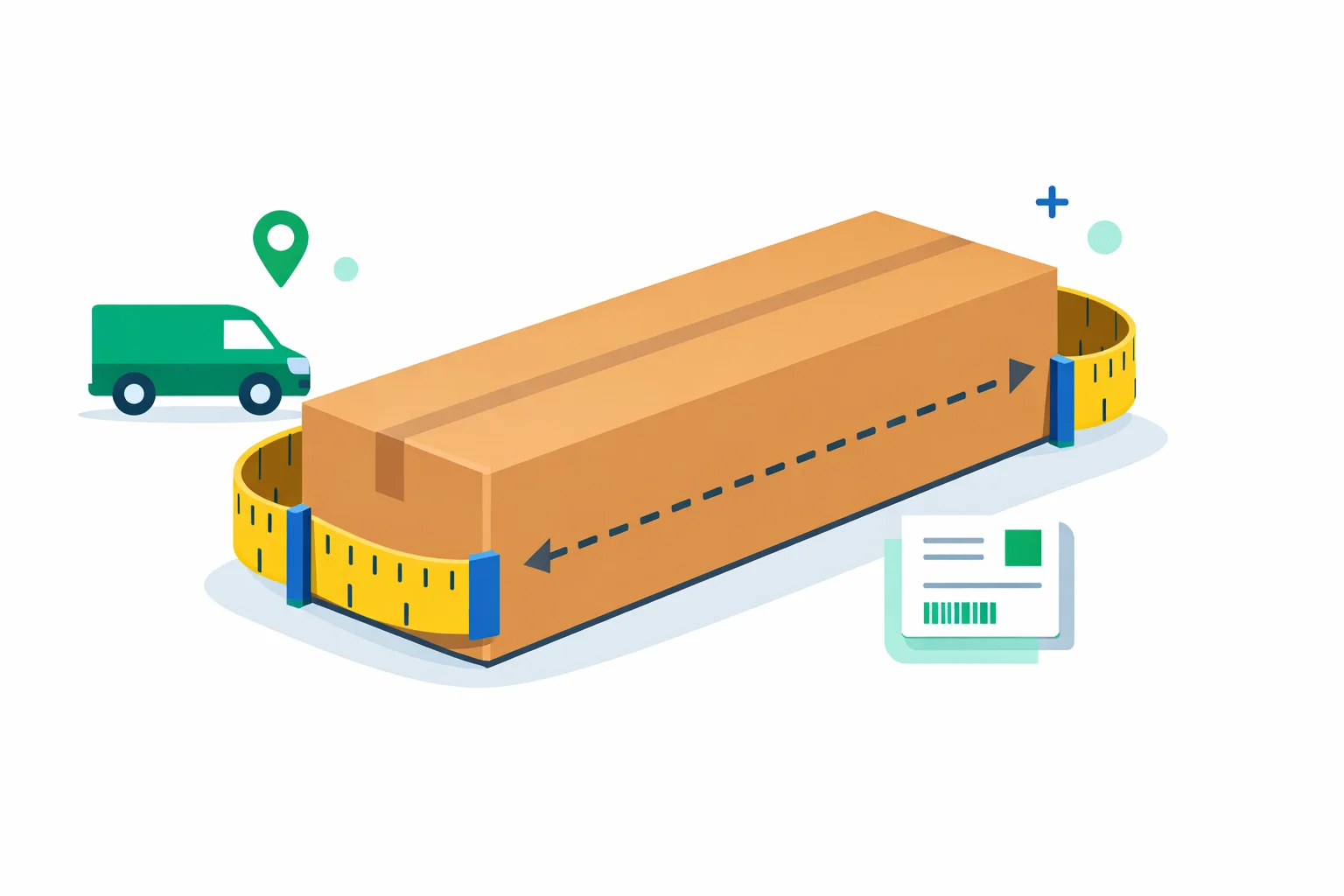
Which side of your box is the “length”? A package girth calculator lives or dies on that one question, because girth is measured around the two sides that aren't the length — and picking the wrong side can make a perfectly legal 116-inch package look like a 138-inch one that no carrier will touch. Take a 40 × 20 × 18 inch carton. Loop your tape the wrong way and you'll talk yourself into a surcharge you never owed, or worse, hand a box to a driver that gets returned three days later with a $1,000-plus over-maximum charge attached.
The Myth: Girth Is the Distance Around Your Box
Almost every explanation you'll read says girth is “the measurement around the package.” That sentence is true and useless at the same time, because a rectangular box has three different ways around it. Run all three on that 40 × 20 × 18 carton and watch the answer swing:
| Loop you measured | Girth | Length + girth | Verdict |
|---|---|---|---|
| Around the 20 and 18 sides — correct | 76 in | 116 in | Ships fine on UPS and FedEx |
| Around the 40 and 18 sides | 116 in | 136 in | Falsely reads as oversize |
| Around the 40 and 20 sides | 120 in | 138 in | Falsely reads as oversize |
Same cardboard, three answers, a 22-inch spread. Only the first row is girth. The rule carriers actually apply is that the longest side is the length, always, regardless of how the box is labelled, which way the flaps open, or which side you think of as the “front.” Girth is the loop perpendicular to that longest side, so it wraps the two remaining dimensions. The other big misreading is simpler: length + girth is not L + W + H. On this box that shortcut gives 78 inches, a number that has nothing to do with anything.
The Reality: L + 2 × (W + H), and Nothing Else
Sort your three measurements largest to smallest, then substitute:
- L = the longest side — 40 in
- W and H = the two remaining sides, in either order — 20 in and 18 in
- Girth = 2 × (W + H) = 2 × (20 + 18) = 76 in
- Length + girth = L + girth = 40 + 76 = 116 in
Because W and H are added and then doubled, their order genuinely doesn't matter — 2 × (20 + 18) and 2 × (18 + 20) are the same 76. That is why the calculator above takes three numbers in any sequence and sorts them for you. Round each side to the nearest whole inch before you do any of this, since that's how a hub scanner records it, and measure the outside of the sealed box at its widest bulge rather than at the seams.
Why an Inch of Height Costs Twice as Much as an Inch of Length
Here's the part that changes how you pack. Length appears once in the formula. Width and height each appear twice. Shave one inch off the 40-inch length and length + girth drops by exactly 1 inch, to 115. Shave one inch off the 18-inch side and it drops by 2, to 114. Every inch of height or width is worth two inches of size budget.
Say you're at 138 inches and need to reach 130 to dodge the oversize charge. You're 8 inches over. That's either 8 inches off the length — often impossible, because the product inside sets that dimension — or just 4 inches off the height, which is frequently nothing more than repacking with less void fill and folding the flaps down properly. Shippers reach for the length first because it's the biggest number on the box. It's the least efficient thing they could cut.
Same Volume, Wildly Different Girth
Size limits are written against length + girth, not volume, and those two things drift apart fast. Every box below holds exactly 5,184 cubic inches — three cubic feet, identical usable space — yet they land on opposite sides of every threshold in the industry:
| Box (all 5,184 cu in) | Girth | Length + girth | What it triggers |
|---|---|---|---|
| 17.3 × 17.3 × 17.3 — a cube | 69 in | 87 in | Nothing. Cheapest shape there is |
| 24 × 18 × 12 | 60 in | 84 in | Nothing |
| 48 × 12 × 9 | 42 in | 90 in | Nothing — but one inch of length away from handling fees |
| 72 × 12 × 6 | 36 in | 108 in | Sitting exactly on the USPS oversized line |
| 96 × 9 × 6 | 30 in | 126 in | Additional handling; 4 in from the oversize line |
| 108 × 8 × 6 | 28 in | 136 in | Too big for USPS entirely; oversize on UPS and FedEx |
The cube is not a coincidence. For any fixed volume, length + girth bottoms out at 5 × the cube root of that volume — 5 × 17.3 = 87 inches here — and every departure from cubic proportions pushes the number up from there. That's why a rolled rug, a fishing rod, or a strip of trim is so expensive to ship relative to how little space it occupies: 108 × 8 × 6 wastes 49 inches of size allowance purely on shape. It also explains why the same product bills differently depending on how you pack it. Two 36-inch curtain rods laid side by side in one 36 × 6 × 4 box measure 56 inches of length + girth and pay one base rate; split them into two 36 × 4 × 4 boxes and you're shipping 52 inches twice, for 104 inches of measured package and two base rates.
Every Girth Limit That Actually Exists
Three numbers do almost all the work in US domestic parcel: 108, 130 and 165 inches. Here's the full board, with the weight ceilings that sit alongside them:
| Service | Max L + girth | Max length | Max weight | Surcharge starts at |
|---|---|---|---|---|
| USPS Priority Mail & Express | 108 in | 108 in | 70 lb | — (108 is a hard stop) |
| USPS Ground Advantage | 130 in | 108 in | 70 lb | Oversized price above 108 in |
| UPS Ground & Air | 165 in | 108 in | 150 lb | Large Package above 130 in |
| FedEx Ground & Home Delivery | 165 in | 108 in | 150 lb | Oversize above 130 in |
| FedEx Express | 130 in | 108 in | 150 lb | — (130 is a hard stop) |
Read the second column and the third column as separate tests, because they are. A 110 × 5 × 4 box measures only 128 inches of length + girth — comfortably inside the 165-inch ceiling — and is still rejected by every carrier on the list, because the 108-inch maximum length applies on its own. Passing one test tells you nothing about the other. The exact physical standards live in the USPS Domestic Mail Manual section 101, and price changes are filed roughly 45 days ahead through the Postal Regulatory Commission, which is where the January threshold revisions show up first.
Where the Money Leaks
Four mistakes that turn a measuring error into an invoice, in rough order of how much they cost:
- Crossing 130 inches by an inch or two. This is the expensive one, and not because of the surcharge itself. UPS and FedEx apply a 90 lb minimum billable weight to oversize packages. A 14 lb box of foam that measures 132 inches gets rated as if it weighed 90 lb, on top of a flat oversize fee that runs into the low hundreds. Two inches of cardboard, and the shipment reprices by a factor of six.
- Going past 165 inches or 108 inches of length. That isn't a surcharge, it's an over-maximum-limits charge north of $1,000 per package on published UPS and FedEx rates — and the package still may not be delivered. Anything in that territory belongs on an LTL pallet, priced by density through our freight class calculator rather than as a parcel.
- Measuring at the seams instead of the bulge. Carrier dimensioners scan the box as it arrives, bowed sides included. A carton packed tight enough to bulge one inch on each of the two short sides gains four inches of length + girth by the time it's scanned. Measure a packed, taped box, never a flat one.
- Assuming girth limits and weight pricing are the same conversation. They aren't. Girth decides whether the package is accepted and whether a surcharge applies; the rate itself comes from billable weight, which is the greater of actual and dimensional weight. Our dimensional weight calculator handles that second half, and the UPS shipping cost calculator and FedEx shipping calculator turn the result into a price by zone and service.
If you ship the same product repeatedly, measure once and design the carton around the threshold rather than the contents. A SKU that sits at 128 inches of length + girth has a two-inch cushion for bulge, seasonal packaging changes, and a supplier quietly switching to thicker corrugate. A SKU that sits at 129 has none, and you'll find out on a random Tuesday when a hub dimensioner rounds against you.