
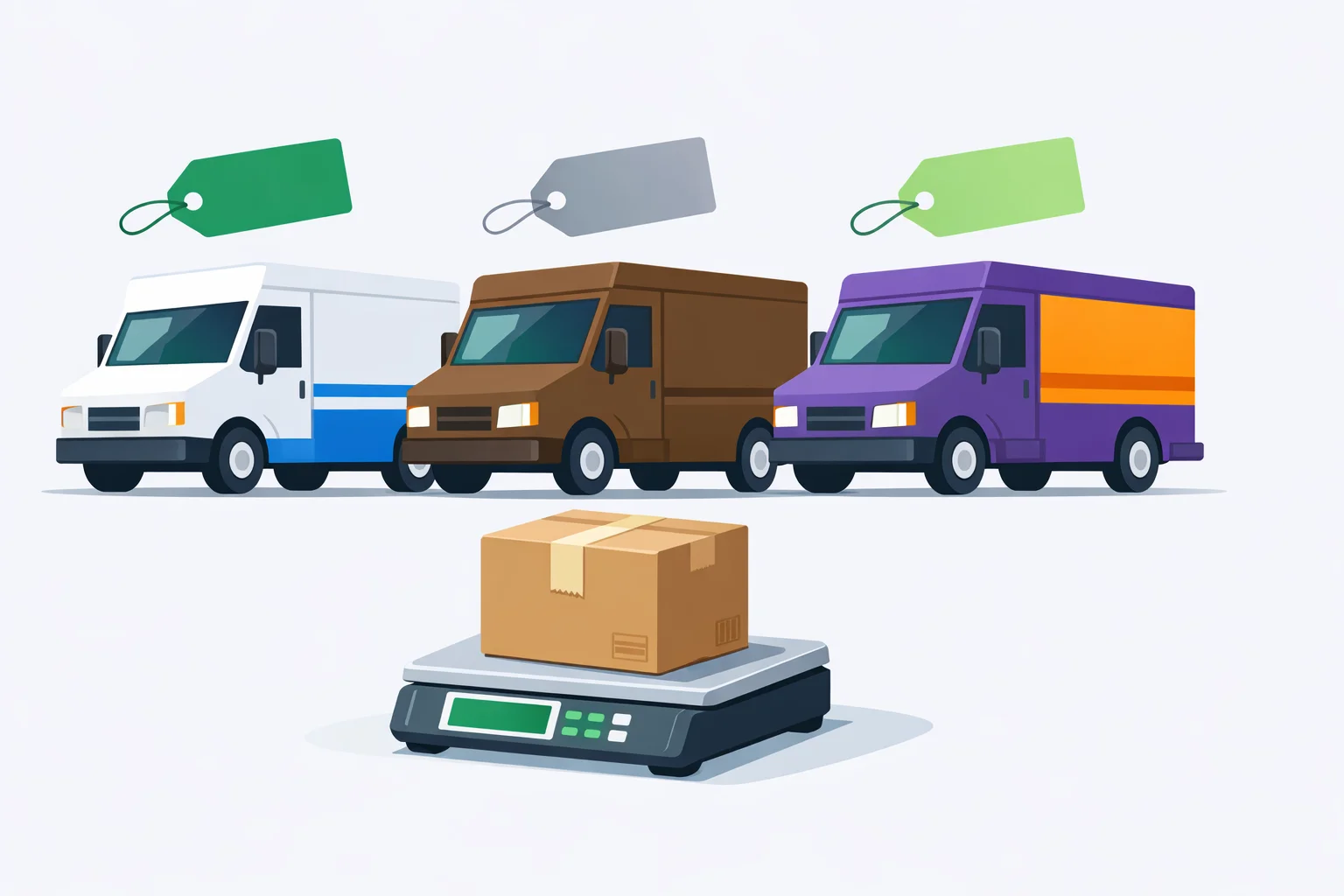
USPS vs UPS vs FedEx isn't a close race for a typical home shipment: the same 5-pound box traveling 800 miles costs $15.40, $28.08, or $28.55 at the retail counter, depending on whose door you walk through. That's an 85% spread on identical cardboard. The calculator above ranks all three quotes for your exact package, and this guide explains where that $13 gap comes from — and the handful of situations where the Postal Service, despite those numbers, is the wrong pick.
Why Does the Same Box Cost $13 More at UPS?
It's not the trucks. The gap is almost entirely surcharge stacking. A USPS retail price is all-in: fuel is baked into the rate, and there's no fee for delivering to a house, because houses are the Postal Service's entire network. UPS and FedEx quote a base transportation rate, then add a residential surcharge of roughly $5.55 to $6.25 per package, then multiply nearly everything by a fuel surcharge that has hovered around 16-18% at retail.
Watch it compound. UPS Ground for a 6-lb billable package to Zone 5 starts around $18.75. Add $5.65 for a home address and you're at $24.40. Multiply by 1.17 for fuel and the counter asks for $28.55. The base rate was competitive — the extras added 52% on top. Send that same box to a business address instead and the UPS quote drops to about $21.94, while the USPS price doesn't move at all.
Matching the Tiers: The Only Fair Comparison
Plenty of “comparisons” put Priority Mail Express against UPS Ground and call USPS expensive. Each carrier sells three broadly equivalent speeds, and prices only make sense inside a tier. Here's the map our comparison uses, with the delivery commitment each service actually makes:
| Speed tier | USPS | UPS | FedEx |
|---|---|---|---|
| Economy ground | Ground Advantage, 2-5 days | UPS Ground, 1-5 days | Ground / Home Delivery, 1-5 days |
| Expedited | Priority Mail, 1-3 days (not guaranteed) | 2nd Day Air, 2 days by end of day | FedEx 2Day, 2 days by 4:30-8 PM |
| Overnight | Priority Mail Express, guaranteed | Next Day Air Saver, by 3-4:30 PM | Standard Overnight, by 4:30-8 PM |
One asterisk matters more than the prices: Priority Mail's 1-3 days is a target, not a promise. Priority Mail Express is the only USPS product with a money-back guarantee, while nearly every UPS and FedEx air service carries one. The other asterisk is billable weight — each carrier decides it differently, using the zone charts published on USPS Postal Explorer and its UPS and FedEx equivalents. That's where the next example gets interesting.
Run One Box Through All Three
Take the box from the opening line: 5 lb actual weight, 12×10×6 inches, Zone 5 (about 601-1,000 miles), delivered to a house, cheapest ground tier. Three carriers, three different bills for it:
USPS Ground Advantage. The box is 720 cubic inches — under the 1-cubic-foot threshold (1,728 cu in), so USPS ignores dimensions entirely and bills the scale weight: 5 lb. Zone 5 pricing runs $11.00 for the first pound plus $1.10 for each additional: $11.00 + (4 × $1.10) = $15.40. No residential fee, no fuel line. Done.
UPS Ground. UPS checks dimensional weight on every package: 720 ÷ 139 = 5.2, rounded up to 6 lb billable — your 5-lb box just gained a phantom pound. Base plus weight comes to $18.75, the residential surcharge adds $5.65, and the 17% fuel surcharge multiplies the lot: ($18.75 + $5.65) × 1.17 = $28.55.
FedEx Home Delivery. Same DIM math (720 ÷ 139 → 6 lb), slightly gentler base: ($18.25 + $5.55) × 1.18 = $28.08. FedEx edges out UPS by 47 cents; USPS beats both by nearly thirteen dollars. Ship one box a week like this and picking the wrong counter costs about $680 a year.
Where Each Carrier Actually Wins
Those numbers make USPS look unbeatable, and at retail, under 70 lb, to a home address, it usually is. But “usually” has edges. Here's the honest split we'd use for our own packages:
- Under 1 lb: USPS, no contest. Ground Advantage prices sub-pound parcels by the ounce starting around $5-7, a bracket UPS and FedEx don't even offer at retail — run the exact ounce tiers through our USPS shipping cost calculator.
- 1-20 lb to a residence: USPS wins almost every zone once the $5.55-$6.25 residential fee and fuel hit the other two quotes.
- Books and media, any weight: USPS by a mile — Media Mail ships 10 lb of qualifying books to any state for $11.02, less than half of anyone's ground rate. Check what qualifies with our Media Mail calculator.
- Big but light boxes: still USPS, and by more than you'd think — its DIM divisor is 166 versus 139, and it only applies over one cubic foot.
- Over 70 lb: USPS is out — that's a hard limit, not a surcharge. UPS and FedEx take packages to 150 lb, so compare them head-to-head with our UPS shipping cost calculator and FedEx shipping calculator. Past 150 lb or anything on a pallet, you've left parcel entirely — price it with our LTL freight calculator instead.
- A guaranteed morning deadline: FedEx Priority Overnight and UPS Next Day Air commit to 10:30 AM in most ZIP codes; Priority Mail Express guarantees the day, not the hour.
- 50+ packages a week: negotiated UPS/FedEx commercial rates run 20-50% below the counter prices in this comparison and flip most of the rankings above.
What Do People Get Wrong About “Cheapest”?
The expensive mistake isn't picking the wrong carrier — it's comparing the wrong numbers. Retail counter prices and online commercial prices are different rate cards: USPS Click-N-Ship, UPS.com, and FedEx.com labels run roughly 20-40% below what the counter charges, so weighing your friend's discounted UPS quote against your walk-in USPS price proves nothing.
Dimensional weight is the second trap, and it's brutal on light, bulky boxes. A 20×16×12-inch box of pillows weighs 4 lb on the scale, but UPS bills 3,840 ÷ 139 = 28 lb — turning a $25.97 shipment into a $56.86 one, a $30.89 penalty for air. USPS bills the same box at 24 lb (3,840 ÷ 166) for $36.30, which is why bulky-but-light packages lean USPS even harder than heavy ones. Our dimensional weight calculator shows exactly when your box crosses that line.
Two smaller leaks: paying for insurance you already have — all three carriers include $100 of coverage on these services, and our shipping insurance cost calculator prices the layer above it — and paying the Priority Mail premium believing it's guaranteed. It isn't, and when a “2-day” Priority box lands on day four, USPS owes you nothing.
Three Years, Three Rate Hikes of 5.9% or More
Whatever the calculator shows today will be stale within a year, and predictably so. UPS and FedEx raised general rates 6.9% in 2023, then 5.9% in both 2024 and 2025, and both announced another 5.9% for 2026 in their annual rate guides. Compounded, a $20 shipment from 2022 costs about $23.98 now: a 20% climb in three years. USPS files its own increases — typically twice a year, reviewed by the Postal Regulatory Commission and published on the official USPS prices page — but Ground Advantage has stayed the cheapest ground option throughout, because the surcharge gap renews itself with every January increase. The ranking between carriers has been far more stable than the prices themselves.