
Understanding Freight Class & NMFC Codes
In the world of LTL (Less Than Truckload) shipping, Freight Class is the universal language that determines shipping rates. Defined by the National Motor Freight Traffic Association (NMFTA), these classes range from Class 50 (least expensive) to Class 500 (most expensive).
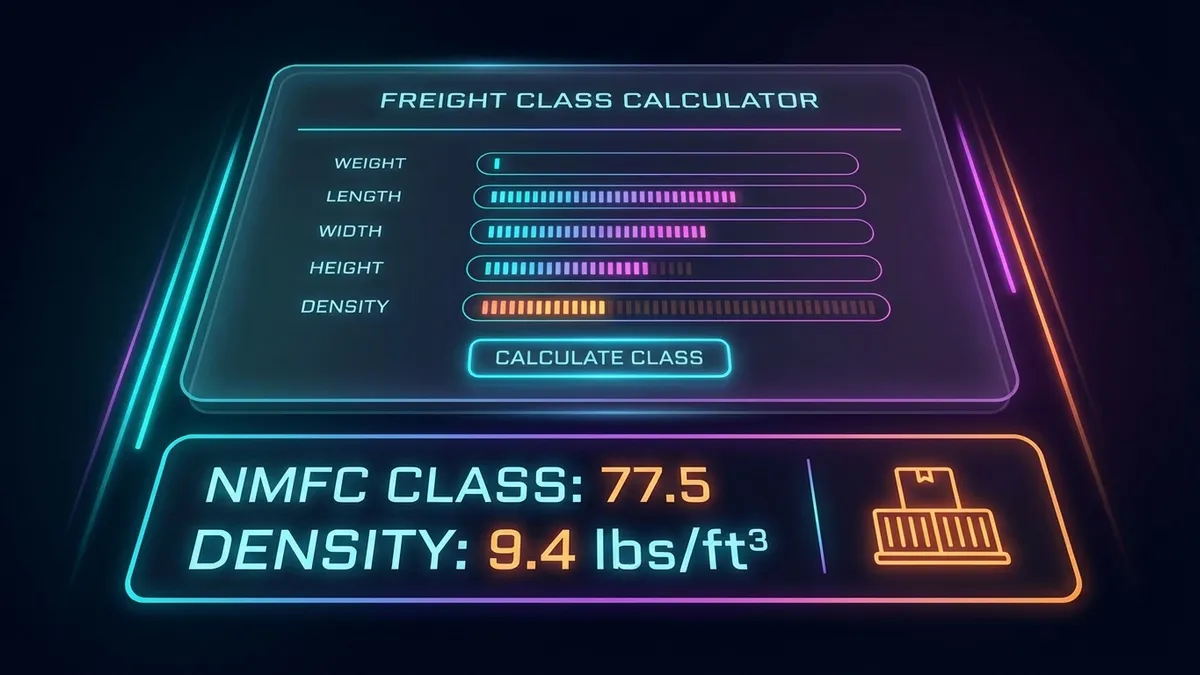
Our Freight Class Calculator uses the density of your shipment to estimate its NMFC class. While density is the primary factor for many commodities, understanding how stowability, handling, and liability affect your class is crucial for avoiding costly re-classification fees.
How to Use This Calculator
- Measure Dimensions: Measure the length, width, and height of your palletized shipment in inches. Include the pallet in your measurements!
- Weigh Your Shipment: Enter the total weight in pounds, including packaging and pallets (use our Truck Freight Tonnage Calculator for bulk estimates).
- Calculate: Click the button to see your shipment's density and estimated freight class.
- Review: Use the result to quote your LTL shipment accurately.
Standard NMFC Density Guide
Most carriers use the standard 11-tier density scale to determine freight class for commodities that don't have a specific fixed class.
| Density (lbs per cu ft) | Freight Class | Typical Items |
|---|---|---|
| Less than 1 | 500 | Ping pong balls, Gold leaf |
| 1 to 2 | 400 | Deer antlers, Light fixtures |
| 2 to 3 | 300 | Model boats, Cabinets |
| 3 to 4 | 250 | Mattresses, Bamboo furniture |
| 4 to 5 | 200 | Auto sheet metal parts |
| 5 to 6 | 175 | Clothing, Couches |
| 6 to 7 | 150 | Auto body parts, Bookcases |
| 7 to 8 | 125 | Small appliances |
| 8 to 9 | 110 | Table saws, Cabinets |
| 9 to 10.5 | 100 | Car covers, Boat covers |
| 10.5 to 12 | 92.5 | Computers, Monitors |
| 12 to 13.5 | 85 | Crated machinery |
| 13.5 to 15 | 77.5 | Tires, Bathroom fixtures |
| 15 to 22.5 | 70 | Car engines, Food items |
| 22.5 to 30 | 65 | Car accessories, Books |
| 30 to 35 | 60 | Hardwood flooring |
| 35 to 50 | 55 | Bricks, Cement |
| Over 50 | 50 | Steel bolts, Nuts |
The Four Factors That Determine Freight Class
Density is the most common trigger, but the NMFTA actually weighs four characteristics when assigning a class. Miss any one of them and you can end up with a re-class bill that wipes out the savings you thought you locked in at quote time.
Density
Weight per cubic foot. Higher density means lower class and lower cost — this is the lever our calculator measures and the one you have the most control over at the dock.
Stowability
How easily the freight packs with other shipments. Excessive length, weird shapes, or items that can't be double-stacked eat trailer space and push your class up two or three tiers.
Handling
Does it need a forklift with special attachments? Is it fragile, temperature-sensitive, or prone to tipping? Carriers charge more when terminals have to slow down for a single pallet.
Liability
High-value items like electronics, jewelry, or hazardous materials carry a higher risk of theft or damage. Insurance exposure is baked directly into the class.
Worked Example: A 48x40 Pallet of Auto Parts
Let's walk through a real shipment so the density math clicks. Say you're shipping a pallet of alternators and starters from a warehouse in Ohio to a body shop in Texas. Your pallet measures 48" long x 40" wide x 36" tall and the total weight including the pallet itself is 720 lbs.
First, convert the dimensions to cubic feet: (48 × 40 × 36) / 1,728 = 40 cu ft. Then divide the weight by volume: 720 / 40 = 18 lbs per cubic foot. Pulling that number up on the density table above, 15 to 22.5 lbs per cu ft falls into Class 70 — one of the cheapest rates LTL carriers offer. On a ~1,200 mile lane, that might run $350-$450 depending on your contract — our LTL freight calculator itemizes that quote into linehaul, fuel surcharge, and accessorial fees so you can see where the money goes.
Now imagine the same shop loads the pallet loosely and stacks it 60" tall instead of 36". Volume jumps to 66.7 cu ft, density drops to 10.8 lbs per cu ft, and your class bumps up to 92.5 — potentially adding $80-$120 to the invoice for the exact same parts. That's why seasoned shippers obsess over pallet tightness. A cheap shrink wrap job and a shorter stack often pay for themselves on a single shipment. If you're also comparing ground rates, try our Shipping Cost Calculator for parcel-sized loads.
Mistakes That Trigger a Reclassification Fee
We've seen shippers lose hundreds of dollars per load by making the same handful of mistakes. Here's what gets flagged at the terminal scale most often:
- Forgetting the pallet in the weight. A standard wood pallet weighs 30-50 lbs. Leave it out and your declared density is wrong from the start.
- Measuring the freight instead of the total footprint. If your boxes overhang the pallet by even 2 inches, the carrier measures the outermost edge — always.
- Declaring an old NMFC code. The NMFTA updates codes several times a year. Using a deprecated code is one of the easiest ways to get hit with a correction.
- Ignoring commodity-specific classes. Some items (like mattresses, tires, or plumbing fixtures) have fixed classes regardless of density. Don't assume the density formula applies to everything.
Pro Tips: How to Lower Your Freight Cost
- Avoid Overhang: Items hanging over the pallet edge are easily damaged and may be re-classified or charged extra fees.
- Use Standard Pallets: 48x40 pallets are the industry standard. Odd sizes may be harder to stow.
- Describe Accurately: Using the wrong NMFC code is a guaranteed way to get hit with a "Re-weigh and Inspection" fee. When in doubt, ask your carrier.
- Hauling LTL on Your Own Authority? Class determines what a load pays, but your tractor note decides what you keep. Our semi truck loan calculator breaks a truck payment down into cents per mile so you can quote lanes above your real cost.
Frequently Asked Questions
Disclaimer: This calculator provides an estimate based on density. Official classification is determined by the NMFTA. For more details on freight shipping, visit the Wikipedia page on LTL shipping. Always verify with your carrier before shipping.