
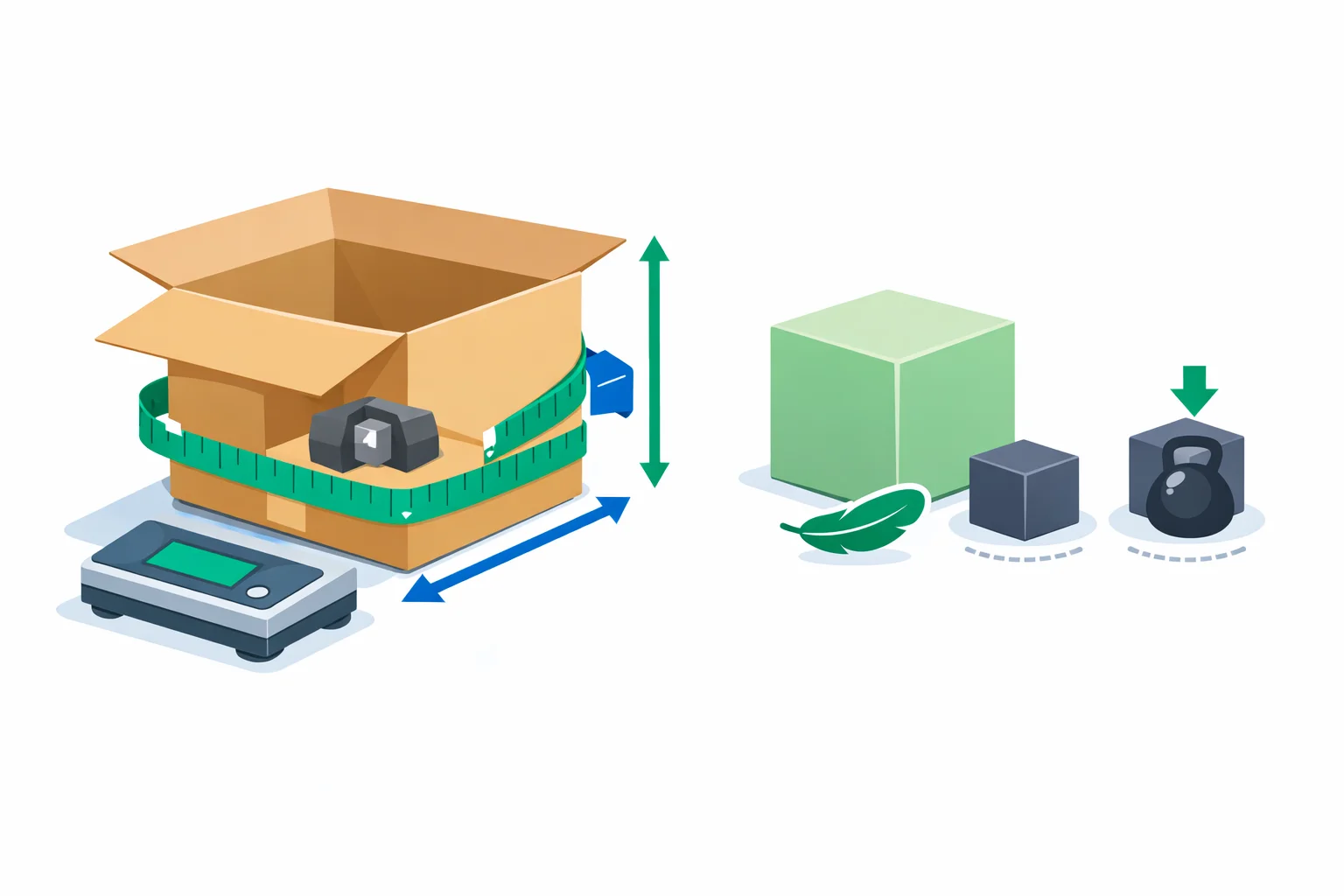
A dimensional weight calculator runs one line of arithmetic — (L × W × H) ÷ divisor — and that single division decides most of what you pay to ship a box. Take an 18 × 14 × 12 inch carton: multiply it out and you get 3,024 cubic inches. Divide by the 139 that UPS and FedEx use on standard rates and you get 21.8, which rounds up to 22 lb. If that box actually weighs 9 lb, you are not billed for 9. You are billed for 22. The other 13 lb is air — and the fuel surcharge, the residential fee, and every other percentage on the invoice gets calculated off the inflated number too.
Which Weight Wins? The Answer in 30 Seconds
Carriers compute two weights for every package and charge you for whichever is larger. That larger number is your billable weight. There is no averaging, no blending, no partial credit — it is a straight either/or, resolved package by package.
| Shipment | Actual | Dimensional (÷139) | Billable |
|---|---|---|---|
| 18 × 14 × 12 — two pillows | 9 lb | 22 lb | 22 lb (DIM) |
| 12 × 10 × 8 — hand tools | 26 lb | 7 lb | 26 lb (actual) |
| 16 × 16 × 16 — mixed retail | 30 lb | 30 lb | 30 lb (tie) |
Look at the middle row. Twenty-six pounds of wrenches in a small box produces a dimensional weight of 7 lb, so dimensional pricing is irrelevant — a fact that surprises shippers who assume DIM weight is something everyone pays. It only bites when the box is big relative to what is inside it. The pillow shipment pays 144% more than its scale weight. The tool shipment pays nothing extra at all.
139 vs 166 vs 194: Same Box, Three Different Bills
The divisor is where the money actually moves, and it runs backwards from intuition: a bigger divisor produces a smaller dimensional weight, which means a cheaper shipment. Here is that same 3,024 cubic inch carton run through every divisor you are likely to encounter on a US rate sheet.
| Divisor | Metric equivalent | Who bills at it | 3,024 cu in becomes |
|---|---|---|---|
| 139 | 5,000 cm³/kg | UPS Daily Rates, FedEx Express & Ground, DHL Express | 22 lb |
| 166 | 6,000 cm³/kg | Retail counter rates, USPS over 1 cu ft | 19 lb |
| 194 | 7,000 cm³/kg | Commonly negotiated, mid-volume shippers | 16 lb |
| 250 | 9,000 cm³/kg | High-volume contract | 13 lb |
Twenty-two pounds at the top, thirteen at the bottom. Same carton, same truck, same driver — a nine-pound swing that lives entirely in a contract clause. If you ship steady weekly volume and have never asked your account rep about the divisor, that is the cheapest negotiation available to you, and it costs the carrier nothing operationally to grant.
The metric column is worth a second look because it confuses people who ship internationally. 5,000 cm³/kg is not a different, gentler policy — run the unit conversion and 139 cu in per lb comes out to 5,021 cm³ per kg. It is the identical rule written with a different measuring stick, which is why the calculator above switches divisors automatically when you flip to centimetres. Once you have a billable weight, our UPS shipping cost calculator and FedEx shipping calculator turn it into an actual price by zone and service.
How Do You Actually Calculate DIM Weight?
Six steps, and the order of the rounding matters more than most people expect:
- Measure the outside of the sealed box at its widest points. A bowed side counts. Carriers measure the carton as it arrives at the hub, not as it left your packing bench.
- Round each dimension to the nearest whole inch. 18.4 becomes 18; 12.6 becomes 13.
- Multiply the three sides: 18 × 14 × 12 = 3,024 cubic inches.
- Divide by the divisor: 3,024 ÷ 139 = 21.75.
- Round the result up to the next whole pound — always up, never to the nearest. 21.75 becomes 22.
- Compare with the actual weight (also rounded up) and bill the greater of the two.
That step-two rounding is where a surprising amount of money hides. Suppose the same carton measures 18.6 inches long instead of 18.4. It now rounds to 19, the volume becomes 3,192 cubic inches, and the dimensional weight goes to 22.96 — billed as 23 lb. Two tenths of an inch of cardboard bulge cost you a full pound of billable weight, on every unit, on every shipment of that SKU, for as long as you keep using that box.
12.4 lb Per Cubic Foot: The Line That Decides Everything
Here is the part almost no shipping guide states plainly. There are 1,728 cubic inches in a cubic foot. Divide that by 139 and you get 12.4. That number is a density threshold: any package that carries less than 12.4 lb per cubic foot will always be billed on dimensional weight, and any package above it will always be billed on actual weight. You do not need to run the formula on a new box to know which side you land on — you need to know what your product weighs per cubic foot. At the 166 divisor the line drops to 10.4 lb per cubic foot, which is why retail counter pricing forgives bulky shipments that account rates punish.
| What is in the box | Rough density | Bills on |
|---|---|---|
| Bottled drinks, canned goods | ~60 lb/cu ft | Actual weight, comfortably |
| Hardcover books, printer paper | ~35 lb/cu ft | Actual weight |
| Hand tools, hardware, auto parts | ~25 lb/cu ft | Actual weight |
| The 139 break-even line | 12.4 lb/cu ft | Either — they tie here |
| Shoes in retail boxes | ~9 lb/cu ft | Dimensional weight |
| Folded apparel, bedding | ~8 lb/cu ft | Dimensional weight |
| Pillows, foam, packing peanuts | ~2 lb/cu ft | Dimensional weight, badly |
The 12.4 line falls between hand tools and shoes, and that gap explains an entire pattern in e-commerce economics. Hardware sellers rarely think about DIM weight because their products never approach the threshold. Apparel, bedding and home goods sellers live below it permanently, which is why their shipping costs track box size rather than product weight — and why cutting two inches off a carton height is often worth more to them than shaving a pound off the product.
Why Did DIM Weight Get So Expensive? A 2015 Rule Change and a 2017 Divisor Cut
Dimensional weight is not new, but its reach is. Before 2015, UPS and FedEx applied it to ground packages only when they exceeded three cubic feet — 5,184 cubic inches, roughly a 17 inch cube. Almost nothing an online retailer shipped qualified. Then, over the 2014–2015 turn, both carriers extended dimensional pricing to every ground package regardless of size, and the exemption that had protected small light boxes vanished overnight.
The second move was quieter and cost more. In January 2017, both carriers cut the daily-rate divisor from 166 to 139. Divide one by the other — 166 ÷ 139 = 1.194 — and every dimensionally-billed package in the country got 19.4% heavier without a single published rate going up. Our 3,024 cubic inch carton went from 19 lb to 22 lb on the strength of a number change alone.
That is the practical lesson for anyone budgeting freight: when the annual general rate increase is announced at "5.9%," the divisor is a separate lever that does not appear in that headline. Check it every January. USPS made a comparable move by adopting dimensional pricing on Priority Mail and Ground Advantage above one cubic foot — the current thresholds live in the USPS Notice 123 price list, and rate filings appear roughly 45 days ahead of time through the Postal Regulatory Commission.
When DIM Weight Doesn't Apply
Four situations where the formula above is the wrong tool, and reaching for it will give you a number that has nothing to do with your invoice:
- USPS packages under one cubic foot. This is the single best exemption in domestic parcel shipping. A 12 × 10 × 8 box measures 960 cubic inches — below the 1,728 threshold — so USPS never applies dimensional weight to it no matter how light the contents are. Ship that same box on a UPS account and it bills at 7 lb of DIM. Our USPS postage calculator prices those by class and weight. And if the small box is also heavy, the size rule flips in your favor entirely: Priority Mail Cubic prices commercial boxes under half a cubic foot by size tier and ignores weight up to 20 lb — find your tier with our USPS cubic pricing calculator.
- Flat rate boxes. If it fits, it ships, up to 70 lb. Volume is irrelevant by definition because the box is a fixed size and the price is fixed with it.
- Anything over 150 lb or 165 inches of length plus girth. That leaves parcel service entirely and moves to LTL freight, where density drives an NMFTA freight class instead of a divisor. Same underlying idea — light and bulky costs more — different arithmetic. Our freight class calculator handles that side.
- Large Package Surcharge shipments. Once length plus girth passes 130 inches, UPS and FedEx impose a minimum billable weight of 90 lb that overrides both actual and dimensional weight. A huge, nearly empty carton is not billed at its DIM weight of 60 lb; it is billed at 90, plus the surcharge itself. Our package girth calculator measures that line properly — girth wraps the two shorter sides, so it is 2 × (W + H), not the distance around the box the long way.
For everything in between, the fix is almost always the box rather than the contract. Dropping an 18 × 14 × 12 carton to 16 × 12 × 10 takes the volume from 3,024 to 1,920 cubic inches and the billable weight from 22 lb to 14 lb — a 36% cut with no change to what is inside. That is why serious shippers carry eight box sizes instead of three.