
So Is Uber Actually Cheaper Than a Taxi?
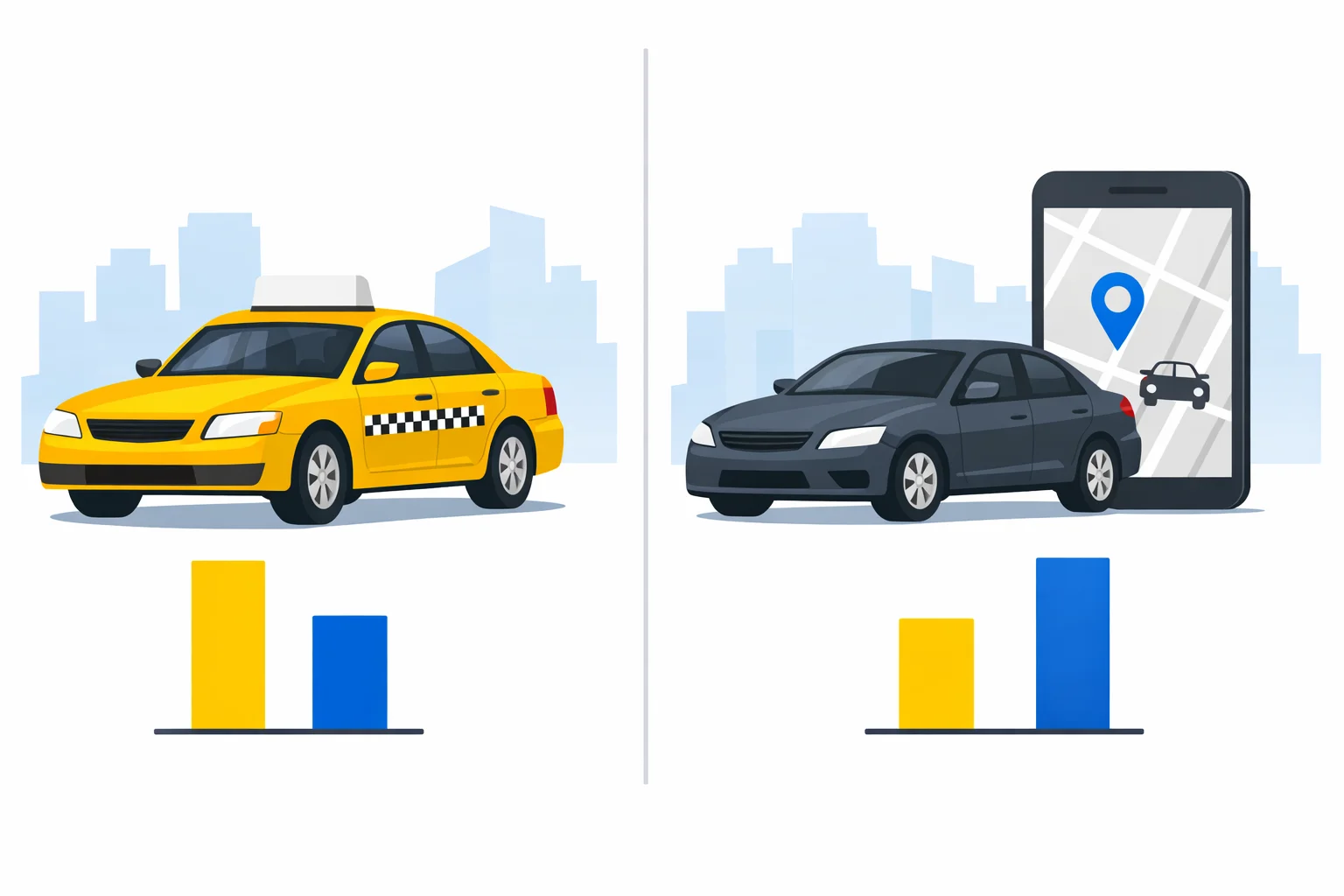
Run a taxi vs Uber calculator on the same six-mile city trip and the honest answer is: yes, by a lot — until it isn't. At national-average rates, that ride costs $24.60 in a metered cab and $13.68 on UberX. The app is $10.92 cheaper, a 44% gap, and that's with a 20% tip on the meter against 15% in the app.
Then surge shows up and the whole thing inverts. At 2.0x the same UberX ride is $24.49 — eleven cents under the cab. At 2.5x it's $29.90, and the yellow car at the curb just became the budget option. The useful question was never “which is cheaper,” because that changes minute to minute. It's at what surge multiplier do they cross. The calculator above solves for exactly that number, and the rest of this page explains why it lands where it does.
Two Meters, Two Completely Different Formulas
A taxi and an Uber look like the same product and price like opposites. A cab meter is a regulated tariff: fixed inputs, published by a city agency, identical for every passenger on every day of the year. Uber runs an upfront-price model where the same inputs get multiplied by live demand before you ever see a number.
Taxi total = (drop + miles × per-mile rate + slow minutes × per-minute rate + surcharges) × (1 + tip) + tolls
Uber total = [max(minimum fare, (base + miles × per-mile + minutes × per-minute) × surge + booking fee)] × (1 + tip) + tolls
Two structural differences do most of the damage. First, surge only multiplies the metered portion — Uber's $2.50 booking fee sits outside the multiplier, so a 2x surge doesn't double your receipt, it doubles about 79% of it. Second, the taxi bills time only when you're barely moving (below roughly 12 mph), while Uber bills every minute of the trip at a flat per-minute rate. Those two clocks run on completely different schedules.
| Pricing mechanic | Metered taxi | UberX |
|---|---|---|
| Who sets the rate | City regulator, published tariff | Uber, adjusted per market |
| Demand pricing | None — ever | 1.0x–3.0x+ on the metered portion |
| Time charge | Only below ~12 mph ($0.50/min avg) | Every minute of the trip ($0.20/min avg) |
| Fixed add-ons | $3.00 drop + local surcharges | $2.50 booking fee, outside surge |
| Price floor | The drop charge | $7.50 minimum fare |
| Price known before you ride | No — the meter decides | Yes — quoted upfront |
The 2x Rule: Where Your Break-Even Surge Falls
Here's the number that actually settles the argument. Set the two totals equal and solve for the surge multiplier s. Tolls appear on both sides and cancel out, so:
Break-even surge = [taxi total ÷ (1 + Uber tip) − booking fee] ÷ metered fare at 1x
Plug in our six-mile trip. The cab charges $24.60 all-in. Uber's metered portion at 1x is $1.00 base + (6 × $0.90) + (15 × $0.20) = $9.40, and the booking fee is $2.50. So s = ($24.60 ÷ 1.15 − $2.50) ÷ $9.40 = $18.89 ÷ $9.40 = 2.01x. Below 2.01x, order the ride. At or above it, walk to the curb.
Now the part we didn't expect when we built this. That break-even barely moves with trip length. At national-average tariffs a 3-mile trip breaks even at 1.99x, a 5-mile at 2.01x, a 6-mile at 2.01x, and a 10-mile at 1.99x. Both models scale with distance at roughly the same ratio, so the crossover stays pinned near 2x. That gives you a rule you can use without opening anything: if the app is showing under 2x, it's almost certainly still the cheaper ride. Above 2x, a cab is worth a look — and the exact figure depends on your city, which is where it gets interesting.
Your City Decides More Than Your Trip Does
Metered tariffs are set locally and they vary wildly. A San Francisco cab pulls $4.15 off the meter before the wheels move; Boston asks $2.60. New York charges $3.50 a mile plus a $1.50 state and city surcharge on every trip; D.C. charges $2.16 a mile. Rideshare pricing varies too, but not on the same axis — Uber runs roughly 32% above national average in NYC, SF, and Boston, and near baseline in Las Vegas. Stack those two independent variables and the break-even surge swings by a full point across markets.
| Market | Drop | Per mile | Taxi total | UberX at 1x | Break-even surge |
|---|---|---|---|---|---|
| Las Vegas | $3.50 | $2.76 | $29.77 | $13.92 | 2.44x |
| Los Angeles | $3.10 | $2.92 | $28.04 | $15.31 | 2.05x |
| U.S. average | $3.00 | $2.50 | $24.60 | $13.68 | 2.01x |
| San Francisco | $4.15 | $3.25 | $31.68 | $20.49 | 1.67x |
| New York City | $3.00 | $3.50 | $34.80 | $22.62 | 1.65x |
| Chicago | $3.25 | $2.25 | $22.08 | $15.09 | 1.58x |
| Washington, D.C. | $3.50 | $2.16 | $22.57 | $15.81 | 1.53x |
| Boston | $2.60 | $2.80 | $26.10 | $19.58 | 1.41x |
Six-mile trip, five minutes stopped in traffic, 20% tip on the meter and 15% in the app. Trip time is estimated at each city's typical door-to-door speed.
Boston is the outlier worth knowing about: the cheapest drop charge in the table sits in one of Uber's priciest markets, so a Boston cab wins at just 1.41x — a surge level you'll hit on any rainy Tuesday. Las Vegas runs the opposite way at 2.44x, because the Strip's $2.00 airport-and- resort surcharge and a $2.76 metered mile go up against baseline Uber pricing. Same two products, opposite verdicts, 2,500 miles apart. You can check the published figures yourself — the NYC Taxi & Limousine Commission and the SFMTA both publish their full tariffs.
Traffic Punishes the Cab, Not the App
Most people assume gridlock is bad news for both options equally. It isn't close. A New York meter charges $0.70 a minute while you sit still. UberX in New York charges about $0.26 a minute — the $0.20 national rate scaled up 32%. The cab bills traffic at 2.7 times the app's rate, and unlike the app it hasn't already quoted you a price it has to honor.
Watch what that does to a six-mile Manhattan crosstown. In free-flowing traffic the cab runs $34.80 and UberX runs $22.62, a break-even of 1.65x. Add twenty minutes of genuine standstill and the meter climbs to $47.40 while the Uber quote — already locked in — stays at $22.62. The break-even jumps to 2.32x. Traffic doesn't just make the cab more expensive; it widens the surge cushion the app gets to enjoy before it loses. If you're looking at a jam, the app's upfront quote is worth more than the price difference suggests.
There's a flip side to that guarantee. Because Uber quotes before the trip, it prices its estimate of your travel time, and it charges for every minute of it — even the fast ones. Our taxi fare calculator breaks the metered side down in more detail if you want to see how the two clocks diverge, and the Uber cost calculator does the same for the app.
Hail or Tap? A Decision Framework
Skip the calculator and use these thresholds when you're standing on a corner with a phone in your hand:
- Surge under 1.4x — take the Uber, anywhere. No U.S. market in our table breaks even below 1.41x. The app wins on price in every one of them.
- Surge 1.4x–2.0x — it depends on your city. In Boston, D.C., Chicago, NYC, or SF, the cab has probably already won. In LA, Vegas, or an average mid-size market, the app is still ahead.
- Surge above 2.0x — hail the cab. Nothing on the meter responds to demand. A 2.5x UberX on our six-mile trip is $29.90 against a fixed $24.60.
- Trips under 2 miles — check the minimum fare. A 1.5-mile ride prices at Uber's $7.50 floor, so the quote is $8.63 with tip against $9.90 on the meter. The gap is $1.27, and surge barely moves it because the floor is already doing the work.
- Airport runs — the app, decisively. An 18-mile trip is $60.00 metered versus $33.00 on UberX, and it takes a 1.90x surge to close that. Just confirm the airport hasn't set a flat taxi rate for your route first — several cities have, and a flat rate beats both models.
One thing the price comparison won't tell you: at genuinely extreme demand, surge is also a signal that no cars are available. Uber's multiplier exists to pull drivers onto the road, and NerdWallet's breakdown of what an Uber costs walks through how the fee stack behaves under demand. When the number spikes past 2.5x, the taxi stand often wins on wait time before it wins on price. If you're choosing between apps rather than modes, our Uber vs Lyft calculator prices both platforms against each other with independent surge sliders.