
A taxi fare calculator only makes sense once you know the strangest fact about a cab meter: it charges you two completely different ways on the same trip. When the wheels are turning, you pay for distance. When you're stuck at a red light or crawling through downtown, the meter quietly switches to billing time. That single mechanic explains almost every "why was my cab so expensive?" moment, and it's exactly what the tool above models — drop charge, per-mile rate, slow-traffic minutes, surcharges, and tip, using the real regulated tariffs from eight major U.S. cities.
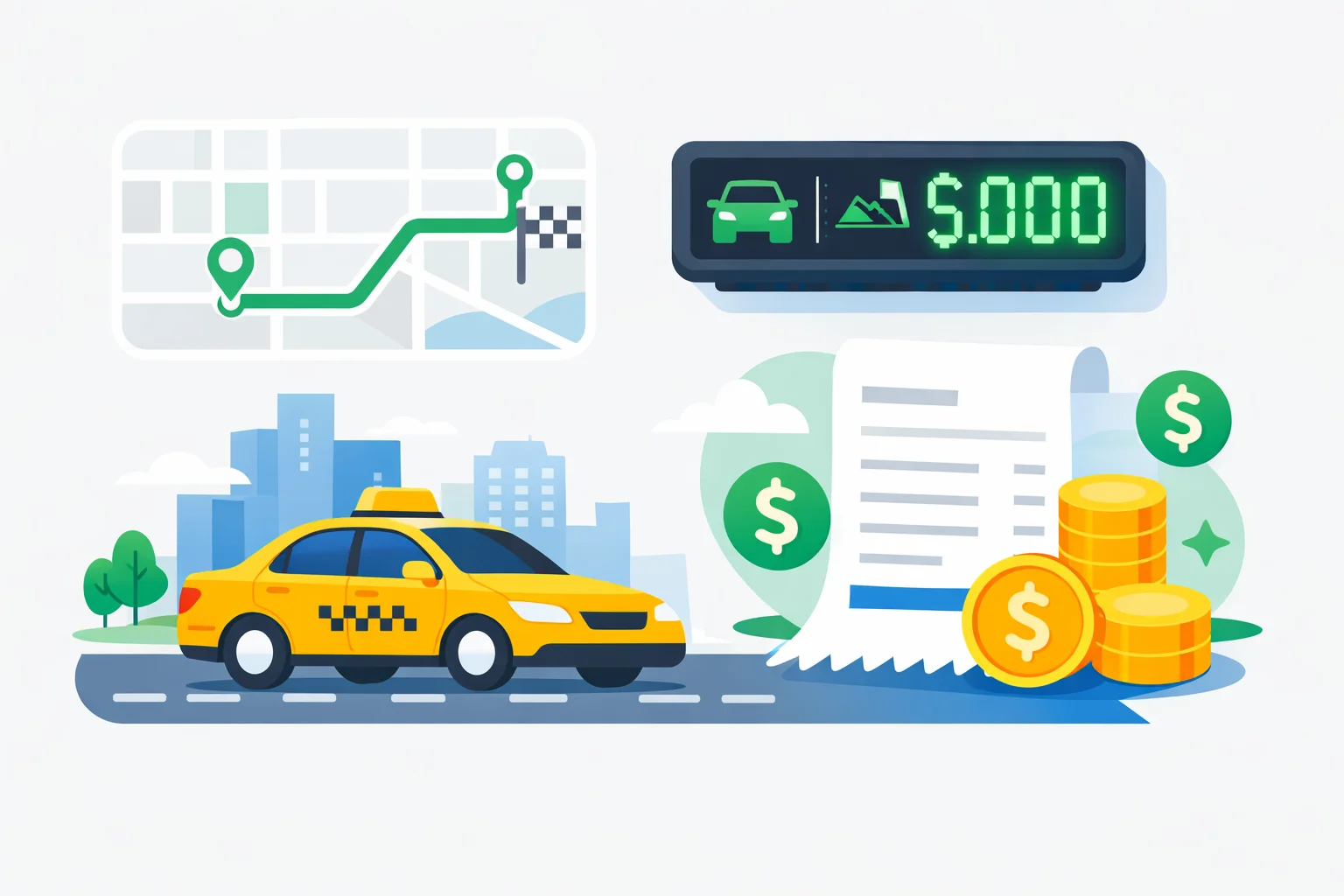
How a Taxi Meter Actually Works: Distance Until You Slow Down, Then Time
Every metered cab fare starts the same way — with a flat drop charge (also called the flag pull) the moment your trip begins. In an average U.S. market that's around $3.00, and you pay it whether you go two blocks or two miles. From there the meter runs on a speed switch. Above roughly 12 mph it bills by the mile; below that threshold it stops counting distance and starts counting minutes instead.
This is the part riders never see coming. A 5-mile ride at 2 a.m. on empty roads might meter out to $15. The same 5 miles during a 5 p.m. crawl can hit $24, because you spent 15 minutes barely moving and the meter spent those 15 minutes ticking on time at $0.50 a minute. The cab didn't cheat you — the route just spent more of itself in "time mode" than "distance mode." That's why the calculator asks for your slow-traffic minutes separately: it's the single biggest reason two identical-length trips cost different amounts.
Metered Taxi Rates in 8 Major U.S. Cities
Unlike Uber and Lyft, traditional taxi rates aren't set by an app — they're fixed by city or county regulators and printed on a sticker in the cab. That makes them refreshingly predictable. Here are the published meter rates the calculator uses, so you can see how far apart markets really are:
| City | Drop charge | Per mile | Per minute (wait) |
|---|---|---|---|
| U.S. national average | $3.00 | $2.50 | $0.50 |
| New York City (yellow cab) | $3.00 | $3.50 | $0.70 |
| Chicago | $3.25 | $2.25 | $0.33 |
| Los Angeles | $3.10 | $2.92 | $0.55 |
| San Francisco | $4.15 | $3.25 | $0.55 |
| Washington, D.C. | $3.50 | $2.16 | $0.42 |
| Boston | $2.60 | $2.80 | $0.47 |
| Las Vegas | $3.50 | $2.76 | $0.55 |
Look at the per-mile column and the gaps jump out. A 10-mile ride costs about $25 in distance charges in New York but only $22.50 in Chicago — and that's before New York stacks on its $1.50 in MTA and improvement surcharges. San Francisco's $4.15 flag pull is nearly $1.60 higher than the national norm, which is why short SF hops feel punishing. New York also adds a $0.50 overnight surcharge, so the "late-night ride" toggle in the calculator isn't cosmetic — it reflects a real line on the tariff.
A Real 7-Mile Cab Ride, Metered to the Dollar
Numbers beat theory, so let's meter an actual trip. You hail a cab for a 7-mile ride across an average-rate city during light rush hour — say 8 minutes of the trip is spent stopped or crawling. Using the national tariff ($3.00 drop, $2.50/mile, $0.50/minute) and an 18% tip, here's how the meter builds the bill:
- Drop charge: $3.00 the instant the meter starts
- Distance: 7 mi × $2.50 = $17.50
- Waiting time: 8 min × $0.50 = $4.00
- Meter total: $24.50 before tip
- Tip (18%): $4.41
- Total you pay: $28.91 — about $4.13 per mile all-in
Now run the same 7 miles with no traffic and the waiting charge disappears entirely: the meter total drops to $20.50 and your all-in cost falls to roughly $24.19. That $4.72 swing came purely from 8 minutes of sitting still. It's the clearest argument there is for asking your driver to take the longer-but-flowing route over the "shortcut" that dumps you into gridlock — on a meter, motion is almost always cheaper than standing still.
When a Taxi Still Beats Uber or Lyft
Ride-hailing didn't make cabs obsolete; it just changed when each one wins. Because a taxi meter is fixed by regulation, it never "surges." That's its superpower on the exact nights apps get ugly. Use this framework to decide:
Take the taxi when…
- • It's a surge event — New Year's, a concert letout, a downpour. A flat meter beats a 2.5x multiplier.
- • You're on an airport flat-rate route (JFK–Manhattan is a fixed ~$70 plus tolls and surcharge).
- • There are no drivers on the app but a cab line is right there.
- • You want to pay cash or skip a booking fee entirely.
Open the app when…
- • Demand is calm — base rideshare rates usually undercut a meter.
- • The trip is long and free-flowing, where per-mile app rates near $0.90 shine.
- • You want an upfront price instead of a meter you can't see climbing.
- • You're comparing tiers or splitting a fare with friends.
The honest move is to price both. Run your trip here, then check the app side with our Uber fare calculator or settle the eternal debate with the Uber vs Lyft price comparison. If you mostly ride one app, the Lyft calculator breaks that fare down the same way this one breaks down a meter. And if you just want the verdict, our taxi vs Uber calculator prices both models side by side and tells you the surge multiplier where the meter starts winning — roughly 2.0x on an average-tariff trip.
The Surcharges That Quietly Inflate Your Fare
The meter rate is only half the bill. The other half hides in surcharges that vary wildly by city, and missing them is how a "$20 ride" becomes $30. New York layers a $1.50 MTA-plus-improvement fee on every trip, a $0.50 overnight charge, and in much of Manhattan a $1.50 congestion surcharge — that's up to $3.50 before the wheels even move. Las Vegas tacks roughly $2.00 onto airport pickups. Tolls are always passed straight through to you, so a $6.55 bridge toll on an airport run is yours to pay on top of the meter.
The most expensive mistake riders make is assuming the meter total is the final number. On that 7-mile example in NYC, you'd add the $1.50 surcharge to the meter and any toll and an 18% tip — easily $6–$8 you didn't budget for. Tipping a cab driver follows the same 15–20% standard as a restaurant; on a $24.50 meter, 18% is about $4.41, and most card readers bolted to the partition default to those exact preset buttons. For the official rate sheet behind New York's numbers, the NYC Taxi & Limousine Commission fare page is the source of truth, and Wikipedia's explainer on how the taximeter works is a solid neutral primer on the distance-versus-time mechanic behind every fare.