
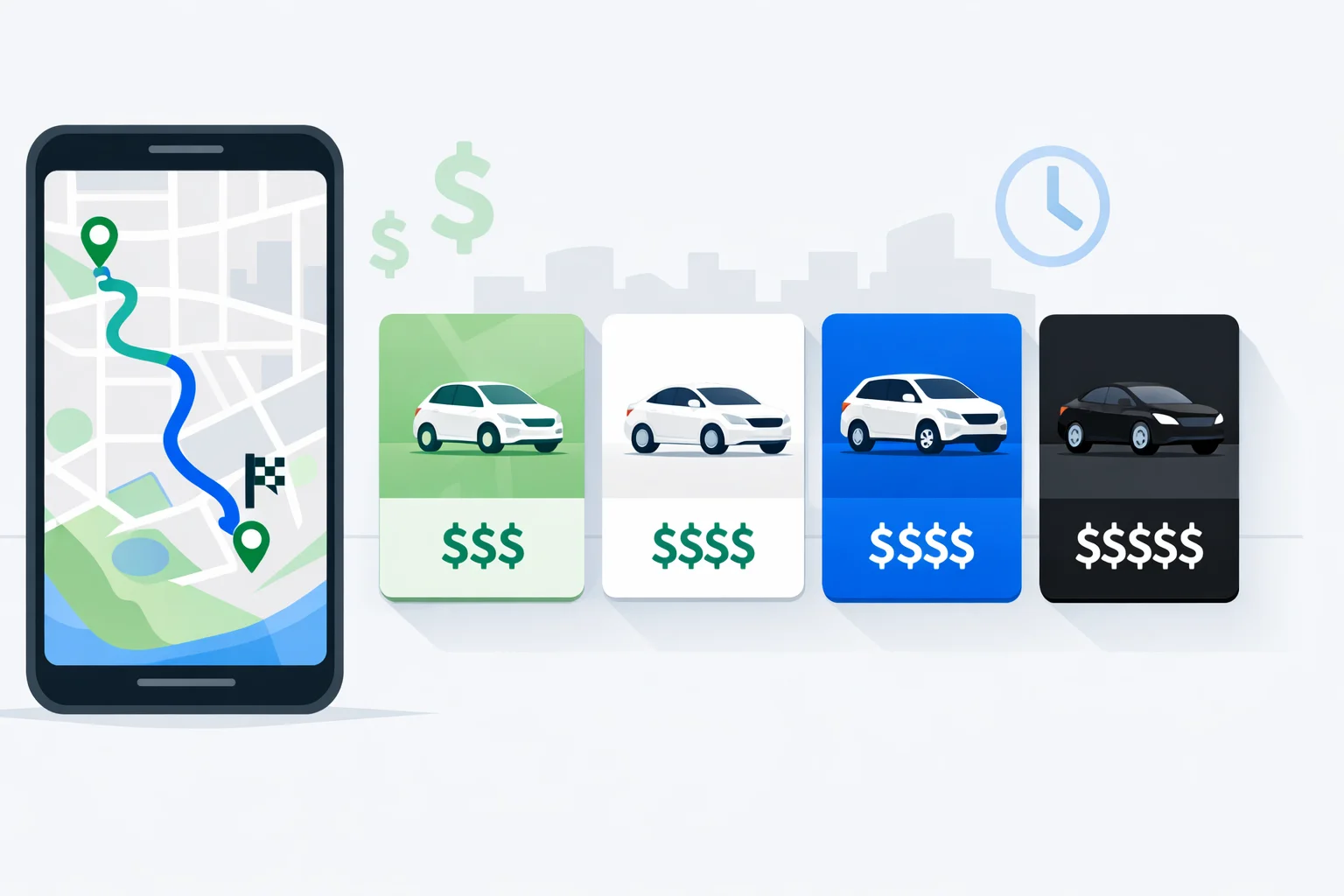
Get an Uber Ride Estimate for Every Tier at Once
An Uber ride estimate tells you roughly what a trip will cost before you ever tap "Request" — and our tool gives you one for all four ride tiers in a single view instead of making you flip between them in the app. Punch in your distance and the calculator shows a price range for UberX, Comfort, UberXL, and Uber Black side by side, plus the drive time and a door-to-door ETA. That's the whole point of an estimate: deciding whether to ride, walk, or wait out a surge before you're committed.
Here's the part most people miss, though. The number you estimate and the price Uber actually charges rarely match to the cent. Below we'll show you why the gap exists, walk a real 6-mile trip across all four tiers, and point out the exact moments when any estimate — ours or the app's — is most likely to be off.
Why Your Estimate and Your Final Fare Rarely Match
Open the Uber app and you'll see a single upfront price, not a range. That upfront number is Uber's own estimate locked in — it bundles a guess about traffic, the current surge multiplier, and your specific city's rate card into one figure. Our estimate shows a range instead because we don't have your live demand data. The low end assumes clean roads; the high end bakes in stop-and-go traffic and a modest demand bump.
Three things move the real price away from any pre-trip estimate. Traffic is the big one: Uber charges per minute, so a 15-minute drive that balloons to 25 minutes in rush hour adds real money. Surge is the second — a 1.8x multiplier turns an $12 UberX into roughly $19 in seconds. The third is the route itself; if the driver takes a longer path or you change your drop-off mid-ride, the per-mile meter keeps running. Want to see exactly how those charges stack up on a finished ride? Our Uber fare calculator breaks a single trip into its base fare, distance, time, booking fee, surge, and tip — line by line.
One 6-Mile Trip, All Four Uber Tiers
Let's estimate the same ride four ways: 6 miles, about 15 minutes of driving, an average U.S. city, no surge. Using national-average upfront rates, here's what each tier costs and who it's for. Notice how the gap between UberX and Uber Black is nearly 4x for the identical route.
| Tier | Estimated Range | Seats | Best For |
|---|---|---|---|
| UberX | $11–$14 | Up to 4 | Everyday solo or pairs, lowest price |
| Comfort | $14–$18 | Up to 4 | Newer cars, extra legroom, top-rated drivers |
| UberXL | $18–$23 | Up to 6 | Groups of 5–6 or lots of luggage |
| Uber Black | $38–$48 | Up to 4 | Luxury sedan, professional drivers |
The takeaway isn't "always pick UberX." If you're four people splitting an UberXL, that $18–$23 works out to about $4 a head — cheaper per person than two separate UberX cars. Estimating every tier at once is the fastest way to spot that kind of math. For a deeper dive on what shapes the base UberX price, see our Uber cost calculator.
How the Estimate Is Built
Every Uber tier uses the same four-part formula, just with different rates. The math is simple once you see it:
Fare = Base + (Per-mile × miles) + (Per-minute × minutes) + Booking fee
For our 6-mile UberX example, that's $1.00 base + ($0.90 × 6 miles = $5.40) + ($0.20 × 15 minutes = $3.00) + $2.50 booking fee = $11.90. Surge, when it's active, multiplies the metered portion before the booking fee is added. A city-pricing adjustment then scales the whole thing — a major metro like New York or San Francisco runs roughly 30% higher than the national average, which is why that same UberX estimate climbs to about $15 in Manhattan.
One rule trips people up: the minimum fare. Every tier has a floor — around $7.50 for UberX. A 1.5-mile hop that meters out to $5.65 still bills the $7.50 minimum, so short trips cost more per mile than long ones. The calculator flags any tier that hits its floor so you're not surprised.
5 Ways to Make Your Estimate Land Lower
An estimate isn't just a number to accept — it's a number you can move. Here's where the savings actually live:
- Wait out the surge. Surge often spikes for 5–15 minutes around event lets-out or rain. Watching a 2.0x multiplier drop to 1.2x can shave $8–$10 off a mid-length UberX with zero effort.
- Walk two blocks out of a surge zone. Surge is geo-fenced. Moving a few hundred feet to a lower-demand pin can re-estimate your trip at the normal rate.
- Split an UberXL with a group. Four-plus riders almost always beat the cost of multiple UberX cars once you do the per-person math.
- Compare against Lyft before you book. Pricing diverges trip to trip. Put both apps head to head with our Uber vs Lyft price comparison or run the route through our Lyft price estimate and take whichever estimate wins.
- Avoid the airport "round trip" trap. Pickup and drop-off surcharges at airports can add $3–$6 that never show in a basic distance estimate — budget for them separately.
When an Estimate Will Be Off the Most
No estimate is a guarantee, and a few situations widen the gap more than others. Skip the estimate-as-gospel mindset when:
- You're riding during peak surge. Multipliers change second to second. An estimate taken at a calm moment can be 50% low if you book 90 seconds later during a spike. If the trip is already on your calendar, our scheduled Uber fare calculator shows the surge level at which locking a price through Uber Reserve costs less than gambling on the spike.
- Traffic is unpredictable. Because Uber charges per minute, a crash or construction on your route can add 10+ minutes of billed time the estimate never saw coming.
- Your city has its own rules. Regulated markets like New York City set their own per-trip surcharges and minimum pay rules, so national-average rates won't match the local card.
For drivers curious about the other side of the fare — how much of that estimate actually reaches the person behind the wheel — our rideshare driver earnings calculator runs the take-home math. To go deeper on the mechanics behind surge, this explainer on dynamic pricing is a solid primer, and NerdWallet's guide to what an Uber costs digs into the real-world numbers. In regulated markets, the NYC Taxi & Limousine Commission publishes the official rate rules that override national averages.