
Does Lyft Charge by Mile or by Time? Both, at the Same Time
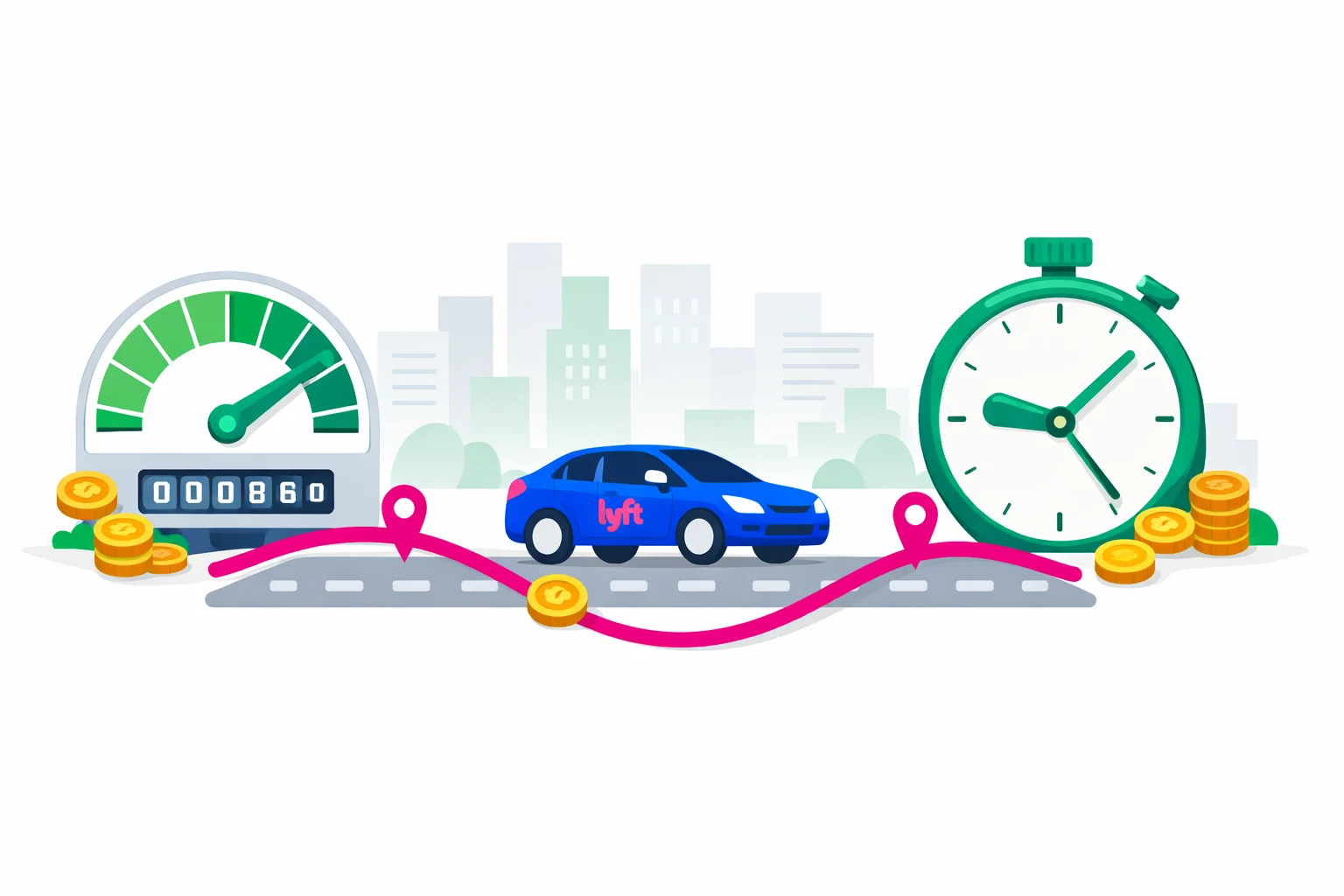
The quick answer to does Lyft charge by mile or time is: it charges by both, simultaneously, on every single trip. Lyft runs two meters at once — one ticks up for each mile you travel, the other for each minute you're in the car — then adds a base fare and a service fee on top. People assume it's one or the other, which is exactly why a ride that “should” be cheap based on distance comes back $4 higher than expected. The minute meter was running the whole time you sat at red lights. This calculator pulls those two charges apart so you can see which half — the Lyft cost per mile or the per-minute charge — is actually driving your fare.
Here's the twist most riders miss: the balance between the two flips depending on how fast you're moving. On an open highway, distance does almost all the work. In stop-and-go downtown traffic, the per-minute charge can nearly catch up to it — for the same number of miles. Understanding that split is the difference between guessing at a fare and knowing why it landed where it did.
The Four Pieces of Every Lyft Fare
Lyft uses upfront pricing, so you see one number before you confirm. But that number is built from a meter with four standard ingredients. Here's what each one does on a typical Standard Lyft ride in an average metro:
- Base fare (~$1.00) — a flat charge just for starting the trip.
- Per-mile rate (~$0.90/mile) — the distance meter, billed on every mile driven.
- Per-minute rate (~$0.15/min) — the time meter, billed on every minute, moving or not.
- Service fee (~$2.75) — a fixed platform charge added to nearly every ride.
There's also a minimum fare (around $3.50–$5.00) that kicks in on very short hops, and on busy nights a Prime Time multiplier that scales the whole meter up. The calculator above models the four core pieces so you can see the mile-vs-minute split clearly; tolls, airport surcharges, and Prime Time sit on top of that base meter. Lyft publishes the live rate card for your city in its how pricing works help center if you want your exact local numbers.
An 8-Mile Trip, Split Line by Line
Take a real example: an 8-mile downtown ride in a medium-cost city, moving at a normal 22 mph, so the trip takes about 22 minutes. Run the standard meter and here's how it breaks down:
- Base fare: $1.00
- Distance charge: 8 mi × $0.90 = $7.20
- Time charge: 22 min × $0.15 = $3.30
- Service fee: $2.75
That's a $14.25 fare. Strip out the base and service fee, and the meter itself is $10.50 of driving — $7.20 from distance and $3.30 from time. So distance is 69% of the meter and time is 31%. The effective rate works out to about $1.78 per mile all-in. At cruising speed, distance clearly wins. But watch what happens when the car slows down.
How Traffic Flips the Mile-vs-Time Balance
The per-minute charge is the reason an identical route can cost different amounts on different days. The distance never changes — it's still 8 miles — but the minutes do, and every extra minute adds $0.15. Here's the same 8-mile trip at three traffic speeds:
| Traffic | Speed / Time | Distance Charge | Time Charge | Total Fare |
|---|---|---|---|---|
| Free-flowing | 38 mph / 13 min | $7.20 (79%) | $1.95 (21%) | $12.90 |
| Moderate | 22 mph / 22 min | $7.20 (69%) | $3.30 (31%) | $14.25 |
| Heavy / gridlock | 11 mph / 44 min | $7.20 (52%) | $6.60 (48%) | $17.55 |
Same 8 miles, but the fare swings from $12.90 to $17.55 — a $4.65 difference, entirely from the time meter. In gridlock the per-minute charge nearly ties the per-mile charge (48% vs 52%). This is why a short crosstown ride during rush hour can cost more than a longer highway trip: you're paying for 44 minutes of someone's time, not just 8 miles of road. To see this on your own routes, drop your numbers into the Lyft price estimate tool for the full upfront range including Prime Time and tip.
Per-Mile and Per-Minute Rates by City
Lyft sets different rate cards by market, so the same trip costs more in San Francisco than in a smaller metro. These are typical Standard Lyft rates — use them to sanity-check the split the calculator gives you:
| City Cost Level | Per Mile | Per Minute | Service Fee |
|---|---|---|---|
| Low (small city / rural) | $0.70 | $0.12 | $2.50 |
| Medium (average metro) | $0.90 | $0.15 | $2.75 |
| High (NYC, SF, LA, Chicago) | $1.15 | $0.25 | $3.00 |
Notice the per-minute rate roughly doubles from a low-cost market ($0.12) to a high-cost one ($0.25). That's why traffic stings far worse in dense, expensive cities — you're paying a premium minute rate andsitting in more of those minutes. For a side-by-side on whether Lyft or its rival is cheaper on your exact route, the Uber vs Lyft price comparison runs both meters at once.
When the Time Charge Quietly Wins
Most riders budget for distance and forget the clock. The per-minute meter takes over the fare in three specific situations — and knowing them helps you predict (or avoid) a surprise:
- Rush-hour crawls. A 5-mile ride at 10 mph takes 30 minutes. At $0.15/min that's $4.50 in time charges versus just $4.50 in distance — a dead heat where you'd expect distance to dominate.
- Stacked detours and reroutes. Construction or a closed road adds minutes even when mileage barely moves. Those extra minutes bill at the full per-minute rate.
- High-cost cities. At $0.25/min, 20 minutes of city driving is a flat $5.00 before you've counted a single mile. In these markets the time meter is rarely a rounding error.
The flip side: long highway trips are where distance dominates and the per-minute charge fades to background noise. A 25-mile suburban airport run at 45 mph is about 33 minutes — $22.50 in distance against $4.95 in time, so time is under a fifth of the meter. If you're comparing a Lyft to a metered cab on that kind of trip, our taxi fare calculator uses the same distance-plus-time logic that traditional taxi meters run on, and the Lyft calculator gives you a fast all-in total when you don't need the breakdown.
Why Your Lyft Cost More Than the Distance Suggested
If you ever stared at a receipt thinking “it was only 6 miles, why was it $19?” the answer is almost always one of two things: time or Prime Time. A 6-mile ride that took 35 minutes in traffic carries about $5.25 in time charges on a medium rate card — nearly as much as its $5.40 in distance. Layer a 1.5x Prime Time multiplier on a busy night and the whole meter jumps 50%. Neither shows up as a line you'd notice; they're baked into the single upfront price. For the broader picture of how demand-based pricing inflates the meter, Investopedia's explainer on how surge pricing works is a solid, vendor-neutral reference. Run a few of your own recent trips through the calculator above and the “mystery” fares usually resolve into one over-long, slow ride.