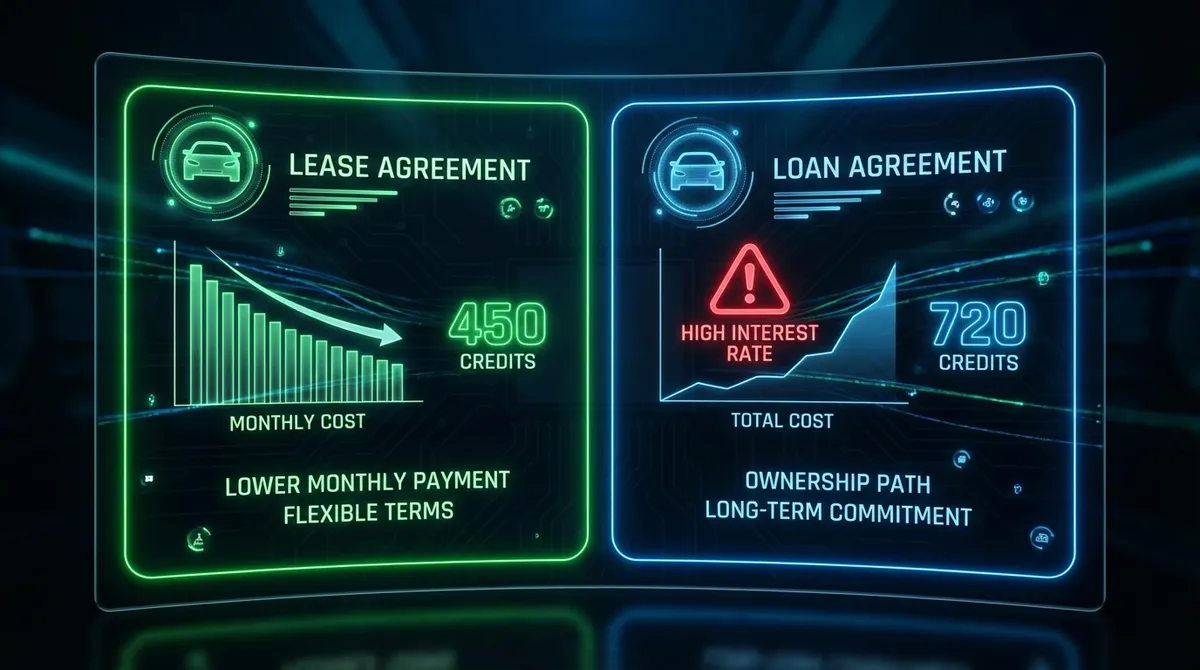
Car Lease Payment Calculator: What $400/Month Actually Costs You Over 36 Months
A car lease payment calculator reveals something most shoppers miss: that $400/month lease you saw advertised actually costs $17,800 once you add the $2,000 down payment and $1,400 in fees the ad conveniently buries in the fine print. The gap between the advertised payment and the real cost of a lease averages $3,200 according to a 2024 Experian analysis of auto lease originations.
We built this calculator specifically to expose every hidden layer — depreciation, rent charge, taxes, and acquisition fees — so you can walk into the dealership knowing your real number, not their marketing number. Let's break down exactly how car lease payments work and where the money goes.
A Real Lease Negotiation: $38,000 SUV, Start to Finish
Here's a scenario we see constantly. You're leasing a midsize SUV with a $40,000 MSRP. The dealer offers you a 36-month lease at $489/month with $3,000 due at signing. Sounds reasonable — but is it?
Plug these numbers into the calculator and the picture changes. With a negotiated price of $38,000 (5% below MSRP), a 57% residual value, a money factor of 0.00175 (4.2% APR equivalent), 7% sales tax, and a $695 acquisition fee, here's what actually happens:
| Component | Per Month | 36-Month Total |
|---|---|---|
| Depreciation (value lost while you drive it) | $373.75 | $13,455 |
| Finance charge (interest to the bank) | $103.16 | $3,714 |
| Sales tax (on monthly payment) | $33.38 | $1,202 |
| Monthly payment | $510.30 | $18,371 |
| + Down payment & acquisition fee | — | $2,695 |
| True total cost of this lease | — | $21,066 |
That $489/month advertised deal? Once you account for the full down payment and fees, the effective monthly cost is $585 — not $489. The difference is $3,456 over the life of the lease. This is exactly why running the numbers yourself matters more than trusting the dealer's quote sheet.
3 Numbers That Control 90% of Your Lease Payment
Lease math has a lot of moving parts, but three variables drive almost everything. Change any one of them and your payment shifts dramatically. Understanding which numbers you can negotiate (the cap cost and money factor) versus which are fixed by the bank (residual value) is the difference between a good deal and an expensive one.
1. The Negotiated Price (Cap Cost)
Every $1,000 you negotiate off the sticker price saves roughly $30/month on a 36-month lease. On that $40,000 SUV, getting the dealer from MSRP down to $38,000 drops your depreciation fee by $55.56/month — that's $2,000 saved over the full term. Many buyers don't realize you negotiate a lease price exactly like a purchase. The selling price isn't fixed just because you're leasing.
2. The Residual Value
Residual is the single biggest lever you can't directly control — the bank sets it. But you can choose vehicles with strong residuals. A car with a 62% residual on a $40,000 MSRP means you only pay for $15,200 in depreciation. Drop that to 52% residual and depreciation jumps to $19,200 — that's $111 more per month for a 36-month term. Hondas, Toyotas, and some luxury brands (Porsche, Lexus) consistently post the highest residuals. The FTC's guide to financing and leasing explains which disclosures dealers must provide.
3. The Money Factor
Money factor is just interest in disguise. Multiply it by 2,400 to get the equivalent APR — our money factor to APR calculator does the conversion both ways. A money factor of 0.00125 = 3.0% APR. A factor of 0.00250 = 6.0% APR. That difference on our $38,000 SUV? About $73/month. Over 36 months, you'd pay $2,628 more in rent charges alone by accepting the higher rate. Always ask the dealer for the "buy rate" money factor — that's the base rate from the bank before any dealer markup.
Here's Where Most People Lose Money on a Lease
We've run thousands of scenarios through this calculator, and the same costly mistakes keep showing up.
Putting $3,000+ down on a lease. Down payments on a lease are fundamentally different from a purchase. If your leased car gets totaled 3 months in, the insurance company pays the leasing bank — and your $3,000 down payment vanishes. You don't get it back. On a 36-month lease, a $3,000 down payment only saves about $83/month. Keep that $3,000 in a savings account earning 4.5% APY and you'll pocket $135 in interest while covering the slightly higher payment.
Negotiating the monthly payment instead of the price. Dealers love when you say "I want to be at $400/month." They can hit any monthly target by stretching the term, burying fees in the cap cost, or inflating the money factor. Always negotiate the selling price first, then ask for the residual and money factor. Our lease calculator shows you exactly how each input changes the output — so you know when a "lower payment" actually costs more over the full term.
Ignoring the acquisition fee. This bank fee ranges from $595 (Honda, Toyota) to $1,095 (BMW, Mercedes). On most leases, it gets rolled into the capitalized cost, meaning you pay interest on it for the full term. A $995 acquisition fee at a 0.00175 money factor adds $6.27/month in hidden finance charges — $226 over 36 months on top of the fee itself.
When You Shouldn't Lease a Car
A lease isn't always the smart move, even when the payment looks attractive. Skip leasing in these situations:
You drive more than 12,000 miles per year. Mileage penalties hit hard — $0.20 to $0.30 per mile is standard. Driving 15,000 miles/year on a 12,000-mile lease means 9,000 excess miles over 36 months. At $0.25/mile, that's a $2,250 bill at lease turn-in. Use our lease mileage calculator to see exactly what your overage will cost and whether buying extra miles upfront saves money. At high mileage volumes, financing the car with our car payment calculator often makes more sense.
The residual value is below 50%. If a car depreciates that fast, you're paying for more than half its value while only "renting" it. At 45% residual on a $35,000 car, your depreciation alone is $535/month for a 36-month term. You could buy the same car with a 60-month loan at 6% APR for $676/month — and actually own it afterward.
You plan to customize the vehicle. Aftermarket wheels, tint, suspension mods — all of it has to come off before turn-in, or you'll pay disposition and damage charges. A lease is a rental. If you want to make the car yours, buy it.
24 vs. 36 vs. 48 Months: Which Lease Term Saves the Most?
Shorter leases have higher monthly payments but lower total costs. Here's the math on the same $40,000 SUV at 0.00175 MF:
| Metric | 24 Months | 36 Months | 48 Months |
|---|---|---|---|
| Typical Residual | 63% | 57% | 51% |
| Monthly Payment | $608 | $510 | $458 |
| Total Lease Cost | $17,287 | $21,066 | $24,683 |
| Total Interest Paid | $2,331 | $3,714 | $5,083 |
| Warranty Coverage? | Full 3yr/36K | Full 3yr/36K | Partial (last year exposed) |
The 24-month lease costs $3,779 less than the 36-month and $7,396 less than the 48-month over the full term. But your monthly payment is $98 higher than the 36 and $150 higher than the 48. The sweet spot for most people is 36 months — it matches the typical 3-year/36,000-mile bumper-to-bumper warranty, so you're never paying for repairs out of pocket. Use the "Compare Terms" toggle in our calculator above to model your exact numbers.
Watch out for 48-month leases. The last 12 months often fall outside the factory warranty, meaning you could be responsible for repairs on a car you don't even own. Some manufacturers offer extended warranty packages, but they add $30-$50/month to your effective cost. You can compare the total cost of buying vs leasing with our lease vs. buy calculator, or use the lease vs finance calculator to see how serial leasing stacks up against financing one car over 5-10 years.
For more details on federal lease disclosure requirements and your rights as a lessee, see the CFPB's guide to auto leasing.