
What If Everything You've Heard About Leasing vs. Financing Is Wrong?
Our lease vs finance calculator compares costs that most people never think to compare: the cumulative price of serial leasing against financing one car and keeping it. "Leasing is just throwing money away" — you've probably heard that from a relative, a finance blog, or a coworker who insists everyone should buy. But that advice ignores how time, interest rates, and depreciation interact over 5-10 years.
Here's the uncomfortable truth: at a 7.5% APR on a 72-month loan, financing a $38,000 car costs you $8,400 in interest alone. Meanwhile, a 36-month lease at $420/month costs $15,120 in payments — but you walk away and start fresh. Which one "wastes" more money depends on a variable nobody talks about at the dealership: how long you actually plan to keep driving. (Walking away mid-term is a different story — our lease early termination calculator shows the same lease can cost $800 or $6,900 to exit depending on the route you pick.)
The "Leasing Is Always Cheaper Per Month" Myth
Yes, lease payments are lower. On a $38,000 vehicle, a typical 36-month lease runs $380-$450/month while a 60-month loan at 6.5% APR costs roughly $743/month. That $300/month gap is real — but it's misleading.
Lease payments cover only depreciation plus a rent charge (the lender's profit). You never build equity. Financing payments cover the full vehicle price, and once the loan ends, you own an asset. A financed $38,000 car with 15% annual depreciation is still worth about $16,300 after 5 years. That residual value drops your net cost by a third.
The monthly payment comparison only tells the truth for the first 3 years. After that, the financer stops paying while the serial leaser starts a brand-new lease — with a brand-new down payment and brand-new acquisition fee.
Where the Break-Even Point Actually Falls
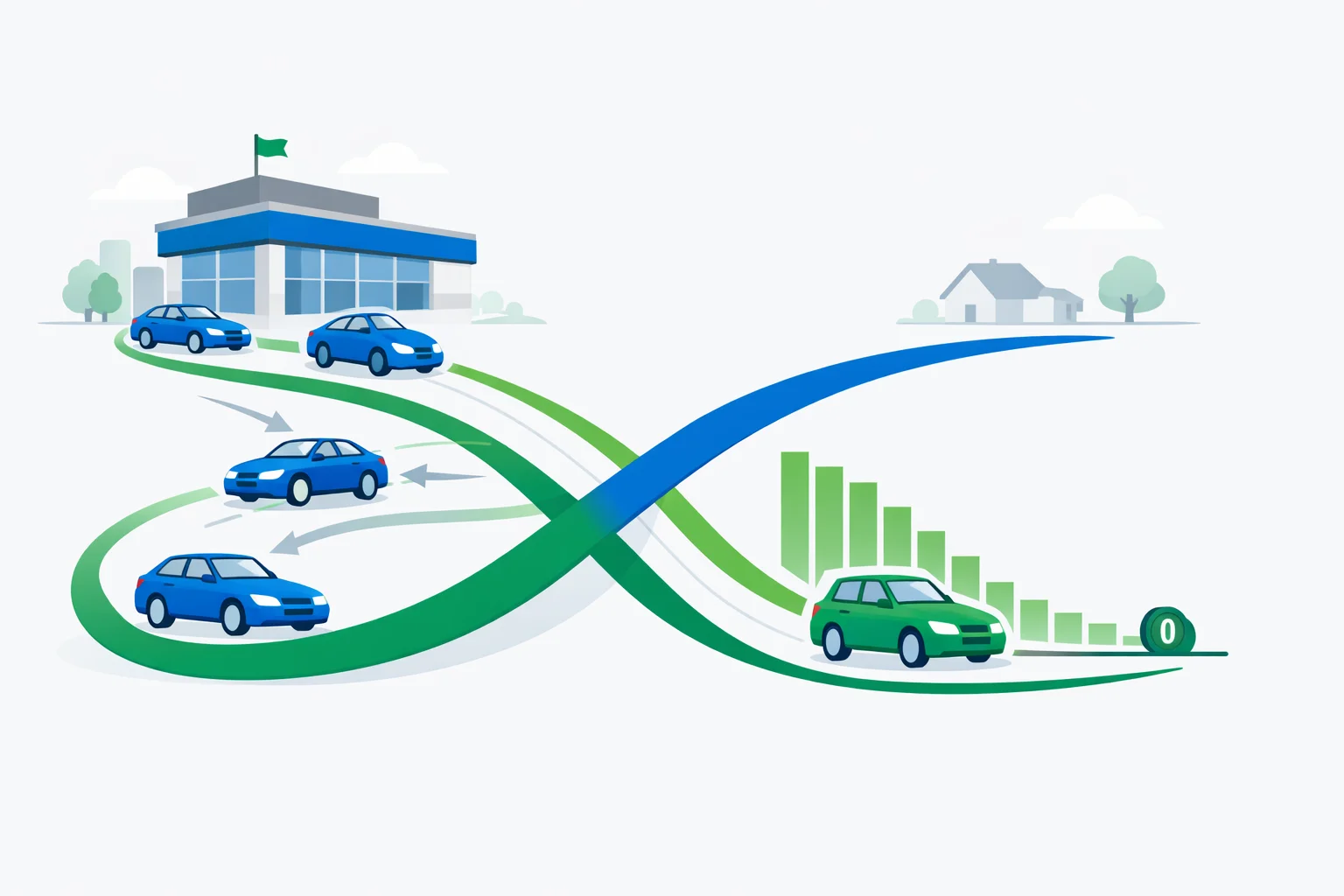
Run the numbers on a $38,000 vehicle, 6.5% finance APR, $420/month lease, and 15% annual depreciation. The cumulative cost curves cross somewhere around month 50-54. Before that crossover, leasing is cheaper. After it, financing pulls ahead — and the gap widens every single month.
By year 7, the financer has spent roughly $49,500 total (down payment + loan payments) but owns a car worth about $12,800. Net cost: ~$36,700. The serial leaser has burned through two full 36-month leases — $2,000 down each, $420/month each, plus $650 acquisition and $400 disposition fees per lease. That's roughly $39,600 with zero equity.
A $2,900 difference might not sound massive, but it grows exponentially. By year 10, the gap is over $15,000 because the financer drives payment-free for 5 years while the leaser signs lease number three.
When Leasing Actually Wins the Math
Financing isn't always the better deal. Three scenarios where leasing comes out ahead:
| Scenario | Why Leasing Wins | Typical Savings |
|---|---|---|
| High depreciation vehicle (20%+/yr) | Luxury cars and some EVs lose 40-50% in 3 years. The residual value that makes financing worthwhile evaporates. | $3,000-$6,000 over 5 years |
| Finance rate above 8% | High-interest loans generate $10,000+ in interest on a $38K car over 60 months, erasing the equity advantage. | $2,000-$5,000 over 5 years |
| Short ownership horizon (3 years or less) | If you're trading in every 3 years anyway, you eat the steepest depreciation without the payment-free years that make financing cheaper. | $1,500-$4,000 per cycle |
Average new car interest rates climbed from 4.5% in early 2022 to over 7.1% by late 2024, according to Experian's auto loan data. That shift pushed the break-even point from around month 42 to month 55+ for many buyers. If rates keep climbing, leasing gets more competitive in pure cost terms.
A Decision Framework That Actually Works
Stop asking "lease or finance?" as a binary question. Instead, answer these three questions — they'll point you toward the right choice faster than any rule of thumb.
1. How many years will you drive this car? If you'll keep it 5+ years, financing almost always wins because you get 2-4 years of payment-free driving. Our lease vs buy calculator can model a single lease-vs-purchase period, while this tool extends that comparison over multiple lease cycles.
2. What's your real APR? Check your credit score first. Buyers with 750+ credit get rates around 5.5-6.5% (as of early 2026), which heavily favors financing. Below 650, rates jump to 10-14%, and financing generates so much interest that leasing often costs less overall. Use our auto loan calculator to see the exact interest burden at your rate.
3. How fast does the car depreciate? Set the depreciation slider in the calculator above to match your vehicle type. Trucks and Toyotas? 10-12%. German luxury sedans? 18-22%. A BMW 5 Series loses about $22,000 in value over 3 years at a 20% annual depreciation rate — that's more than many people pay in total lease costs for the same period.
The Hidden Costs That Shift the Equation
Both paths carry costs that don't show up in the monthly payment. When financing, budget $800-$1,500/year for maintenance once the factory warranty expires (typically at 36-60 months). According to Bureau of Labor Statistics consumer expenditure data, the average American household spends $2,490/year on vehicle maintenance and repairs.
Leasing dodges most of that — you're always under warranty. But leases have their own traps: mileage penalties at $0.15-$0.30 per mile over the limit, wear-and-tear charges at lease return ($500-$2,000 is common), and the acquisition/disposition fees that repeat with every new lease. Our lease mileage calculator can estimate those overage costs before they surprise you.
Don't forget gap insurance. If you total a leased car, you owe the remaining lease balance minus what insurance pays — that gap can hit $3,000-$5,000. Some leases bundle gap coverage; others charge $500-$800 extra.