
Fuel Savings Calculator: How Much a Better MPG Rating Actually Saves You
Our fuel savings calculator shows you the exact dollar difference between two vehicles based on their MPG ratings — no guessing, no hand-waving, just the math. If you're shopping for a new car and keep hearing "you'll save so much on gas," this tool puts a real number on that claim. Spoiler: the gap between 22 MPG and 32 MPG is bigger than most people expect.
We built this because fuel cost is one of those ongoing expenses that sneaks up on you. A $50 difference each month doesn't feel dramatic at the pump, but that's $3,000 gone over five years. Below, we'll walk through exactly how MPG differences translate into dollars, where the biggest savings hide, and a few scenarios that might change how you think about your next purchase.
The Real Cost of Low MPG (It's More Than You Think)
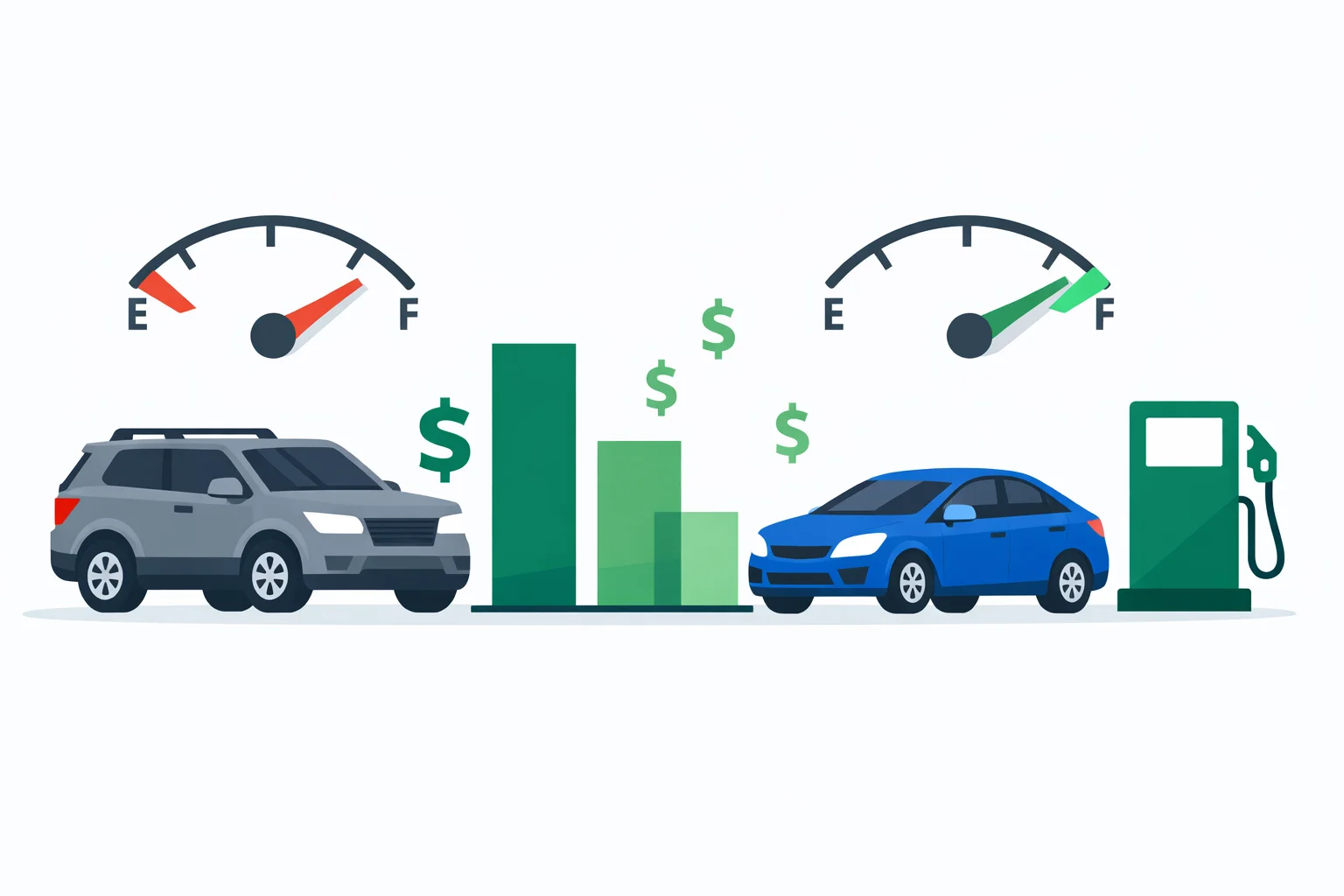
Here's a quick reality check. At $3.50 per gallon and 12,000 miles per year:
- A 20 MPG SUV burns 600 gallons and costs you $2,100/year in gas.
- A 30 MPG sedan burns 400 gallons and costs $1,400/year.
- A 50 MPG hybrid burns 240 gallons and costs $840/year.
The jump from 20 to 30 MPG saves $700/year. Bump that to 50 MPG and you pocket $1,260 annually compared to the SUV. Over a typical 5-year ownership period, that 20-to-50 MPG upgrade keeps $6,300 in your bank account instead of going out your tailpipe.
And those numbers assume gas stays at $3.50. If prices climb to $4.50 — which we've seen happen — that 5-year savings jumps to over $8,000. Try plugging different gas prices into our calculator above to see how sensitive the numbers are to price swings.
Where the Biggest Fuel Savings Actually Come From
Not all MPG improvements are created equal. Going from 15 MPG to 25 MPG saves far more money than going from 35 MPG to 45 MPG — even though both are a 10 MPG jump. Why? It's not linear.
| MPG Change | Gallons Saved/Year | Annual Savings | 5-Year Savings |
|---|---|---|---|
| 15 → 25 MPG | 320 gal | $1,120 | $5,600 |
| 20 → 30 MPG | 200 gal | $700 | $3,500 |
| 25 → 35 MPG | 137 gal | $480 | $2,400 |
| 30 → 40 MPG | 100 gal | $350 | $1,750 |
| 35 → 45 MPG | 76 gal | $267 | $1,333 |
Based on 12,000 miles/year at $3.50/gallon.
The takeaway? Replacing a gas-guzzling truck or older SUV with something even moderately efficient gives you the biggest bang for your buck. A driver trading a 15 MPG pickup for a 25 MPG crossover saves more than twice as much as someone going from 35 to 45 MPG. If you're curious about your current vehicle's actual mileage, our MPG calculator can help you measure it from your last fill-up. You can also look up the EPA-rated MPG for any vehicle at fueleconomy.gov.
Worked Example: Upgrading From an SUV to a Hybrid
Let's walk through a real comparison. Say you currently drive a mid-size SUV rated at 24 MPG combined, and you're eyeing a hybrid sedan rated at 48 MPG. You drive about 15,000 miles a year and gas in your area runs $3.80 per gallon.
Your current SUV: 15,000 ÷ 24 = 625 gallons/year × $3.80 = $2,375/year on gas.
The hybrid: 15,000 ÷ 48 = 312.5 gallons/year × $3.80 = $1,188/year on gas.
Your savings: $2,375 − $1,188 = $1,187 per year. That's $99/month. Over 5 years, you keep $5,935. Over 10 years? Nearly $12,000. That alone can cover a significant chunk of the hybrid's higher sticker price. Need to calculate the full trip cost for a road trip in either vehicle? Check our gas cost calculator.
What Most People Get Wrong About Fuel Savings
Three mistakes we see constantly when people compare vehicles on fuel efficiency:
Mistake #1: Using highway MPG only. Dealerships love quoting the highway number because it's always higher. But unless your commute is 100% interstate, combined MPG is what matters. City driving burns 20-40% more fuel. If your daily grind includes stop-and-go traffic, you could be spending $300-500 more per year than the sticker suggests.
Mistake #2: Ignoring fuel price volatility. Gas was $2.20 in 2020 and over $5.00 in parts of California by 2022, according to EIA gasoline price data. A high-MPG vehicle acts like insurance against price spikes. The wider the MPG gap between your two vehicles, the more you're protected when prices surge. Plug $4.50 or $5.00 into the calculator above to see how dramatically the savings grow.
Mistake #3: Thinking 10 MPG is always 10 MPG. As we showed in the table above, a 10 MPG improvement at the low end saves 2-4x more money than the same improvement at the high end. Replacing a 15 MPG truck saves real money. Going from 40 to 50 MPG? Diminishing returns.
If you commute daily and want to factor in parking, tolls, and other costs beyond just gas, our commute cost calculator gives you the full picture. One drain the MPG math misses entirely is time spent parked with the engine on — our idling fuel cost calculator prices out those wasted warm-ups and drive-thru waits. Considering a hybrid? Our hybrid vs gas calculator shows the exact break-even point where the hybrid premium pays for itself in fuel savings. And if you're weighing a full electric vehicle against a gas car, the EV vs gas cost calculator compares total ownership costs including maintenance, insurance, and depreciation.
Quick Decision Framework
Not sure if upgrading makes financial sense? Here's a simple rule of thumb:
- Drive under 8,000 miles/year? Fuel savings alone probably won't justify a new car purchase. Focus on other ownership costs.
- Drive 10,000-15,000 miles/year? A 10+ MPG improvement pays for itself over 5 years for most drivers. Worth calculating.
- Drive over 20,000 miles/year? Every MPG point matters. Even a 5 MPG bump saves $400-600/year at these distances. Prioritize efficiency.
- Gas prices above $4.00 in your area? Multiply all the savings numbers by 1.15-1.40x. High fuel prices make efficiency upgrades pay off faster.