
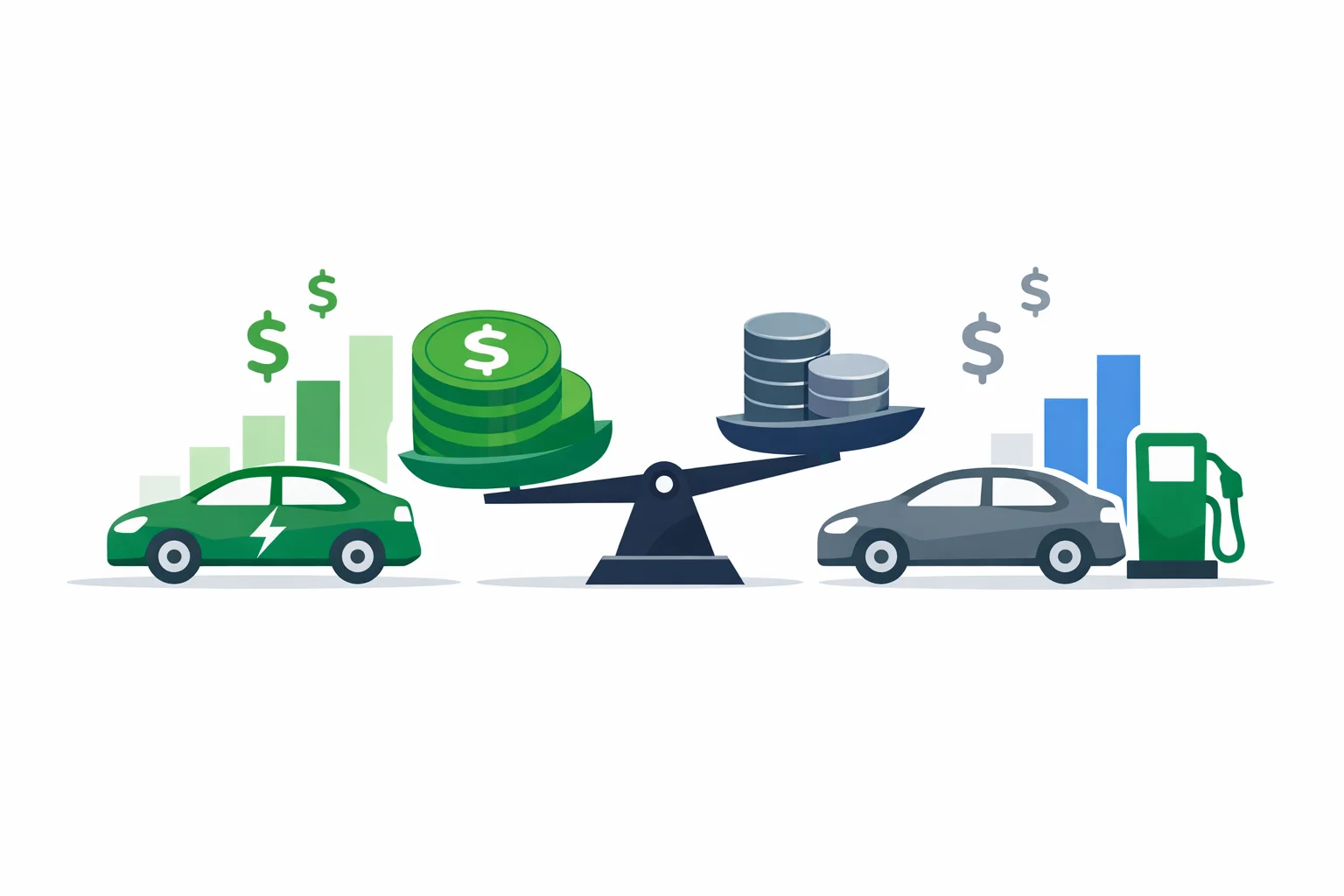
EV vs Gas Cost Calculator: The Real Numbers Behind Electric Car Savings
Our EV vs gas cost calculator compares every dollar you'll spend owning an electric vehicle versus a gas-powered car — fuel, maintenance, insurance, and depreciation — over your actual ownership period. The sticker price only tells half the story. A $35,000 EV and a $28,000 sedan can flip positions entirely once you factor in $1,500/year in fuel savings, $600/year in lower maintenance, and different depreciation curves. We built this tool so you can plug in your real numbers and see exactly when — and whether — an EV pays for itself.
How to Use This Calculator
Getting an accurate comparison takes about two minutes. Here's how to walk through each section:
- Annual Miles Driven — Enter how many miles you drive per year. The average American drives about 12,000 miles annually. Higher mileage amplifies fuel savings for EVs.
- Ownership Period — Set how many years you plan to keep the vehicle. Longer ownership periods favor EVs because running-cost savings compound year after year.
- Electric Vehicle tab — Enter the EV's purchase price, efficiency in miles per kWh (check fueleconomy.gov for EPA estimates), your home electricity rate, annual insurance premium, and annual maintenance cost.
- Gas Vehicle tab — Enter the gas car's purchase price, combined MPG, current gas price per gallon, annual insurance, and annual maintenance.
- Compare Costs — Click the button to see a full side-by-side breakdown with comparison bars, break-even point, and annual savings.
How the EV vs Gas Cost Comparison Works
The calculator adds four cost categories for each vehicle over your ownership period, then compares the totals:
- Fuel / Energy: For EVs, we divide your annual miles by efficiency (mi/kWh) and multiply by your electricity rate. For gas cars, we divide miles by MPG and multiply by gas price.
- Maintenance: Straight multiplication of your annual estimate by ownership years. EVs average $400–$800/year; gas cars typically run $1,000–$1,500/year because of oil changes, brake wear, and exhaust system repairs.
- Insurance: Annual premiums multiplied by years. EV insurance tends to run 15–20% higher due to costlier battery-related repairs.
- Depreciation: We apply declining-balance depreciation — about 12% per year for EVs and 10% per year for gas cars — to model real-world resale value loss.
Worked Example: Tesla Model 3 vs Toyota Camry
Suppose you're comparing a $35,000 Tesla Model 3 (3.5 mi/kWh, $0.16/kWh electricity) against a $28,000 Toyota Camry (28 MPG, $3.50/gallon gas). You drive 12,000 miles per year and plan to keep the car for 5 years.
| Cost Category | Tesla Model 3 (EV) | Toyota Camry (Gas) | Difference |
|---|---|---|---|
| Fuel / Energy (5 yr) | $2,743 | $7,500 | −$4,757 |
| Maintenance (5 yr) | $3,000 | $6,000 | −$3,000 |
| Insurance (5 yr) | $9,000 | $7,500 | +$1,500 |
| Depreciation (5 yr) | $16,570 | $11,937 | +$4,633 |
| Total Ownership Cost | $31,313 | $32,937 | −$1,624 |
In this scenario, the EV saves $1,624 over 5 years despite costing $7,000 more upfront. The break-even point lands at roughly 4.3 years. Extend ownership to 7 years and the EV advantage grows to over $4,500 because fuel and maintenance savings keep compounding while the price gap stays fixed.
Key Factors That Shift the EV vs Gas Equation
Small changes in a few variables can swing the comparison dramatically. A $1.00 jump in gas price or a move to a state with cheap electricity can turn a break-even result into a clear win for one side. Here are the four inputs that matter most and how much each one moves the needle.
Gas Prices
At $3.00/gallon, a 28 MPG car costs $0.107/mile in fuel. At $4.50/gallon, that jumps to $0.161/mile — a 50% increase. Meanwhile, EV energy costs barely budge because residential electricity rates are far more stable than gas prices. Every $1.00 increase in gas price adds roughly $430/year for a 12,000-mile driver, widening the EV's advantage. Use our gas cost calculator to model specific fuel price scenarios. Those same gallons carry a carbon cost too — our car CO2 emissions calculator converts your annual mileage into tons of tailpipe CO₂, the emissions an EV shifts to the power grid instead.
Annual Mileage
The more you drive, the faster an EV pays back its premium. At 8,000 miles/year the fuel savings are modest ($630/year). At 15,000 miles/year they jump to $1,180/year, cutting break-even time by nearly 2 years. Long-distance commuters and rideshare drivers benefit most from switching to electric. Not ready for an EV? Our fuel savings calculator compares any two gas vehicles by MPG so you can see how much a more efficient car would save.
Electricity Rates
The U.S. average residential electricity rate is about $0.16/kWh, but it ranges from $0.10/kWh in states like Louisiana to $0.35/kWh in Hawaii. Charging at home on a time-of-use plan during off-peak hours can drop your effective rate to $0.08–$0.12/kWh. Public DC fast charging at $0.40–$0.50/kWh erases much of the fuel savings — charge at home whenever possible. Check your rate with our EV charging cost calculator. Charging at home does carry a one-time cost most comparisons leave out: our EV charger installation cost calculator puts a typical Level 2 setup at $1,200–$1,800, which a driver saving $1,400 a year on fuel pays back in under 15 months.
Maintenance Savings
EVs have no oil changes, no transmission fluid, no timing belts, and use regenerative braking that extends brake pad life by 2–3x. According to the U.S. Department of Energy, battery EVs cost roughly 40% less to maintain than gas vehicles over their lifetime. On a $1,200/year gas car, that's $480/year back in your pocket.
Pro Tips for Getting the Most Accurate Comparison
Running generic numbers gives you a rough idea, but these adjustments make your results much more realistic:
- Subtract EV incentives from the purchase price. The federal credit was repealed for vehicles acquired after September 30, 2025, so budget $0 there. State rebates still run from $0 to about $8,000 depending on where you register — our EV tax credit calculator works out what you actually qualify for. Enter the net price after incentives for a fair comparison.
- Use your actual electricity rate, not the national average. Check your last utility bill for the per-kWh charge. Off-peak rates can be 30–50% cheaper than peak rates.
- Factor in home charger installation. A Level 2 home charger costs $500–$1,500 installed. Add that to the EV purchase price for a complete picture.
- Extend ownership to 7–10 years for the full picture. EV batteries are warranted for 8 years/100,000 miles. The longer you own, the more running-cost savings accumulate.
- Compare similar vehicle classes. Pitting a $55,000 EV SUV against a $22,000 compact sedan isn't a fair test. Compare vehicles you'd actually cross-shop.
Common Mistakes When Comparing EV and Gas Costs
We see three errors that consistently lead to wrong conclusions:
- Ignoring depreciation entirely. Depreciation is the single largest ownership cost for both vehicle types. A $35,000 EV loses roughly $16,500 in value over 5 years. Leaving this out of the comparison overstates the EV's advantage by thousands of dollars.
- Using public DC fast charging rates for all EV charging. Most EV owners charge at home 80–90% of the time at $0.10–$0.16/kWh. Using the $0.45/kWh DC fast charging rate for the full calculation almost triples the EV's energy cost.
- Forgetting that EV insurance costs more. Battery replacement risk means higher premiums. Budget 15–20% more than a comparable gas car's insurance. That's typically $200–$400 extra per year.
Need to estimate your monthly car payment on either vehicle? Our car payment calculator handles both new and used auto loans. And if you're comparing how much you'll spend on gas alone for a specific trip, try our trip gas cost calculator. Not ready to go fully electric? Our hybrid vs gas calculator compares hybrid and gas-only total ownership costs — hybrids still use gas but at nearly double the MPG. And for truck and SUV buyers, the diesel vs gas cost calculator shows when a diesel's better economy is worth its higher pump price and purchase premium. Own a flex-fuel vehicle? The E85 vs gas cost calculator works out whether ethanol's cheaper pump price actually beats its lower MPG.