
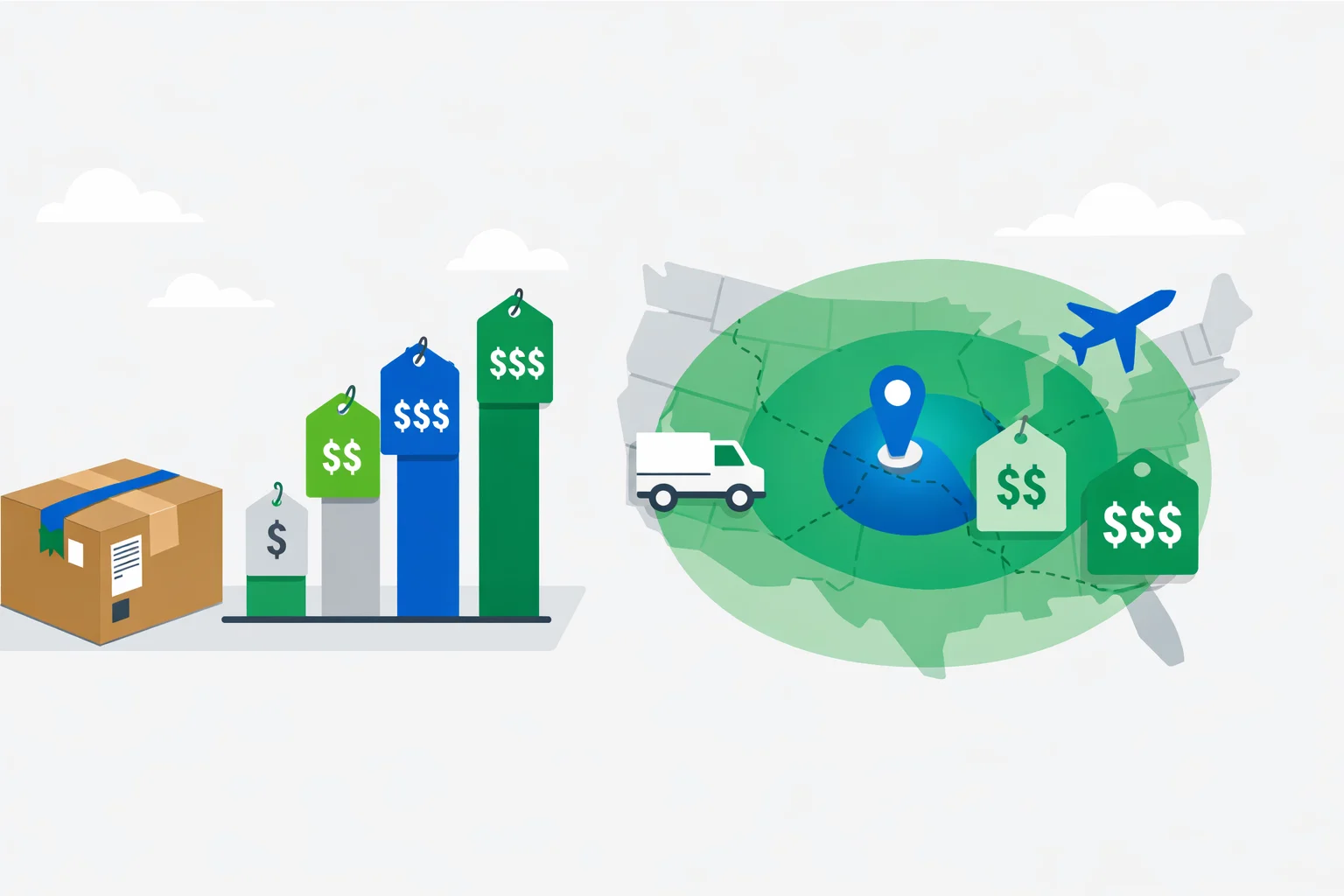
5 Myths a FedEx Rate Calculator Quietly Busts
Punch one box into a FedEx rate calculator and it spits back five different prices for the exact same package — which is the first clue that almost everything people assume about FedEx pricing is wrong. A 9-pound box going 600 miles isn't "a FedEx shipment." It's a FedEx Ground rate, an Express Saver rate, a 2Day rate, and two overnight rates that can differ by $70 or more. The calculator above runs all of them at once so you can see the spread. Below, we bust the five myths that make shippers overpay, each one with the numbers that prove it.
Myth 1: "FedEx Ground is always the cheapest"
Usually, yes — but not when dimensional weight kicks in. FedEx prices every package on its billable weight, which is the greater of the actual weight and the dimensional (DIM) weight. The DIM formula is simple: length × width × height ÷ 139. A 14" × 12" × 10" box weighs 13 DIM pounds (1,680 ÷ 139 = 12.08, rounded up). If your item only weighs 8 pounds, FedEx still bills you for 13. Ship that same item in a snug 10" × 8" × 6" box and the DIM weight drops to 4 pounds, so your actual 8 pounds wins — and every service tier gets cheaper at once. The cheapest service only stays cheapest if you stop paying for air.
Myth 2: "The rate I see is the rate I pay"
The base transportation charge is rarely the final number. Two surcharges hit almost every shipment. The fuel surcharge floats around 16–20% of the transportation charge and changes weekly — our calculator assumes ~18%. The residential delivery surcharge adds roughly $5–$6 to anything going to a home address rather than a commercial dock. On a $14 Ground label, an 18% fuel charge plus a $5.95 residential fee turns the "quote" into about $22.45 — a 60% jump. Toggle the residential switch in the calculator and watch every row move. That gap is exactly why a published rate chart never matches your invoice.
Myth 3: "Overnight costs about double Ground"
It's closer to triple or quadruple, and the multiplier grows with weight and distance. Here's the same 9-pound box priced across all five service levels at Zone 4 (about 600 miles), residential, before account discounts:
| Service | Transit Time | Est. Rate | vs. Ground |
|---|---|---|---|
| FedEx Ground | 1–5 business days | $36 | — |
| Express Saver | 3 business days | $74 | 2.1× |
| 2Day | 2 business days | $92 | 2.6× |
| Standard Overnight | Next day by 4:30pm | $162 | 4.5× |
| Priority Overnight | Next day by 10:30am | $199 | 5.5× |
The lesson isn't "never ship overnight" — it's that the right question is whether one extra business day is worth $126. For a birthday gift, no. For a replacement part shutting down a production line, absolutely. Seeing the full ladder, rather than two endpoints, is the whole point of a rate calculator.
Myth 4: "FedEx rates are basically flat year to year"
FedEx posts a General Rate Increase (GRI) almost every January, and it has been steep. The published average increase was 5.9% for 2023, 5.9% again for 2024, and another 5.9% for 2025 — and the "average" hides sharper jumps on specific zones, residential deliveries, and surcharges that climb faster than the headline number. Stack three years of ~5.9% and a package that cost $36 in 2022 runs roughly $43 today, before any new surcharges. That's why a quote you saved last spring is already stale. Re-run your common shipments through the calculator each January so your pricing and free-shipping thresholds keep up.
Myth 5: "A calculator is only useful for one-off shipments"
The bigger payoff is repeatable decisions. If you ship 200 packages a month and the calculator shows Ground beats 2Day by $56 on your typical lane, that's an $11,200 monthly line item to defend or cut. Use the tool to set the default service in your store's checkout, to decide where to set free-shipping minimums, and to sanity-check whether a thinner, lighter box pays for itself. For broader carrier shopping, compare these numbers against our shipping price calculator and the single-service FedEx shipping calculator when you already know exactly which tier you need. Don't have a scale or tape measure yet? Start with a quick FedEx shipping estimate to get a ballpark range first.
3 Mistakes That Quietly Inflate Your FedEx Bill
Most overpayment comes from a handful of avoidable errors, and each one carries a dollar tag:
- Shipping air. Using a 14" box for an 8-pound item triggers a 13-pound DIM charge. On a Zone 6 Ground shipment that single mistake adds about $9 per package — $1,800 a month at 200 shipments.
- Ignoring the residential flag. Forgetting that home deliveries carry a ~$5.95 surcharge throws off your margin math on every D2C order. At 500 orders a month, that's nearly $3,000 you never budgeted for.
- Defaulting to Express out of habit. Picking 2Day when Ground would have arrived in time on a short Zone 3 lane can cost $40+ per box for speed the customer never asked for.
When NOT to Trust This Estimate
This calculator is a planning tool, not a binding quote, and a few situations push the real number well away from the estimate. If you have a negotiated FedEx account, your discounts (often 20–40% off published Ground rates) make these figures high. Oversized or 70-pound-plus freight, dangerous goods, and additional-handling surcharges aren't modeled here. And the zone is approximated from straight-line miles — real FedEx zones go by origin and destination ZIP, so a mountain route or an island can land a band higher. For anything you're invoicing a client for, confirm on FedEx's official tool before you commit. The U.S. Postal Service publishes its own dimensional weight and price rules if you want to compare how DIM pricing differs across carriers, and the Bureau of Labor Statistics CPI data is a useful gut-check on how fast shipping costs are climbing relative to everything else.