
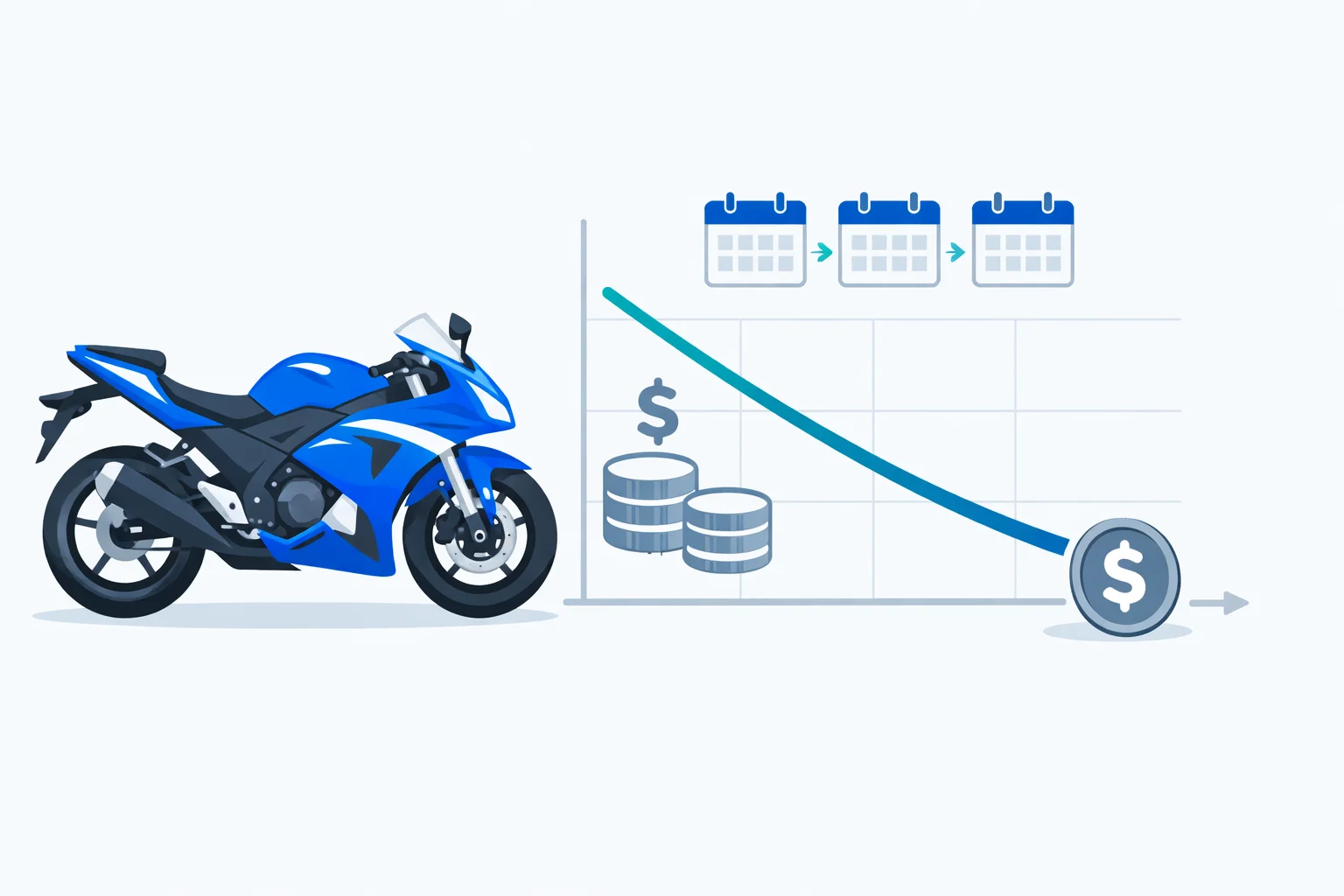
48.8% Gone in Five Years
Our motorcycle depreciation calculator values a new $14,000 sportbike at $7,165 after five years. That's $6,835 gone — 48.8% of the purchase price — on a bike with 15,000 easy miles on it. The number surprises people because motorcycles carry a reputation for holding value, and that reputation is doing a lot of work it hasn't earned.
Here's where the confusion starts. Bikes are cheap relative to cars, so the dollar loss looks small next to a truck shedding $20,000. But percentage-wise a supersport depreciates faster than the average new car, which lands closer to 40% over the same five years. Three beliefs drive most of the bad math riders do before buying. Let's take them one at a time, with the actual figures.
The $2,883 Badge: What Brand Really Buys You
“Harleys don't depreciate” is the most repeated claim in motorcycling, and it's half true. Spend the same $14,000 on a Harley-Davidson cruiser instead of that supersport and you land at $10,048 after five years — 71.8% retained against the sportbike's 51.2%. The badge saved you $2,883. Real money, and the single largest lever in this calculator.
But “slower” isn't “never.” Run a $26,000 Street Glide out to fifteen years and it settles near $10,599 — 40.8% retained, $15,401 evaporated. Harleys depreciate on a gentler slope, not a flat line, and anyone who tells you a touring bike is an investment is quoting a bar-stool statistic. The reason the slope is gentle is unglamorous: Harley builds the same platforms for decades, parts stay available, and a 2014 model doesn't look obsolete parked next to a 2026 one. Model-year churn is what kills resale, and cruisers barely have any.
At the other end sit electric bikes. A $20,000 Zero SR/F projects to $8,588at five years — 42.9% retained, the worst class in the tool. Battery-range anxiety on the used market plus fast-moving model years make early EV motorcycles the sharpest depreciation curve on two wheels right now.
Riding Less “To Protect Resale” Costs You $1.29 a Mile
This is the one that flips people. Riders baby their bikes to keep the odometer low, and low miles genuinely do help the sale price — our calculator agrees. Park that $14,000 sportbike at 1,000 miles a year and it's worth $7,554 at five years instead of $7,165. You protected $389.
Now divide by what you actually got out of it. Five years at 1,000 miles a year is 5,000 miles, so each one cost you $1.29 in depreciation. Ride the same bike 10,000 miles a year and it's worth $6,256 at year five — a worse sale price — but those 50,000 miles cost $0.15 each. Same machine, same five years, an 8.6x difference in what riding actually cost.
| Miles / Year | Value at 5 Yrs | Total Miles | Depreciation / Mile |
|---|---|---|---|
| 1,000 | $7,554 | 5,000 | $1.29 |
| 3,000 (US average) | $7,165 | 15,000 | $0.46 |
| 6,000 | $6,608 | 30,000 | $0.25 |
| 10,000 | $6,256 | 50,000 | $0.15 |
Why does this matter more for bikes than cars? Because the typical motorcycle covers roughly 3,000 miles a year while the average car does about 13,500, according to the travel data published in the FHWA Highway Statistics series. Depreciation runs on the calendar, not the odometer — so when you spread a calendar-driven cost over a quarter of the miles, the per-mile figure explodes. At 45 mpg and $3.30 a gallon, gas costs about $0.07 a mile. On the default scenario, depreciation is 6.5 times your fuel bill. Almost nobody budgets it, which is why it's the headline output of the calculator rather than a footnote.
Ten Bike Classes, One $14,000 Budget
Type beats every other input here. These are five-year projections on an identical $14,000 spend, ridden 3,000 miles a year and kept stock with normal wear:
| Class | Yr-1 Drop | Annual After | Value at 5 Yrs | Retained |
|---|---|---|---|---|
| Harley-Davidson cruiser | ~10% | ~5% | $10,048 | 71.8% |
| Full-dress tourer | ~13% | ~6% | $9,309 | 66.5% |
| Dual-sport / enduro | ~14% | ~6% | $9,202 | 65.7% |
| Adventure / sport-touring | ~15% | ~6.5% | $8,902 | 63.6% |
| Metric cruiser | ~16% | ~7% | $8,609 | 61.5% |
| Standard / naked | ~18% | ~8% | $8,047 | 57.5% |
| Scooter / moped | ~19% | ~9% | $7,607 | 54.3% |
| Dirt bike / motocross | ~20% | ~10% | $7,186 | 51.3% |
| Sportbike / supersport | ~22% | ~9.5% | $7,165 | 51.2% |
| Electric motorcycle | ~30% | ~11% | $6,012 | 42.9% |
Dual-sports at 65.7% are the quiet winner and the one most buyers overlook. A KLR650 or a DR650 has been mechanically frozen for years, it's cheap to fix, and every used listing competes against a new bike that looks nearly identical. Sportbikes lose at the other end for a reason that has nothing to do with reliability: buyers assume every used supersport was flogged, and they price that assumption in whether or not it's true about yours.
The Formula, and the Floor Cars Don't Have
The calculator runs a declining-balance curve with a separate first-year rate:
V = P × (1 − d₁) × (1 − r)n−1, floored at F
- V — projected resale value
- P — purchase price
- d₁ — first-year drop (0.10 for a Harley, 0.30 for an electric)
- r — annual rate afterwards, adjusted for mileage and condition
- n — years of ownership
- F — the value floor, 15–32% of original MSRP by class
Substituting the default: V = $14,000 × (1 − 0.22) × (1 − 0.10)⁴ = $10,920 × 0.6561 = $7,165. The exponent is n − 1 because year one runs on its own steeper rate. Buy used and that cliff is already behind you — the previous owner paid it — so the tool applies only the annual rate from your price forward. That's why a three-year-old version of this same sportbike, bought at $8,845 and held five years, loses just $3,622 against the new buyer's $6,835.
The floor is where motorcycles genuinely differ from four wheels. A car eventually chases scrap value; a running motorcycle doesn't, because there's a permanent floor of new riders and project builders. Hold that $14,000 sportbike twenty years and the tool stops it at $2,800 in year 14 and keeps it there. Our car depreciation calculator models no such floor, which is the clearest structural difference between the two curves. If you want the formal accounting treatment of declining-balance math, the IRS lays it out in Publication 946.
Mods and Drops: A $705 Lesson
Motorcycles punish modification in a way cars mostly don't. Take the default sportbike at $7,165 and change nothing but its condition: stock and immaculate reads $7,325, lightly modified with an aftermarket exhaust and bars reads $6,944, and heavily modified or previously dropped reads $6,460. That's a $705 swing from the top of the range to the bottom — and riders routinely spend $1,200 on the pipe that causes it.
The logic is straightforward once you've shopped used. A modified bike narrows your buyer pool to people who happen to want your exact taste, and it raises the suspicion that the previous owner rode hard. Keep the stock exhaust, headlight, and bodywork in a box. Selling the bike stock and the parts separately routinely beats selling it modified. Cosmetic damage from a tip-over is worse still, because it can't be undone before the listing photos.
When This Calculator Will Mislead You
A class-average curve is the wrong tool in four situations, and it's worth saying so plainly:
- Collectible and limited-run bikes. An air-cooled Ducati, a low-mile RC51, or an anniversary-edition cruiser can flatten out or appreciate. Declining-balance math cannot model scarcity, and it will understate these badly.
- Salvage or rebuilt titles. A branded title typically takes 40–50% off the clean-title value in one step. Enter your realistic market price as the purchase price rather than trusting the curve to find it.
- Trade-in figures. Everything here reflects private-party value. Dealer trade-in on that five-year $7,165 sportbike lands closer to $5,400–$6,100 — plan on 15–25% under private sale.
- Loan payoff decisions. Depreciation only tells you the asset side. Pair it with our motorcycle loan calculator to see the balance, because that gap is where riders get stuck. Finance that same $14,000 bike at 9% over 72 months with nothing down and the payment is $252 — but you're $1,237 underwater at year one and still $313 short at year two. Positive equity doesn't arrive until year three. Shorter terms close that window; our motorcycle payment calculator shows what the monthly difference actually costs.
One last framing that helps. On the default scenario, depreciation runs $114 a month — an invisible payment sitting alongside the visible one, and usually larger than insurance. Riders who treat it as a real line item make better buying decisions than riders who discover it on sale day — and it's the single biggest line in our motorcycle ownership cost calculator, which stacks it against tires, insurance, gear and storage for the full annual bill. Recreational vehicles behave the same way, and our RV depreciation calculator shows an even steeper version of the same trap.