
Car Down Payment Calculator: Find the Right Amount to Put Down on Your Next Vehicle
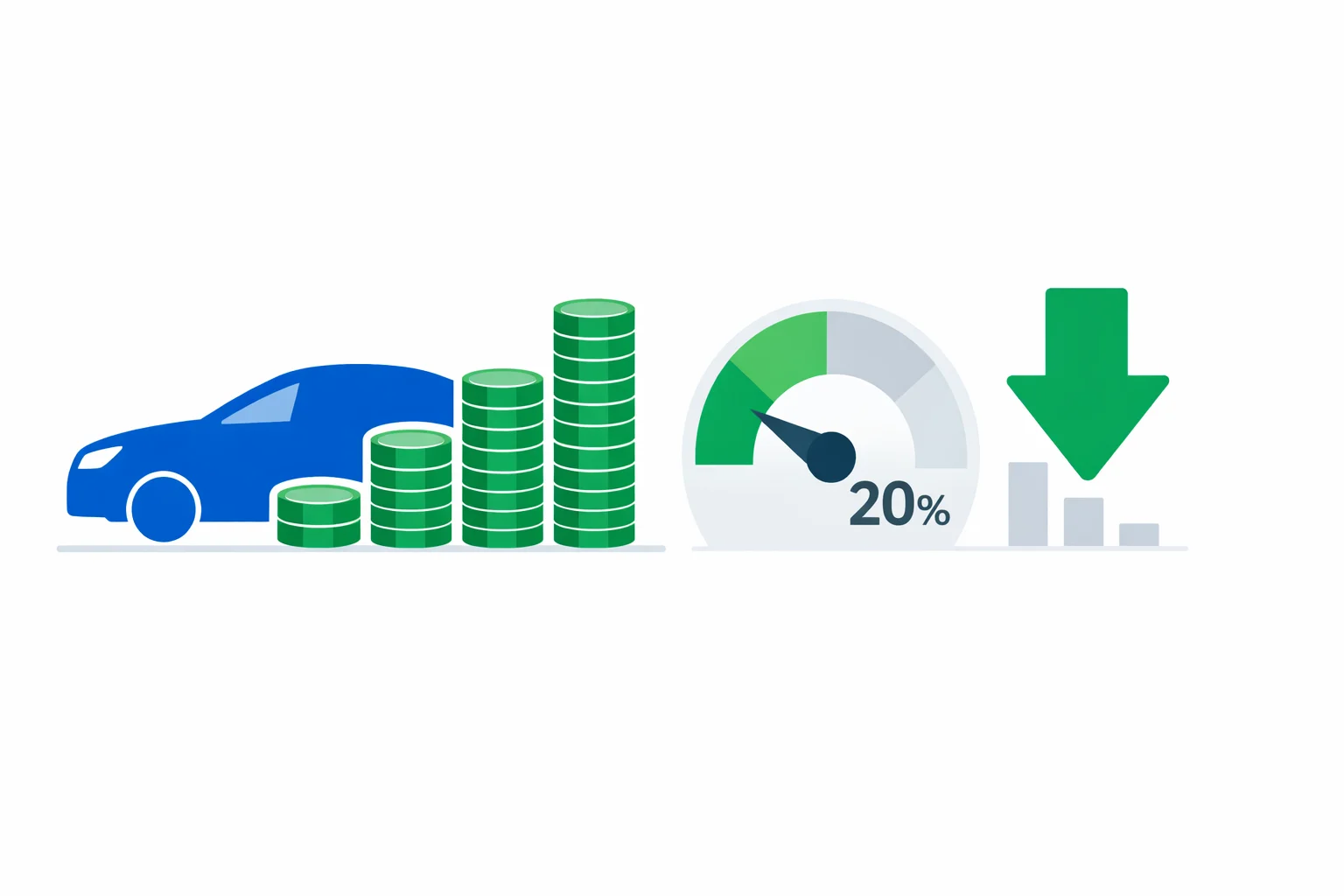
Our car down payment calculator helps you figure out exactly how much cash to bring to the dealership — and shows you what happens when you put down more or less. Most buyers either overcommit their savings or skip the down payment entirely, and both mistakes cost thousands. On a $35,000 car at 6.5% APR over 60 months, the difference between putting 0% down and 20% down is roughly $2,400 in total interest and $130 less per month.
We built this tool to give you a clear, side-by-side comparison of multiple down payment scenarios so you can make a confident decision. Below, we break down how the math works, what the 20/4/10 rule actually means for your wallet, and how to avoid going underwater on your loan.
How to Use This Calculator
Getting an accurate estimate takes less than a minute. Follow these five steps to compare down payment scenarios and find the amount that fits your budget:
- Enter the Vehicle Price — type the total sticker price or negotiated out-the-door price of the car you want. Include estimated taxes and fees if your dealer quoted an all-in number.
- Add Your Trade-In Value — if you are trading in your current vehicle, enter the amount the dealer is offering. Trade-in equity works exactly like cash and reduces your loan amount dollar-for-dollar.
- Set the Interest Rate and Loan Term — enter the APR your lender quoted (or estimate based on your credit score range). Choose your loan term from 36 to 84 months. Shorter terms mean higher monthly payments but dramatically less interest.
- Adjust the Down Payment Slider — drag the slider from 0% to 50% and watch the results update. This is where the magic happens: you will see your monthly payment, total interest, and equity status change in real time.
- Review the Comparison Cards — the calculator generates side-by-side scenarios (0%, 10%, 15%, 20%, 25%, 30%) so you can compare at a glance. The "Recommended" badge highlights your selected percentage.
How Down Payments Work: The Formula Behind the Savings
A down payment directly reduces the principal you borrow. Every dollar you put down is a dollar that never accrues interest. The standard auto loan payment formula is:
Monthly Payment = Loan Amount × [r(1+r)^n] / [(1+r)^n − 1]
Where r is the monthly interest rate (APR ÷ 12) and n is the total number of monthly payments. The loan amount equals the vehicle price minus your down payment and trade-in value.
Worked Example: $35,000 Car at 6.5% APR
Let's walk through three scenarios on a $35,000 new car with a 60-month loan at 6.5% APR and no trade-in:
| Scenario | Down Payment | Loan Amount | Monthly Payment | Total Interest |
|---|---|---|---|---|
| 0% down | $0 | $35,000 | $685 | $6,100 |
| 10% down | $3,500 | $31,500 | $617 | $5,490 |
| 20% down | $7,000 | $28,000 | $548 | $4,880 |
Going from 0% to 20% down saves $1,220 in interest and cuts $137 from your monthly payment. That $7,000 upfront effectively earns a guaranteed 17% return over the loan's life — far better than most investments.
The 20/4/10 Rule: A Simple Framework for Car Affordability
Financial advisors consistently recommend the 20/4/10 rule for car buying. Our calculator checks whether your inputs meet this guideline and flags it clearly:
- 20% down payment — protects you from immediate depreciation. New cars lose 20% of their value in the first year alone. Putting 20% down means you are unlikely to owe more than the car is worth.
- 4-year (48-month) maximum loan term — keeps total interest manageable. A 72-month loan on $28,000 at 6.5% costs $2,400 more in interest than a 48-month loan on the same amount.
- 10% of gross monthly income — your total transportation costs (payment, insurance, fuel, maintenance) should stay under this threshold to avoid becoming "car poor."
If 20% feels out of reach, even 10% down is significantly better than zero. Use our car affordability calculator to determine the maximum car price that fits your income and expenses.
Negative Equity: Why Your Down Payment Amount Matters More Than You Think
Going underwater — owing more than your car is worth — is one of the most common and costly financial traps in auto financing. It happens when depreciation outpaces your loan payoff, and it is almost guaranteed if you put $0 down on a new car.
Our calculator estimates how many months you would be underwater based on standard depreciation rates (approximately 20% in year one for new vehicles, tapering to 6-8% annually after year three). With 0% down on a $35,000 car, you could be underwater for 24+ months. With 20% down, you start with equity from day one.
Being underwater matters if you need to sell the car, trade it in, or if the vehicle is totaled in an accident. In a total loss, your insurance pays the market value — not your loan balance. Without gap insurance, you would owe the difference out of pocket. Our gap insurance calculator sizes that shortfall for each down payment scenario — on a $34,000 car, 0% down leaves $4,784 exposed at month six, while 20% down never goes underwater at all.
Pro Tips for Maximizing Your Down Payment
These strategies help you get the most out of every dollar you put down:
- Negotiate the vehicle price before discussing the down payment. Dealers sometimes inflate the price when they know you have cash ready. Settle on the out-the-door number first, then apply your down payment.
- Combine trade-in equity with cash. If your trade-in is worth $5,000 and you add $2,000 cash, that $7,000 total functions as a 20% down payment on a $35,000 car. Use our car payment calculator with down payment to model this.
- Time your purchase around manufacturer incentives. Year-end clearance events, holiday sales, and model-year transitions can save $1,000-3,000 — money you can redirect into a larger down payment.
- Save in a high-yield account for 3-6 months before buying. At current rates (4-5% APY), a $6,000 balance earns $200+ in interest over 6 months — free money toward your down payment.
- Round up to the nearest 5%. If you can afford 17% down, stretch to 20%. That extra 3% on a $35,000 car is just $1,050 more — but it crosses the threshold where lenders often offer better rates.
How Credit Score Affects Your Down Payment Strategy
Your credit score and down payment work together to determine your loan terms. According to NerdWallet, average auto loan rates vary significantly by credit tier:
| Credit Score | Avg. New Car APR | Avg. Used Car APR | Recommended Down Payment |
|---|---|---|---|
| 750+ (Excellent) | 5.0% | 6.5% | 10-20% (flexibility to put less down) |
| 700-749 (Good) | 6.5% | 8.5% | 15-20% (builds equity quickly) |
| 650-699 (Fair) | 9.0% | 12.0% | 20%+ (offset higher rates) |
| Below 650 (Poor) | 13.0%+ | 18.0%+ | 25%+ (may be required for approval) |
With fair or poor credit, a larger down payment does double duty: it reduces the principal that accrues expensive interest and signals lower risk to the lender, which can sometimes unlock a better rate. If your score is below 650, putting 25% down on a $30,000 car ($7,500) could reduce your total interest by $3,000-5,000 compared to the same loan at 10% down. Check your rate estimate with our car loan interest rate calculator.
Common Down Payment Mistakes to Avoid
We see these errors repeatedly — and each one has a measurable cost:
- Draining your emergency fund. Putting every dollar into the down payment feels smart, but if you face a $2,000 repair bill next month, you will end up financing that on a credit card at 22% APR. Keep 3 months of expenses in reserve.
- Putting a large down payment on a lease. Unlike a purchase, lease down payments (capitalized cost reductions) are lost if the car is totaled or stolen early. Gap insurance pays the leasing company, not you. Most experts recommend $0 down on leases.
- Ignoring trade-in timing. Trading in a car you still owe money on can create negative equity that rolls into your new loan. Pay off your current loan first, or at least calculate the equity gap before shopping.
- Focusing only on monthly payment. A dealer might offer a low payment by extending the term to 84 months with minimal down payment. The monthly number looks great, but you pay $4,000+ more in total interest and stay underwater for years.