
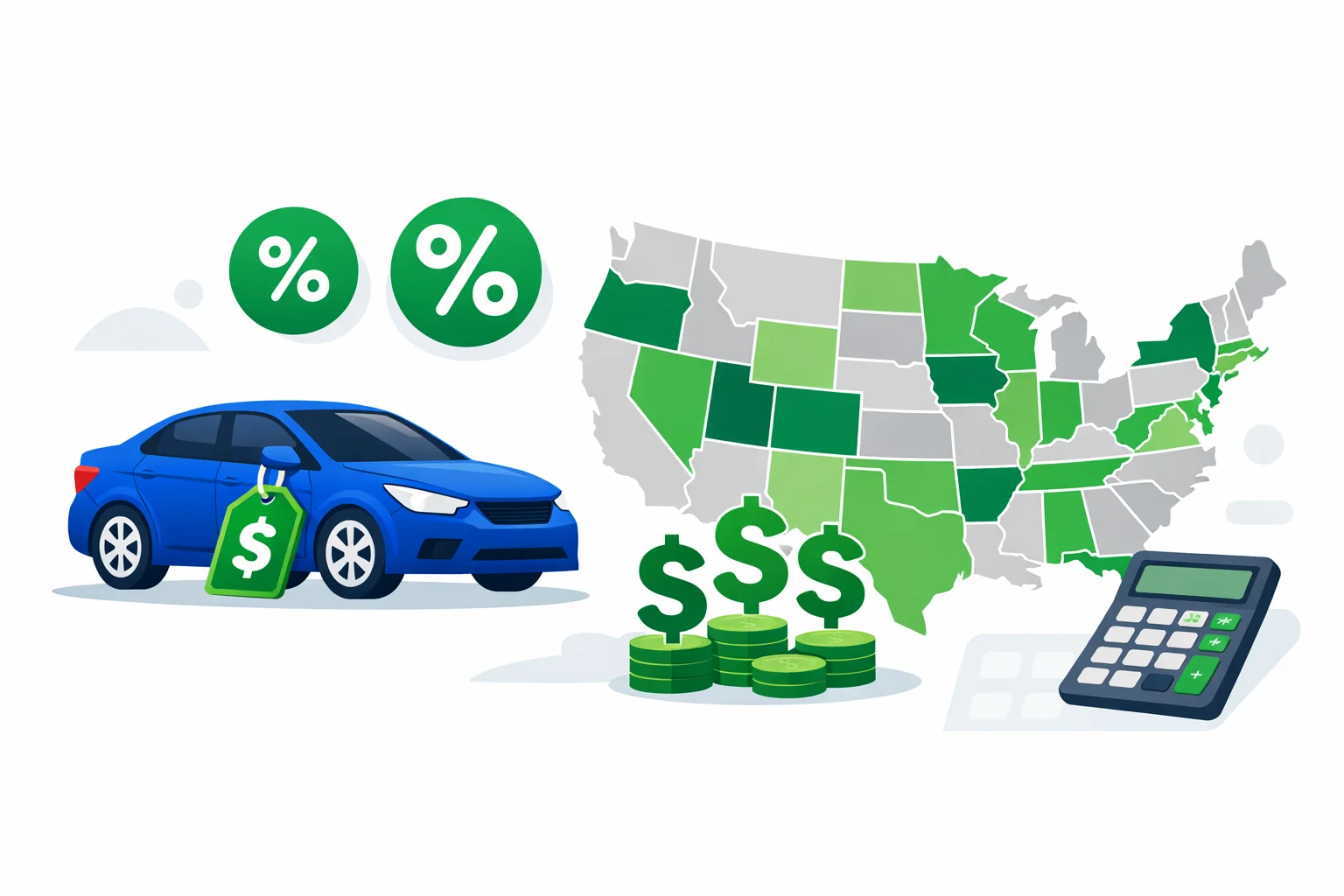
Car Sales Tax Calculator: How Vehicle Tax Varies by State and How to Reduce It
Our car sales tax calculator shows you exactly how much sales tax you'll owe on a vehicle purchase in any U.S. state — before you set foot in the dealership. Buying a $35,000 truck in Texas? You'll pay $2,187.50 in state sales tax. The same truck in Montana? Zero. That's a difference big enough to cover your first six months of insurance. Sales tax is one of the largest hidden costs of buying a car, and it varies dramatically from one state — and even one county — to the next.
This guide breaks down how car sales tax works in all 50 states, which states offer trade-in tax credits, and practical strategies to legally minimize what you owe. We'll walk through real examples with specific dollar amounts so you know exactly what to expect at the dealership. And keep in mind sales tax is a one-time charge — in about a dozen states you'll also owe an annual vehicle property tax on your car's value every year you own it.
How to Use This Calculator
Getting an accurate sales tax estimate takes about 30 seconds. Here's how to use each field:
- Select your state from the dropdown menu. The calculator automatically loads your state's sales tax rate and shows whether your state offers a trade-in tax credit.
- Add your local tax rate in the "Local Tax Rate" field. Many states allow cities and counties to add their own tax on top of the state rate. You can find your exact local rate on your county assessor's website or by calling your local DMV.
- Enter the vehicle purchase price — this is the negotiated price you'll pay for the car, not the MSRP sticker price. If you've already negotiated a deal, use that number.
- Enter your trade-in value if you're trading in a vehicle. In states with a trade-in tax credit, this reduces the taxable amount and saves you hundreds.
- Add any rebates or incentives the dealer is offering. Manufacturer rebates typically reduce the taxable price in most states.
- Review your results — the breakdown shows state tax, local tax, fees, trade-in savings, and your total out-the-door cost.
How Car Sales Tax Is Calculated
The basic formula is straightforward: Taxable Amount × Tax Rate = Sales Tax. But the "taxable amount" varies by state. Some states tax the full purchase price. Others let you subtract your trade-in value first. A few states cap the total tax at a fixed dollar amount.
Here's a worked example for a buyer in Florida purchasing a $35,000 vehicle with a $10,000 trade-in:
- Vehicle price: $35,000
- Trade-in value: $10,000
- Florida offers a trade-in tax credit, so: Taxable amount = $35,000 − $10,000 = $25,000
- Florida state rate: 6% → State tax = $25,000 × 0.06 = $1,500
- Hillsborough County surtax: 1.5% → Local tax = $25,000 × 0.015 = $375
- Total sales tax: $1,875
Without the trade-in credit, the buyer would owe $2,625 in total tax — a savings of $750 thanks to the credit. That's real money you keep in your pocket. If you're planning to finance the full amount, use our car payment calculator with tax to see how tax affects your monthly payment. To combine that tax with the doc fee, title, and registration in one drive-off total, run the deal through our out the door price calculator.
Car Sales Tax Rates by State: Key Comparisons
State sales tax rates on vehicles range from 0% to over 9% when you include local taxes. Here are the states that matter most to buyers:
| State | State Rate | Avg. Combined Rate | Trade-in Credit | Notes |
|---|---|---|---|---|
| Montana | 0% | 0% | N/A | No sales tax at all |
| Oregon | 0.5% | 0.5% | No | New vehicles only |
| North Carolina | 3% | 3% | Yes | Capped at $250 max |
| Texas | 6.25% | 6.25% | Yes | Flat statewide rate |
| California | 7.25% | 8.68% | No | Highest base rate + locals |
| Tennessee | 7% | 9.55% | Yes | Highest combined rate |
| South Carolina | 5% | 5% | Yes | Capped at $500 max |
The difference is staggering. On a $40,000 vehicle, you'd pay $0 in Montana but up to $3,820 in Tennessee (9.55% combined). That's why some buyers near state borders drive across the line to purchase — though be aware that most states require you to pay the tax based on where you register the vehicle, not where you buy it.
Trade-in Tax Credits: Which States Save You Money?
About 33 states currently offer a trade-in tax credit, which means you only pay sales tax on the difference between the new car price and your trade-in value. This is one of the biggest financial advantages of trading in at a dealership rather than selling privately.
Consider this scenario: you're buying a $30,000 car and your current vehicle is worth $12,000. In Texas (trade-in credit state), you pay 6.25% on $18,000 = $1,125. In California (no credit), you pay 7.25% on the full $30,000 = $2,175. The trade-in credit plus the lower rate saves the Texas buyer over $1,000.
If you're weighing whether to trade in or sell privately, our car price calculator can help you compare the net proceeds from each approach. In trade-in credit states, the tax savings often close the gap between trade-in and private sale prices.
5 Pro Tips to Minimize Car Sales Tax
- Negotiate the price down first. Sales tax is calculated on the actual purchase price, not the MSRP. Every $1,000 you negotiate off the price saves $60-$100 in tax depending on your state.
- Trade in at the dealership in credit states. If your state offers a trade-in credit, trading in saves you the tax on your trade-in value. On a $15,000 trade-in at 7%, that's $1,050 in tax savings — even if you could get $500 more selling privately.
- Time your purchase around tax holidays. A few states occasionally offer sales tax holidays or reduced rates on vehicles. Check your state's department of revenue website for current promotions.
- Buy in states with caps. North Carolina caps vehicle tax at $250 and South Carolina at $500 — regardless of the vehicle price. A $60,000 truck in NC only generates $250 in tax. Residents of neighboring states may benefit from registering or purchasing strategically.
- Factor in total cost, not just the sticker. Use our car buying calculator to see the complete picture: price + tax + fees + insurance + depreciation. Sales tax at 8% on a $40,000 vehicle adds $3,200 that you'll never recover.
What Affects Your Car Sales Tax Amount?
Five variables determine exactly how much you'll owe in vehicle sales tax. Understanding each one helps you plan your budget accurately:
- State tax rate: Ranges from 0% (Montana, Delaware, New Hampshire) to 7.25% (California). This is the single biggest factor.
- Local taxes: Cities and counties often add 0.5-4% on top. In Louisiana, combined rates can exceed 11%. Always check your specific locality.
- Trade-in value: In the 33 states with trade-in credits, a $10,000 trade-in at 7% saves $700 in tax.
- Rebates and incentives: Manufacturer rebates reduce the taxable price in most states. Dealer discounts always reduce it.
- Special caps or fees: NC caps at $250, SC at $500. Georgia charges a flat 6.6% title ad valorem tax instead of sales tax. Delaware charges no sales tax but adds a 4.25% document fee. Dealer-side charges are separate from tax — our dealer fee calculator shows which doc and add-on fees you can negotiate.
- Electric vehicle exemptions: New Jersey exempts zero-emission vehicles from sales tax entirely, worth $2,781 on a $42,000 EV at the state's 6.625% rate. Several other states discount EV excise or registration tax instead. Our EV tax credit calculator folds those exemptions in alongside state rebates.
For a deeper look at how your state's fees stack up, the Tax Foundation's annual sales tax report provides detailed combined rate data for every state and major city. You can also check your state's DMV website for the most current vehicle-specific tax rates through the USA.gov motor vehicle services directory.